
Measuring System Drift Variance When Vector Delta Offsets Reciprocate Under Uncalibrated Exogenous Environmental Signals
System drift variance compounds when coupled vector deltas treat reciprocal internal corrections as fresh exogenous inputs across uncalibrated baselines.
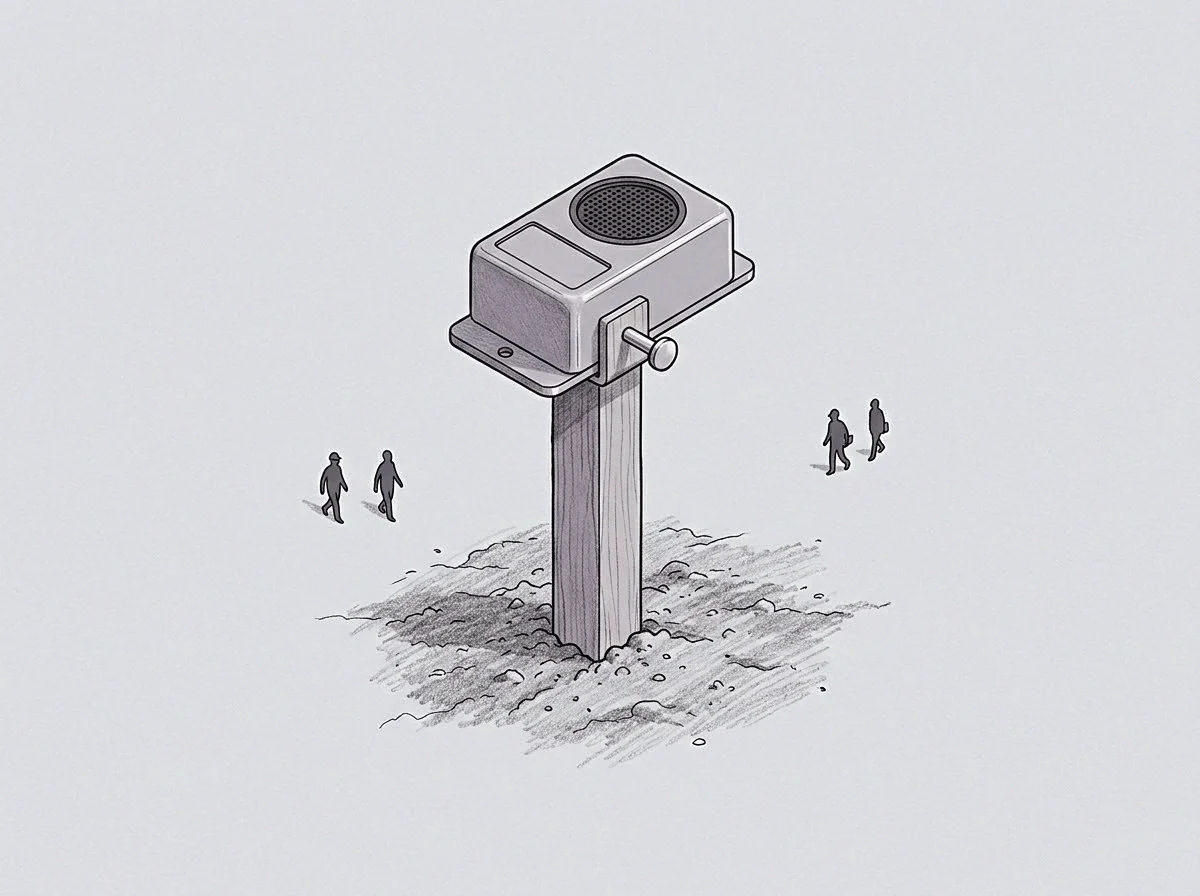
Offset
An operator records a telemetry signal across sixty days, notes a fourteen percent displacement along the primary vector, and adjusts the control parameter to center the reading. Three days later the exogenous signal swings by twenty units, the offset adjustment feeds back into the secondary vector, and the observed drift doubles without any alteration in internal machine state. The adjustment created the movement it attempted to eliminate.
Measuring system drift variance begins by separating true internal displacement from reciprocal adjustments induced by external inputs. When an exogenous signal lacks calibration, the incoming reading mixes environmental variance with baseline sensor error. Applying a corrective vector delta directly to that uncalibrated signal introduces an internal offset.
As secondary system components react to that offset by issuing their own adjustments, the delta offsets reciprocate across internal channels.
A corrective vector applied to an uncalibrated signal converts external noise into internal systemic displacement.
The main difficulty lies in the feedback path. An uncalibrated environmental signal enters the input register, leading the primary controller to detect a displacement from the nominal baseline and apply an offset vector. That shift alters downstream operating conditions, which lower-level subsystems treat as an exogenous shock and counter with reciprocal offsets back to the primary controller.
The resulting drift variance then reflects the internal resonance of control loops rather than the true state of the system.
Miscalibrating this relationship forces control loops to expend computational capacity dampening artificial variance generated by their own corrective routines.

Coupling
Dynamic coupling converts directional deltas into circular variance loops. When two vectors share state dependencies, an offset introduced along vector alpha changes the reference baseline for vector beta. Vector beta then shifts its delta to restore balance against that baseline, and this second shift feeds back into vector alpha as a new apparent error term.

Mathematical Properties of Reciprocating Offsets
The exchange of offsets between linked vectors follows distinct transfer mechanics. Tracking these mechanics requires separating three specific variables across the measurement window:
- Primary vector displacement measures the raw distance traversed by the initial state variable away from the nominal baseline prior to downstream compensation.
- Reciprocal feedback coefficient defines the exact proportion of secondary offset transmitted back into the primary input channel per computation cycle.
- Exogenous signal noise ratio quantifies the variance of the uncalibrated external input relative to the internal state resolution.
Assume an initial baseline established over ninety days. An uncalibrated external signal injects a delta offset of four units into the primary vector. The coupling logic transfers seventy percent of that displacement to the secondary vector within twelve milliseconds.
The secondary vector counters with an inverse correction of three units. Because the external signal remains uncalibrated, the primary sensor interprets this secondary correction as a fresh exogenous disturbance.
Coupled vector channels process reciprocal corrective signals as independent exogenous disturbances when reference baselines remain uncalibrated.
The system enters a sustained hunting pattern marked by continuous computational activity, high throughput, and constant adjustments. Measured drift variance rises linearly with the number of evaluation cycles. An observer tracking only aggregate variance might conclude that the external environment has become volatile, when the volatility actually originates inside the reciprocal calculation loop.
When the coupling ratio exceeds the attenuation capacity of the baseline filter, the system sustains continuous artificial drift variance regardless of external stability.

Shelf
A physical test bench isolates these dynamics under controlled conditions. Placing measurement instruments on an isolated test shelf separates structural vibration from electronic sensor drift. The shelf provides an invariant mechanical reference point, eliminating mechanical crosstalk between adjacent actuator assemblies.

Is Reciprocal Delta Tracking Stable Without Invariant Baselines?
Stability collapses when reference classes lack fixed bounds. If the baseline updates dynamically from the uncalibrated input signal, the system lacks a stationary reference point. The delta becomes a relative comparison between two moving registers.
| Coupling Configuration | Calibration State | Observed Drift Variance | Feedback Latency | Stability Classification |
|---|---|---|---|---|
| Decoupled Single Vector | Uncalibrated Signal | Low Additive | Zero | Static Offset Drift |
| Symmetric Dual Vector | Uncalibrated Signal | High Exponential | Sub-second | Resonant Oscillation |
| Asymmetric Multi Vector | Uncalibrated Signal | Moderate Chaotic | Variable | Bounded Divergence |
| Symmetric Dual Vector | Fixed Baseline Shelf | Minimal Residual | Deterministic | Asymptotic Convergence |
The data demonstrates the divergence. In the symmetric uncalibrated state, observed drift variance compounds through rapid reciprocal exchanges. Introducing an invariant reference shelf arrests the feedback amplification by anchoring the error calculation to a stationary baseline.
The external signal fluctuates constantly while internal adjustments merely track the movement of internal compensators.

Variance
Calculating the true system drift variance requires decomposing the aggregate signal into its constituent vectors. Aggregate variance contains three distinct elements: true environmental noise, sensor calibration error, and reciprocal offset artifacts. Measuring the delta across multiple isolated observation windows exposes the internal components.

Window Decomposition and Invariance Verification
A live calculation changes its output as inputs fluctuate. A cached response returns invariant outputs despite changing inputs. When evaluating system drift, an operator tests whether the measured variance is live computation or an artifact of cached baseline assumptions.
The process steps through sequential verification stages:
- Signal freeze testing halts incoming exogenous telemetry to observe whether internal reciprocal offsets continue cycling through the feedback loop.
- Window attenuation scaling widens the measurement window from ten seconds to ten minutes to isolate high-frequency reciprocal oscillations from long-term trends.
- Orthogonal vector separation decouples the primary and secondary channels to measure baseline drift independently without cross-channel feedback.
A measurement window shorter than the reciprocal feedback cycle registers internal compensation loops as external environmental drift.
Widening the observation window filters out high-frequency reciprocal oscillations. If true systemic drift exists, the vector sum increases monotonically over time. If the variance arises from uncalibrated reciprocal offsets, the vector deltas alternate signs around a static mean, producing high variance without net displacement.
Variance measured across an unanchored window tracks the frequency of compensation rather than the magnitude of displacement.

Residue
After isolating external signals and decoupling reciprocal vectors, a residual offset remains. This residue represents the true physical drift of the system. It tracks sensor decay, mechanical wear, and genuine environmental displacement across extended operating cycles.
Baseline Construction for Long Term Tracking
Constructing a durable baseline requires an ordinal reference class. Instead of relying on cardinal precision from uncalibrated inputs, the operator establishes ordinal boundaries. The system verifies whether vector alpha moved farther than vector beta over a thirty-day window.
Live computation resolves this comparison on every cycle. If the computed delta stays within the ordinal boundary, the system suppresses reciprocal corrections. This deadband threshold breaks the feedback loop, preventing uncalibrated exogenous noise from initiating internal compensation cycles.
The unresolved question is whether dynamic deadband thresholds can adapt to genuine systemic acceleration without reintroducing reciprocal offset resonance into the primary measurement vectors.