
Calculating Negative Gradient Vectors From Avoided High Value Operational Decisions
Negative gradient vectors derive from measuring the capital, labor hours, and operational drift consumed by workarounds designed to evade high-friction decisions.
Deflection
A software team spends eighteen months refactoring internal tooling while conversion rates on the primary checkout flow collapse. The executive team reviews the deployment logs every Tuesday morning. Capital remains abundant, the servers run smoothly, and the Jira board registers high velocity.
When an operational choice carries severe social friction or threatens executive prestige, an organization routes its labor around the event. In mathematics, a gradient vector points in the direction of greatest rate of increase of a scalar function. When the function represents operational value, rational execution climbs that slope.
Avoidance occurs when the system follows the inverse path, deliberately choosing negative local trajectories to preserve institutional comfort.
A system routes labor around friction when the immediate political cost of an intervention exceeds the immediate political cost of structural decline.
The observable behavior of this dynamic mirrors mathematical descent. An observer cannot always measure the avoided decision directly, because unmade decisions generate no meeting minutes, no vendor contracts, and no balance sheet entries. One measures the deflection instead.
When an obvious production bottleneck requires removing an ineffective division head, and executive leadership responds by commissioning an enterprise-wide process audit, the audit represents a displacement vector. The direction of the audit runs opposite to the required operational correction. The magnitude of the displacement corresponds to the engineering hours, consulting fees, and calendar delays spent evading the confrontation.

The Geometry Of Operational Avoidance
The path of least resistance governs unmanaged corporate systems. Removing an ineffective department head produces immediate interpersonal conflict, uncomfortable board interactions, and potential severance disputes. Commissioning a restructuring study produces pleasant collaborative workshops, professional slide decks, and temporary consensus, though execution speed drops first.
Avoided high-value interventions share three specific properties:
- Displacement volume absorbs operating capital in direct proportion to the severity of the confrontation being evaded.
- Decoupled velocity creates high activity indicators while production output on the value axis remains stagnant.
- Terminal drift alters organizational architecture to normalize the workarounds created to bypass the unresolved problem.
Tracking these deflections exposes the underlying negative gradient. If an executive team votes down an immediate vendor consolidation that would save three million dollars annually, and subsequently allocates four million dollars to custom integration software that keeps both vendors functional, the negative gradient vector has an exact numerical value. The vector magnitude equals the uncaptured three million dollars added to the four million dollars of unnecessary capital expenditure.
The directional sign points toward operational atrophy. When leadership treats structural evasion as standard consensus building, the enterprise steadily exhausts its cash cushion while moving further from productive efficiency.
Coordinate
Extracting the mathematical components of an evasion requires establishing a reference plane. The baseline represents current steady-state operational capacity, measured in throughput per payroll dollar. Two orthogonal axes sit on this plane: the cardinal value axis, which registers cash flow and gross margins, and the ordinal effort axis, which registers organizational exertion and interpersonal difficulty.
Operational decisions occupy positions relative to this coordinate space. A high-value operational choice exhibits a steep positive slope: it demands a discrete amount of ordinal exertion to yield a large cardinal gain. Choosing to abandon a failing product line demands high interpersonal strain for three weeks to terminate seventy million dollars in perpetual technical obligations.
When leadership refuses that action, they select an alternate coordinate, choosing prolonged ordinal strain with negative cardinal returns.
Mirroring the negative gradient above the baseline reveals the unspent productive capacity trapped inside operational avoidance.
Calculating the vector begins with recording the difference between the avoided action and the substitute action. Let the avoided action exist at a theoretical coordinate defined by its required friction and anticipated cardinal yield. The substitute action sits at an observed coordinate, characterized by low immediate social friction and persistent capital depletion.
Subtracting the observed trajectory from the optimal trajectory yields the exact negative gradient vector.
Decomposing The Deflection Vector
The negative gradient consists of three separate components: opportunity loss, overhead absorption, and architectural debt. Opportunity loss registers the gross returns forfeited by not executing the required choice. Overhead absorption tallies the actual salaries, software licenses, and advisory fees spent maintaining the compromise.
Architectural debt measures the structural distortions introduced into the organization to make the compromise bearable.
Consider an enterprise running two redundant enterprise resource planning systems across acquired business units. The operational intervention requires selecting one platform, migrating all records, and decommissioning the other within six months. Leadership avoids this confrontation because neither division head agrees to yield sovereignty.
The table below models the comparative reality of this choice against its substitute, evaluated across a twenty-four-month operational window under identical market conditions.
| Evaluation Vector | Selected Compromise: Dual Maintenance | Avoided Intervention: Platform Consolidation | Calculated Variance Delta |
|---|---|---|---|
| Direct Capital Expenditure | Twelve million dollars in duplicate licensing and custom synchronization bridges | Four million dollars in single-system licensing and one-time migration labor | Eight million dollars in unforced capital loss |
| Human Resource Allocation | Forty-five full-time engineers dedicated to continuous data reconciliation | Eight full-time engineers dedicated to primary system administration | Thirty-seven engineers diverted from revenue-producing products |
| Data Consistency Error Rate | Fourteen percent synchronization discrepancy across international ledgers | Zero percent synchronization discrepancy across uniform database architecture | Fourteen percentage points of enterprise operational vulnerability |
| Execution Latency On New Features | Nine months average deployment cycle due to dual-schema validation | Six weeks average deployment cycle on standardized environment | Seven point five months of competitive paralysis per release |
The variance column defines the negative gradient vector, providing an empirical reading of the true price of peace inside the executive committee. A contract term mandating complete software asset decommissioning within one hundred eighty days of acquisition removes the discretionary space that permits this compromise to take root.
Table
The conference room provides the physical environment where negative vectors are negotiated into existence. A long walnut surface holds laptops, half-empty water glasses, and presentation printouts. Eight individuals sit in leather chairs, reviewing quarterly attrition figures in customer support.
The engineering manager knows the root cause: the core data pipeline was written by an executive favorite who refused to adopt relational integrity checks. Every midnight batch run corrupts customer billing records, creating three thousand support tickets by dawn. Fixing the pipeline requires halting feature development for five weeks and reallocating three senior architects, which requires telling the executive favorite, who continues billing as a contractor, that their architecture is broken.
How An Unmade Cut Compounds Across Quarters?
Reluctance to confront individuals distorts systemic reality. The meeting proceeds through ninety minutes of operational theater. The vice president of operations suggests hiring twenty additional Tier 1 support agents in Manila.
The product director proposes an automated chatbot to pacify customers waiting in queue. The head of people operations introduces a wellness initiative to mitigate support agent burnout. Every proposed remedy points away from the broken pipeline.
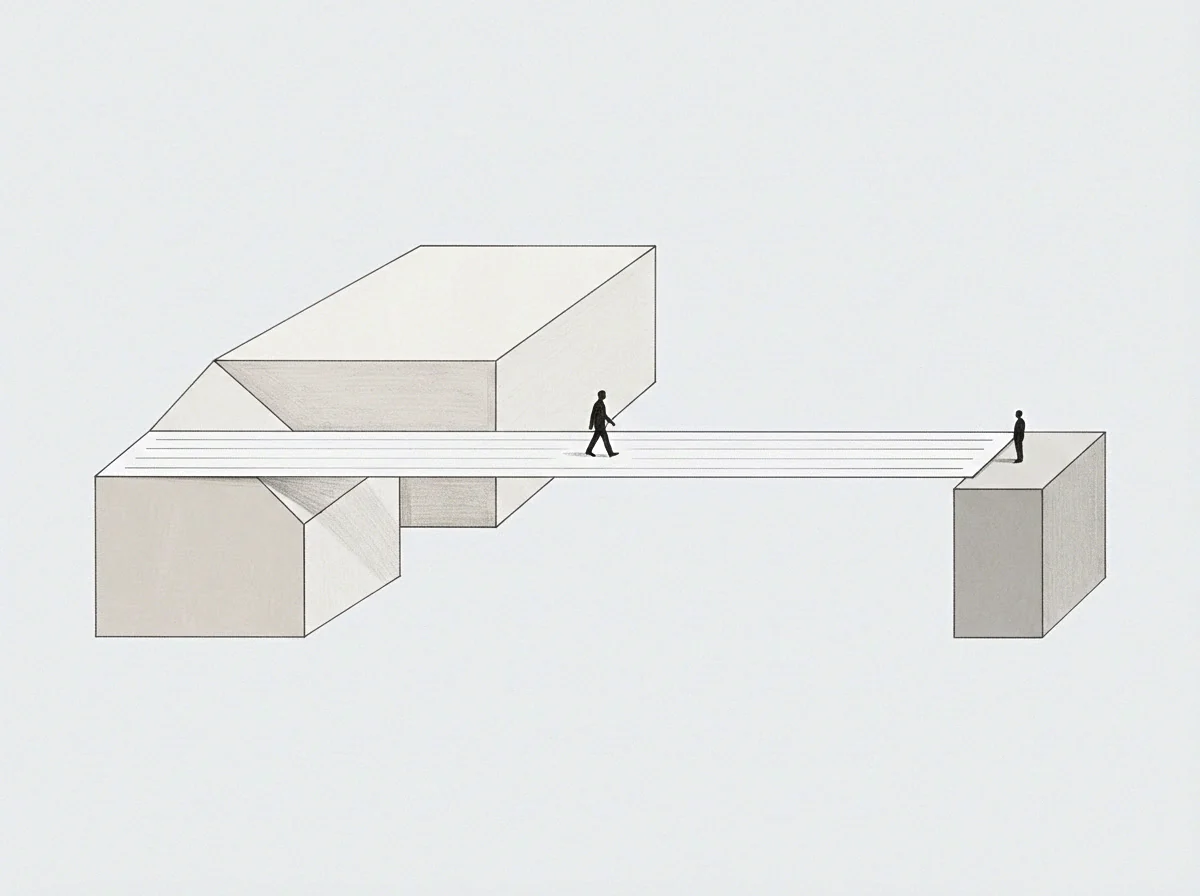
The accumulated expense of these substitute measures outlines the shape of the wall, which represents the perimeter of actions the executive committee refuses to take because doing so threatens internal status hierarchies. Outside the wall sits the five-week pipeline refactor costing two hundred thousand dollars of diverted engineering time. Inside the wall sits a collective four-million-dollar annual budget for additional support agents, chatbot subscriptions, and attrition recruiting.
The unmade cut compounds along three distinct axes:
- Talent dilution occurs when exceptional engineers depart after recognizing that structural remediation is continuously subordinated to political etiquette.
- Operational insulation expands as layers of middle management are hired solely to buffer executive leadership from unresolved technical failure.
- Strategic incapacity emerges because the organization can commit no unencumbered capital to market opportunities while financing its internal avoidance compromises.
Everyone at the walnut surface understands the real problem, yet everyone votes to approve the Manila support expansion. The unmade decision generates immediate operational overhead that compounds through subsequent fiscal periods. The executive committee agreed to hire twenty contractors overseas because the product roadmap could not absorb the disruption of an internal architecture overhaul this quarter.
Basin
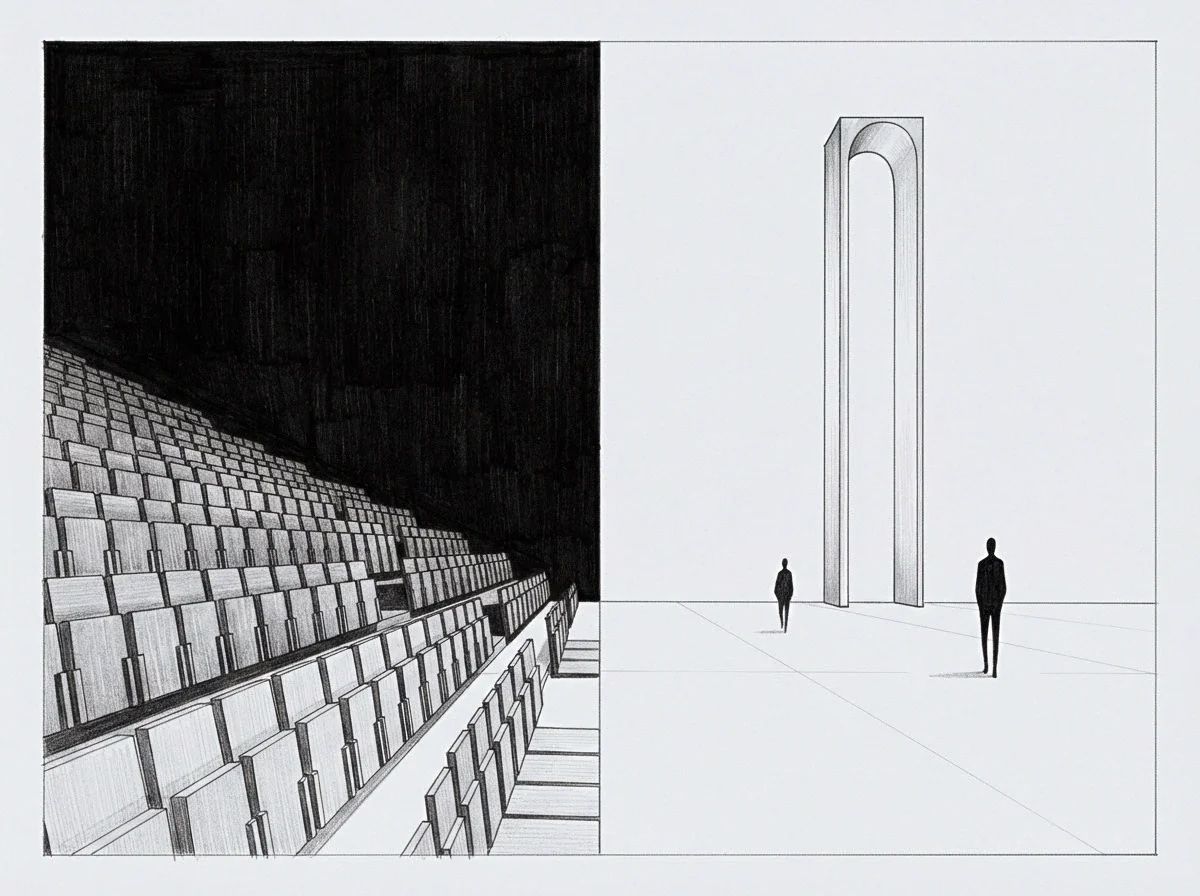
Avoidance creates a gravitational basin that captures organizational resources. In numerical analysis, gradient descent can trap an algorithm in a local minimum, preventing it from ever reaching the global optimum. Human organizations enter an identical trap when minor procedural adjustments generate just enough relief to stave off systemic collapse without fixing the core deficiency.
When an avoided high-value decision sits at the bottom of an operational slope, the enterprise continually drifts back toward it. An executive team may commit to process innovation, yet every workflow alteration circles the perimeter of the unaddressed personnel issue or flawed core contract.
A team trapped in a local operational minimum works at maximum physical exhaustion while generating zero structural advancement.
The depth of the basin corresponds to the duration of the evasion. A decision avoided for six months produces minor operational eddies: duplicate spreadsheets, redundant status syncs, informal back-channel communications. A decision avoided for six years constructs entire departments whose sole function is managing the consequences of the failure.
The personnel in those departments develop vested interests in preserving the dysfunction that justifies their compensation.

Mirroring The Latent Capacity
Calculating the negative gradient vector exposes the inverse potential of the enterprise. The magnitude of the downward vector equals the magnitude of the latent capacity available if the system executes the avoided intervention. If an organization expends twelve thousand engineering hours annually navigating around an obsolete legacy monolith, those twelve thousand hours represent latent engineering capacity waiting to be released.
The calculation requires measuring three operational baselines:
- Friction volume tallies the precise hours spent reconciling data, attending alignment meetings, and handling workarounds generated by the unaddressed decision.
- Suppression cost measures the capital intentionally withheld from growth initiatives to maintain cash reserves for patching recurring operational failures.
- Trajectory deflection charts the divergence between current enterprise throughput and the theoretical throughput of a baseline that contains no political compromises.
Every unmade decision extracts rent. When an operational audit calculates these three components, it generates a mirror image of the current operational profile. Above the baseline sits an unspent volume of capital, attention, and velocity equal in magnitude to the waste below it.
Whether an executive group can accurately calculate this latent potential without external auditing remains an unresolved point of friction in contemporary corporate governance.

Bearing
Reversing a negative gradient vector demands establishing a clear operational bearing based on measured resistance. The conventional founder narrative suggests that breakthrough performance arises from creative inspiration or novel market insight. Empirical operational management demonstrates that breakthrough performance routinely comes from executing the specific, obvious, highly uncomfortable chores that previous management teams routed around for a decade.
The first procedural move is compiling the inventory of structural refusals. An operator inspects the enterprise ledger for persistent micro-allocations that compensate for unspoken failures rather than financial irregularities. When an accounting department maintains sixteen full-time contractors to manually enter vendor invoices into an enterprise system, the operator does not optimize the invoice entry process.
The operator audits why the automated data interface project was shelved three years prior, locating the boundary of the current corporate model by documenting every instance where an employee states that a specific operational change cannot be made because of relational politics.
Executing The Inverse Vector
Converting a negative gradient into an ascent trajectory requires direct confrontation with the systemic wall. The operator treats operational discomfort as a precise instrument measuring organizational computation rather than an interpersonal crisis to be smoothed over. When the leadership team experiences intense resistance to a proposed reorganization, that resistance indicates that the conversation has finally breached the boundary of the legacy comfort zone.
Executing the move requires three disciplined steps:
- Isolating the coordinate identifies the single unmade decision carrying the highest negative displacement vector in the enterprise.
- Liquidating the compromise strips away the supplementary software, interim committees, and outsourced agencies hired to manage the workaround.
- Climbing the gradient commits all freed capital directly into the primary operational intervention until the systemic friction is resolved.
The cost of this ascent is paid entirely in ordinal currency: social friction, administrative fatigue, and temporary operational disruption. The cardinal yield arrives in cash flow preservation, reduced structural overhead, and regained execution speed. An organization climbs toward efficiency only when its leadership values cardinal survival over interpersonal comfort.