
Evaluating Local Friction Coefficients That Distort Edge Execution Pathways
Localized administrative friction distorts operational pathways by forcing edge workers down informal paths of least resistance that accumulate hidden liabilities.

Drag
A product engineer commits forty lines of configuration code at dawn to bypass an approval gate that took seventeen days to clear in the previous quarter. The technical debt remains unrecorded in any backlog, and the sprint velocity registers as positive momentum on the company board. Below that surface recording, execution path divergence begins at the physical interface where individual tasks encounter local institutional friction.
When the energy demanded to traverse an organizational boundary exceeds the perceived return of compliance, actors route laterally around the obstacle. The lateral movement preserves immediate speed while discarding strategic alignment.
Every operational system establishes a value axis determined by its stated production goals. Gradients computed along this value axis reveal the rate of return per unit of applied effort across different operational pathways. In an frictionless execution plane, work follows the gradient of steepest descent directly toward completion.
Real organizations introduce localized friction coefficients through review layers, fragmented authority, ambiguous handoffs, and misaligned incentives. These local drag points alter the topography of the operational plane. Tasks do not travel down the intended slope.
Instead, execution bends toward local minima that minimize immediate personal friction for the operator.
A system routes effort toward the path of lowest local resistance regardless of whether that path serves the central production mandate.
Consider the measurement of these localized resistances. In physical tribology, a friction coefficient expresses the ratio between the force resisting motion and the normal force pressing two surfaces together. In organizational systems, the normal force corresponds to the operational pressure applied to complete an edge objective, such as closing a commercial agreement, deploying software, or provisioning infrastructure.
The resisting force consists of the compliance overhead, coordination latency, and reputational risk exacted at that boundary. When the resulting friction coefficient exceeds a threshold value, the edge actor treats the planned boundary as an impassable barrier.
Execution pathways distort systematically rather than randomly. When a team encounters severe resistance at a compliance handoff, the work does not cease. It shifts along an adjacent vector that circumvents the measurement apparatus entirely.
The circumvented volume accumulates in unmonitored operational spaces. Latent organizational potential remains stranded in these side channels, trapped by boundaries that were constructed to enforce quality but operate primarily as dampening fields.
Repeated displacement of execution vectors generates compounding structural drift that invalidates strategic forecasts and leaves edge operators bearing the cumulative drag of unmaintained local workarounds.

Vector
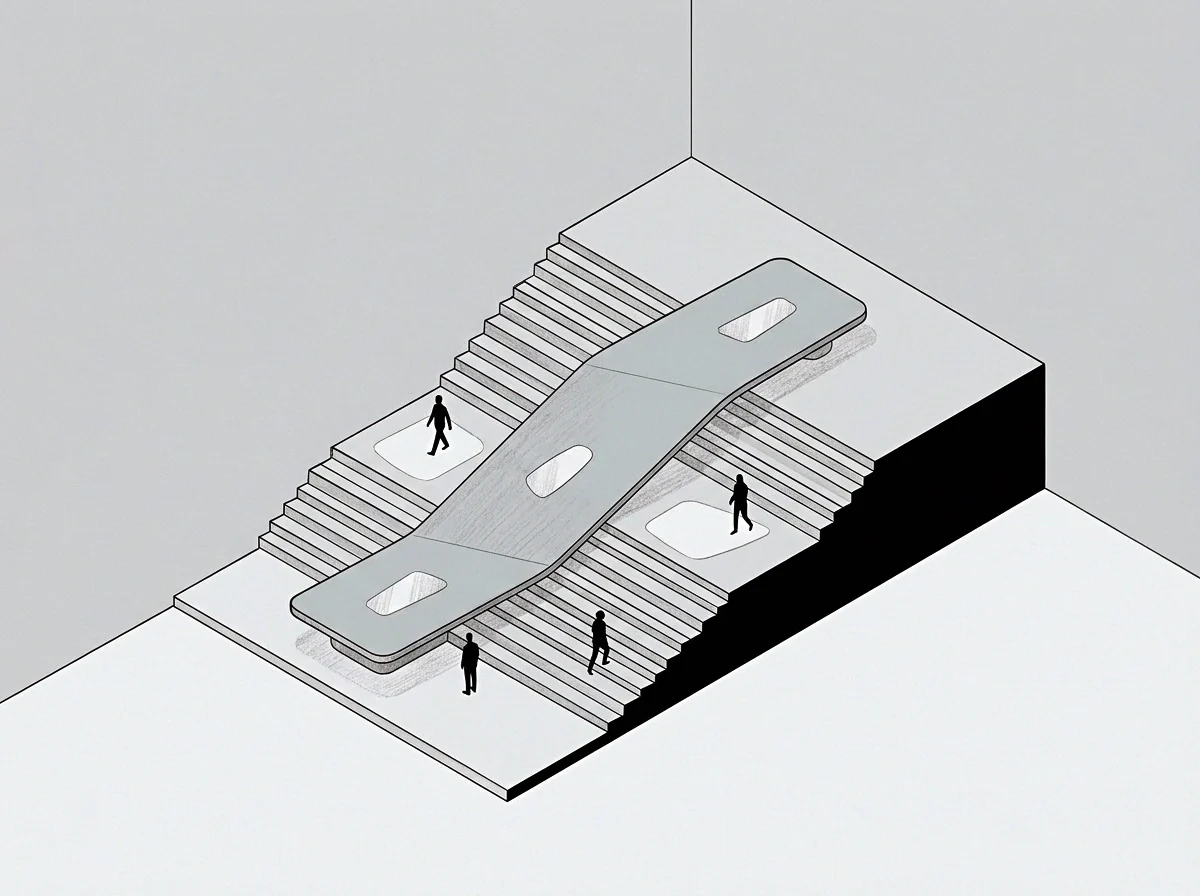
Decomposition of Boundary Friction
Analyzing boundary distortions requires separating static drag from kinetic drag within operating environments. Static friction represents the initial resistance encountered when initiating a non-standard execution path. Kinetic friction measures the continuing energy expenditure sustained while moving along an established workflow.
Static drag often resides in ambiguous decision rights where initiating a task requires multiple informal endorsements before formal processing begins.
Execution vectors possess both magnitude and direction across the firm. The magnitude reflects applied capital, focused operator hours, and computational resources. The direction reflects the vector of steepest descent on the perceived value landscape.
When local administrative policies increase the energetic cost of an edge execution pathway, they alter the direction of that vector without altering the underlying mandate. The operator deflects. Work follows the altered vector into territory where resistance is lower, even when that territory produces lower organizational yield.

How Do Microscopic Resistance Points Reshape Trajectories?
A single procurement sign-off requiring three executive signatures introduces a quantifiable friction coefficient into a vendor integration pathway. If obtaining those signatures consumes four weeks of asynchronous messaging and defensive documentation, the edge operator recalculates the operational gradient. The operator chooses an existing vendor whose capability falls forty percent below the technical requirement, simply because that vendor already sits on the approved master list.
This deflection represents a distortion of the edge pathway under local friction. The strategic intent dictated an optimal integration. The local friction coefficient dictated an inferior substitute.
Over twelve months, dozens of edge teams execute similar deflections. The collective capability of the company settles into an unintended configuration dictated entirely by administrative resistance rather than strategic intent.
Observe the formal differences between distorted pathways and their designed baselines across common execution domains:
| Execution Domain | Primary Resistance Source | Designed Pathway Baseline | Distorted Edge Pathway | Trapped Volume Metric |
|---|---|---|---|---|
| Software Release | Centralized Change Approval Boards | Direct deployment upon automated verification | Feature flags toggled within legacy services | Latent technical debt |
| Commercial Sales | Legal redline review queues | Standard paper closing within three days | Informal side letters granting operational carveouts | Unhedged contractual liabilities |
| Hardware Prototyping | Capital expenditure approval thresholds | Custom tooling procured from specialized shops | Sub-optimal components fabricated on internal benches | Product reliability variance |
| Talent Acquisition | Rigid compensation band enforcement | Direct offer aligned with spot market value | Title inflation combined with prospective bonus tiers | Structural equity distortions |
Execution paths that bend around high-friction gates invariably produce hidden operational liabilities. When the true cost of traversing a boundary remains unexamined, operators treat evasion as rational conservation of capacity.
A boundary with high static friction forces execution to invent informal channels that preserve speed while concealing exposure.
Left uncorrected, the habit of deflection becomes the dominant operating culture of the enterprise. Upstream leadership observes steady activity numbers while remaining oblivious to the lateral drift that separates actual production from the strategic plan.
Effort flows down the steepest accessible slope and ignores any summit whose ascent demands unrewarded personal exertion.

Wedge
The wedge forms where structural friction splits formal authority from actual operational flow. Leadership defines governance protocols to mitigate systemic risk, intending to create guardrails. At the working edge, operators interpret those guardrails as insurmountable walls.
The gap between the protocol on paper and the execution reality widens with every delayed cycle. This cleavage does not resolve spontaneously; it ossifies into organizational infrastructure.
Consider the divergence between stated policy and physical practice in edge execution. An administrative policy requires multi-factor authentication and ticketed approval for staging environments. The engineering team, facing weekly delivery deadlines, creates shared administrative accounts and hardcodes credentials into local build scripts.
The risk profile of the company increases, but delivery velocity remains nominal. The control loop has broken. The feedback metric shows healthy velocity while the system accumulates catastrophic security exposure.
- Static resistance coefficients establish the baseline energy expenditure required to initialize an authorized process across organizational silos, dictating whether edge actors attempt the prescribed pathway at all.
- Kinetic dampening factors degrade execution momentum during transit through administrative checkpoints, systematically consuming the temporal window required for effective market entry.
- Lateral diversion channels represent the informal paths carved out by operators seeking to bypass procedural friction, transferring unprocessed organizational material into ungoverned operational spaces.
The operator on the ground rarely challenges the policy directly. Raising a formal dispute against a compliance mechanism requires spending administrative capital that the edge worker does not possess. Direct confrontation involves political exposure, endless committee hearings, and reputational risk.
Bypassing the mechanism requires only technical ingenuity and quiet coordination with adjacent peers. Evasion is computationally cheap; reform is extraordinarily expensive.
Consider the perspective of an oversight department evaluating an audit log. The paperwork matches the procedural standard, the signatures populate the mandatory database fields, and the formal timeline reflects unbroken compliance with institutional regulations.
Shelf
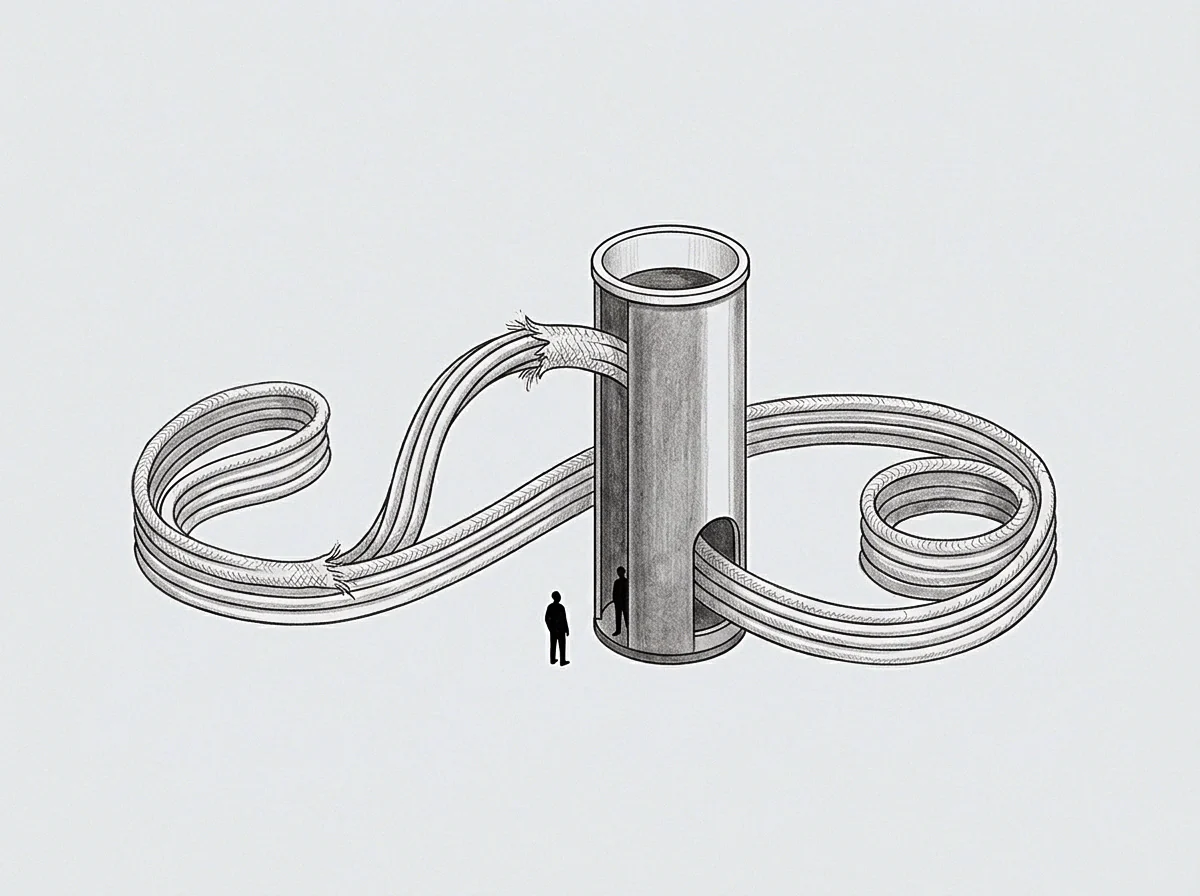
When execution pathways deflect around institutional friction, the bypassed work leaves an unspent volume resting upon an operational shelf. This shelf consists of unintegrated capabilities, pending structural modifications, and deferred administrative reconciliations. It sits above the operating baseline like stored gravitational potential, waiting for an external perturbation to destabilize its balance.
In manufacturing assembly, physical inventory held between workstations represents working capital locked away from cash conversion. In organizational systems, the work held on the operational shelf represents strategic intent that could not penetrate the administrative layer. Teams designed features that sales could not quote due to pricing calcification.
Marketing produced campaigns that legal delayed until market relevance vanished. Engineering built architectural upgrades that operations refused to deploy due to maintenance window restrictions.
The volume of deferred structural work resting on an operational shelf expands in direct proportion to the friction coefficient of the boundary guarding the production core.
This dynamic reveals the true cost of administrative friction. It does not simply slow operations down. It halts the synthesis of cross-functional capability.
The organization continues to consume payroll, operational expenses, and executive focus while the usable output remains stranded in local queues. The capacity exists, the intent exists, but the boundary coefficient prevents reconciliation.
The presence of a mandatory dual-authorization clause on transactions exceeding trivial thresholds transforms an routine procurement into an extended administrative campaign, ensuring that operators seek non-standard off-balance-sheet workarounds.

Notch
Correcting pathway distortion demands cutting a precise notch through the institutional friction barrier rather than dismantling the entire governance structure. Blanket deregulation creates chaotic operational variance that destroys institutional cohesion. Conversely, maintaining punitive friction coefficients strangles edge innovation and encourages covert bypasses.
The resolution lies in identifying the specific operational variables that govern the local friction coefficient.
Reducing friction requires adjusting the administrative normal force. When leadership lowers the cognitive and procedural cost of cross-boundary collaboration, the resisting force drops proportionally. Edge pathways snap back toward strategic alignment.
Work flows through authorized channels because the authorized path becomes the path of least resistance. Operators stop inventing side channels when the main conduit provides faster transit than evasion.
This recalibration relies on rigorous measurement. Leadership must measure the temporal latency between task initiation and final boundary crossing across all major corporate interfaces. When an internal interface exhibits a friction coefficient significantly higher than the external market alternative, the interface demands immediate structural re-engineering.
If provisioning an internal development environment consumes ten business days while an external cloud provider provisions the same resource in four minutes, edge workers will inevitably route execution to unauthorized external infrastructure.
Whether institutional leaders possess the appetite to dismantle protective bureaucratic checkpoints when doing so exposes the organization to the raw volatility of unmediated edge execution remains fundamentally unresolved.