
Measuring Gradient Descent Across Unseen Spatial Impedance In Founder Workflows
Unseen spatial impedance deflects executive effort down local gradients of least resistance, routing work around high-leverage commercial boundaries.

Slope
A spreadsheet tracks daily cash burns alongside server compute costs, while a third parameter climbs silently across three quarters without an assigned column. The founder logs five hours of clean terminal output, commits forty lines of verified infrastructure code, and avoids opening the vendor contract awaiting signature on the second monitor. Time records treat every sixty-minute interval as an identical slice of operational effort.
The nervous system runs a different calculation, weighing the friction of touching an ambiguous commercial agreement against the predictable relief of engineering loops. Effort falls along the path of least resistance, following the steepest drop in perceived friction. That drop defines a negative gradient across the company’s operating space.
When an operating environment presents uneven resistance across tasks, human effort acts like an optimization algorithm descending a loss surface. The scalar field behind this descent is subjective metabolic cost, an ordinal measure of friction across social exposure, legal commitment, unresolved friction, or mechanical ambiguity. Spatial impedance is the quiet resistance that makes moving through one sector of the business take four times the cognitive energy of moving through another.
The desk remains flat, typing requires uniform finger pressure, yet certain operational corridors exert a drag that deflects work away from commercial exposure.
A negative gradient records the local path of least resistance across an uneven surface of cognitive friction.
The calculation of this slope carries no moral weight. Mathematical optimization treats descent along a gradient as a direct consequence of surface topology. A founder who spent twelve days refactoring a working payment webhook instead of calling five enterprise buyers followed the local geometry of the workspace with mechanical precision.
The webhook environment gave immediate compilation feedback, bounded logic, and zero ambiguity regarding social evaluation. The buyer phone calls carried interpersonal friction, delayed outcomes, and asymmetric social risk. Effort followed the fall line toward immediate mechanical equilibrium.
Measuring this descent means separating recorded cardinal hours from ordinal directional displacement. The clock logs ninety hours across two weeks, presenting a picture of undifferentiated executive diligence. Spatial tracking shows something else: eighty of those hours circulated inside a closed three-meter radius around known mechanical tasks, trapped in a local basin.
The remaining ten hours faced the commercial boundary before retreating. The business stalled because the founder followed the line of immediate cognitive comfort down to its local minimum.
Unseen impedance warps the operating surface without leaving an audit trail in financial ledgers. A dispute with an earlier partner introduces unseen spatial impedance across every task touching equity splits, investor presentations, and corporate filings. The founder sits down each morning to draft an institutional pitch, pauses at the capitalization table slide, and switches tabs to tune database indexes.
The company executes two hundred thousand lines of code while the ownership structure remains unresolved, deflected by the resistance around the cap table. The system routes around the dispute, accumulating unprocessed organizational debt behind the barrier.
The term specifying the drag of unstated equity splits alters the entire downstream topology of executive attention.
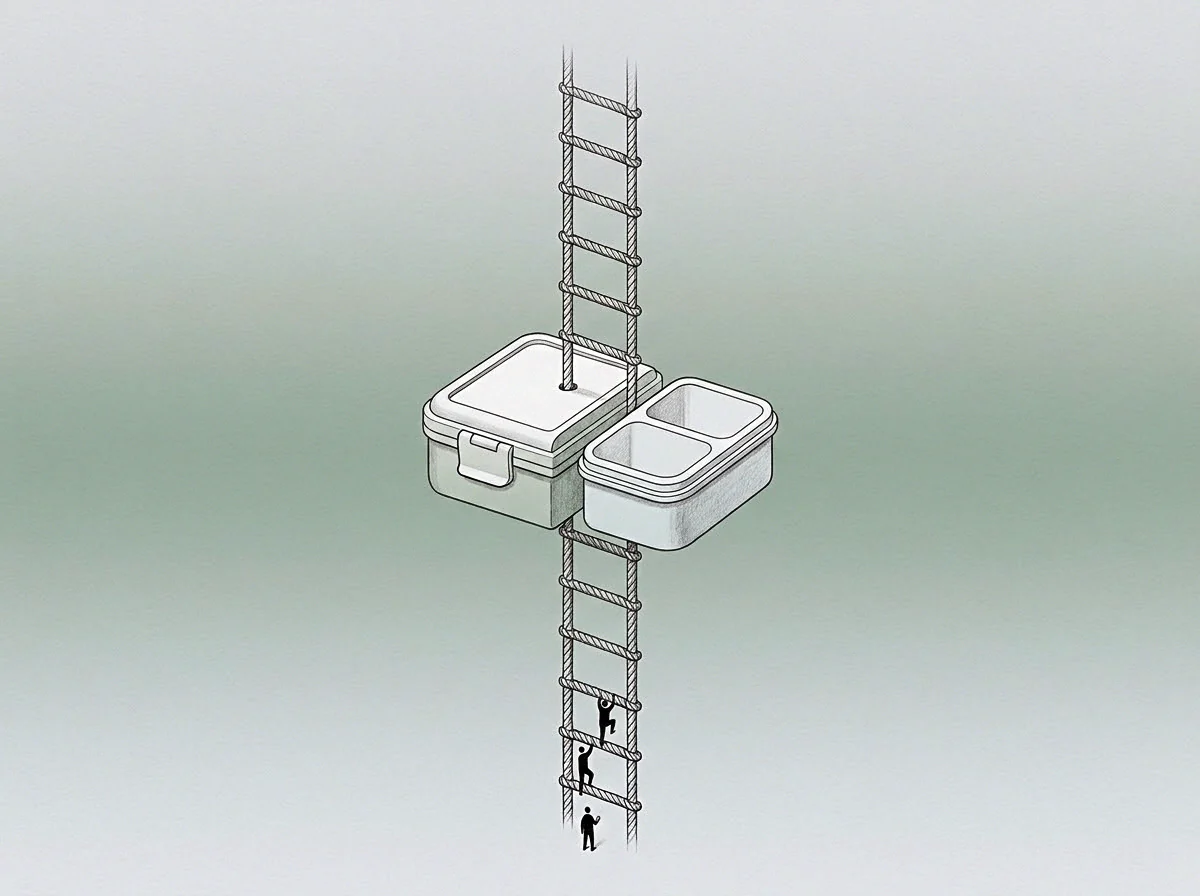
Mirror
Every descent traces an inverted geometry of equal magnitude. When an optimization process routes around a sector of high impedance, the negative vector points directly away from the avoided coordinate. Reflecting this negative gradient across the operational baseline produces the ascent gradient, exposing the latent potential trapped behind the resistance.
The volume of work avoided over eighteen months represents an equivalent reservoir of unspent enterprise capacity.
The coordinate marker of this latent volume is consistent executive avoidance. Standard operational analysis interprets repetitive task omission as negligence, character defect, or poor prioritization. A gradient reading treats avoidance as an exact navigational coordinate, identifying a high-density value pocket shielded by steep structural or emotional impedance.
What a team routes around reveals where unprocessed leverage sits inside the enterprise. The magnitude of the diversion matches the scale of the underlying commercial opportunity or organizational debt.
An enterprise that spends four hundred development hours building an internal analytics engine to avoid negotiating a three-thousand-dollar monthly contract with a hostile third-party vendor reveals an unspent volume equal to that detour. The founder constructs elaborate technical dependencies rather than sitting across a table from an aggressive counterparty. That internal tool serves as an expensive physical monument to spatial impedance, recording the exact shape of the transaction it was built to evade.
Inverting the avoidance map translates an operational liability into a structural exploration plan. The founder traces past evasions to map the boundary walls currently constraining company scale. The process relies on identifying structural markers that differentiate systematic path avoidance from ordinary executive choices:
- Systematic Detours occur when a workflow introduces three intermediate administrative steps to bypass an interpersonal discussion that settles operational authority between two cofounders.
- Recursive Polish Loops capture engineering attention when an interface undergoes five consecutive visual revisions without customer exposure, shielding the team from external product evaluation.
- Phantom Dependencies emerge when product deployment waits on an unnecessary automated pipeline solely to delay publishing pricing figures to the market.
A founder who charts these detours traces the exact outline of the firm’s latent operational capacity. The mirror operation does not demand immediate traversal of the impedance barrier. It establishes the baseline coordinates of the wall, preventing the enterprise from mistaking repetitive lateral motion for structural progress.
The unresolved problem sits inside the shadow cast by the diversion.
The diversion continues while the arrangement records it as careful preparation.

Seat
Physical workspace layout directly amplifies unseen cognitive impedance. Chair placement, the visibility of operational metrics, and the sensory friction of daily tools alter the metabolic cost of executive intervention. An office layout that isolates the technical founder behind three closed doorways while placing customer service desks across an open floor creates a spatial impedance gradient that penalizes technical oversight of frontline operations.
Attention descends into the private room, abandoning client communication to unchecked degradation.

Physical Topography and Executive Deflection
The physical seat establishes an initial momentum vector for the day. A desk configured exclusively for solitary software development presents near-zero impedance to code generation while establishing high physical friction against commercial outreach. Moving from an integrated development environment to an outbound sales dialer requires traversing sensory, psychological, and logistical thresholds.
The founder stays seated in the code editor because shifting tasks demands climbing an immediate energetic slope.
Different spatial setups either absorb or deflect executive capacity:
| Workflow Environment | Primary Impedance Source | Observed Gradient Trajectory | Downstream Cost Component |
|---|---|---|---|
| Isolated Terminal Seat | High context-switching friction to external communication | Descent into mechanical code optimization and local refactoring | Executive isolation and delayed commercial validation loops |
| Shared Counter Workspace | Unbounded ambient social interrupts and conversational drag | Lateral motion across reactive fire-fighting and trivial administrative tasks | Exhaustion of deep cognitive capacity without baseline output |
| Segmented Operational Chambers | Physical transit friction between distinct functional stations | Deliberate threshold traversal with localized task execution | Moderate switching time offset by absolute contextual containment |
A machine toolmaker in a precision workshop organizes cutting bits along a reach arc measured in millimeters to eliminate ergonomic drag. Founder workspaces routinely ignore this discipline, placing high-leverage commercial interfaces behind layers of authentication, scattered hardware, and disorganized domestic space. The metabolic friction of locating customer records or searching for signature documents acts as a resistive barrier that repels daily execution.
The founder routes around the disordered sector, settling back into familiar administrative trivia.
Cognitive friction behaves like physical incline, turning every minor operational barrier into an active steering mechanism.
The energetic discrepancy between physical tasks remains hidden inside executive calendars. A calendar block marked as strategy carries zero intrinsic guidance, leaving the founder exposed to whatever micro-impedance field dominates the desk. Secondary monitors streaming server logs exert continuous gravitational pull on executive attention.
The eyes descend to the moving green text because tracking deterministic metrics requires less cognitive compute than drafting an ambiguous commercial proposal. The physical workspace steers the enterprise.
The operational cost of failing to manage spatial impedance appears as months of intense physical exhaustion paired with zero structural movement along the commercial axis.

Boundary
A system reaches its operating boundary when routine actions fail to yield organizational expansion. That perimeter marks the boundary of the founder’s current operational model, constructed from every task, decision, and confrontation the system avoids because the energetic cost of computing them exceeds current capacity. Navigating inside this perimeter maintains structural safety while guaranteeing systemic stagnation.
What lies beyond the wall is not unknown territory, but deliberately bypassed operational reality.

Which Coordinate Marks the Operational Limit?
The wall reveals its position through the sensation of acute cognitive resistance. Discomfort operates as an instrument of spatial measurement rather than a psychological failure state. When an executive approaches a genuine boundary coordinate, the brain registers high computational load and attempts an immediate lateral escape down the nearest friction slope.
Recognizing this cognitive friction as a topographical boundary line allows the founder to map the firm’s true structural limits.
Errors generated at this boundary function as exact coordinate markers. When a commercial negotiation breaks down over equity vesting or indemnification terms, that failure marks a precise node along the enterprise boundary wall. Founders often treat such breakdowns as isolated operational accidents, retreating inward to resume comfortable internal engineering tasks.
An engineering mindset incorporates the failure point directly into the system’s operational geometry:
- The founder identifies the exact friction threshold where executive attention deflected into tangential tasks during the negotiation.
- The specific clause or conversational boundary that triggered the deflection receives explicit operational boundaries and defined risk limits.
- The team builds structured protocols to traverse that coordinate repeatedly until the local impedance diminishes to baseline levels.
A business model expands exclusively at the boundary where execution becomes expensive. Operating deep inside the basin of low impedance provides reliable, predictable execution of solved problems, but it generates zero structural adaptation. When market conditions shift, an enterprise confined to an unexpanded boundary collapses under external friction.
The founder who remains inside familiar development loops leaves the entire commercial perimeter unmapped and fragile.
The contract has remained open on the desk for nine weeks without a single revised redline returned.

Axis
Value serves as the sole non-arbitrary coordinate axis for enterprise measurement. Operational layers, from software architecture to capital allocation, sit as elevations above this baseline. Deriving gradients against the value axis removes moralistic interpretation from workflow evaluation.
A trajectory either moves toward value extraction or descends into lateral motion along lines of constant comfort. Computing the rate of change along this axis provides an objective assessment of systemic velocity.
Price operates as a cardinal figure, expressing capital balances in discrete, countable currency units. Cost behaves as an ordinal vector, ranking energetic expenditure, executive attention, and temporal capacity relative to alternate paths. Conflating the two creates catastrophic accounting blindness.
A founder might congratulate the enterprise on conserving ten thousand dollars in legal fees by drafting complex commercial agreements in-house. The cardinal price was zero, but the ordinal cost consumed ninety hours of high-leverage product direction, steering the executive down a high-impedance administrative corridor.
A cardinal price tracks currency exchange while an ordinal cost measures diverted human capacity across competing trajectories.
The delta measuring genuine enterprise movement emerges exclusively from differential valuation between consecutive operational states. Activity logs documenting eighty completed Jira tickets or fifty answered client emails measure internal metabolic heat rather than systemic displacement. If the firm’s position along the value axis remains static across the reporting window, the operational loop generated zero net velocity.
The movement was closed circular circulation inside an impedance basin.
Two distinct schools of operational thought debate whether persistent avoidance indicates unprocessed leverage or appropriate defensive economy. The classical operational view holds that sustained resistance toward an activity marks an intuitive recognition that the task yields negative returns on invested attention. The gradient analysis view asserts that high impedance routinely shields high-yield structural milestones, because social evaluation, ambiguity, and contractual exposure concentrate at points of genuine enterprise transformation.
Under this analytical uncertainty, a founder tests the avoided coordinate with minimal probing actions before concluding that avoidance reflects strategic wisdom.
A venture operates under severe structural exposure when executive time expends itself entirely within low-impedance maintenance loops while the primary enterprise risks remain unaddressed behind persistent cognitive barriers.
On this terrain, the operational task that generates the sharpest impulse to reorganize the physical desk marks the steepest upward slope along the value axis.