
Constructing Synthetic Reference Baselines For Unstable Operational Telemetry
Synthetic reference baselines isolate real operational regressions by modeling expected system telemetry as a direct mathematical function of ambient workload variations.

Variance

Unstable Operational Traces Under Shifting Workloads
A production cluster handles ninety thousand requests per minute until a background migration begins at midnight, doubling memory pressure while execution latency rises by twelve milliseconds. The on-call operator observes the jump on the monitoring console, uncertain whether the increase stems from degraded service code or expected garbage collection overhead during heap reallocation. Real systems rarely present stationary operational signatures.
Ingress traffic patterns fluctuate across days, external dependencies degrade without warning, and horizontal autoscaling alters concurrency baselines faster than rolling averages can settle. Attempting to measure performance degradations against a fixed historical average produces phantom alerts or conceals silent regressions. The delta between observed behavior and expected performance remains unreadable without an objective baseline anchored in identical operating conditions.
Telemetry recorded during high volatility behaves like a moving target. When an infrastructure team releases an updated routing service, the recorded throughput figures intermingle the effects of the code patch with the concurrent surge in batch processing tasks. Traditional time-series comparisons select a historical reference interval, such as the preceding hour or the same day of the prior week, assuming environmental equivalence.
That assumption fails in distributed environments. A change in request volume alters internal lock contention, queue wait times, and memory cache hit rates, meaning that identical source code exhibits distinct telemetry across varying workload intensities. Isolating true degradation demands comparing production output against a baseline constructed specifically for the actual workload encountered during the evaluation interval.
A measured performance delta becomes interpretable only when external environmental variables are mathematically neutralized across the evaluation period.

The Separation Between Ambient Noise and Structural Regressions
Telemetry instability arises from two distinct origins that require mechanical isolation. First, environmental factors create exogenous fluctuations: diurnal consumer access habits, network transit hiccups, and co-tenant resource saturation inside virtualized infrastructure. Second, internal defects introduce endogenous regressions: memory leaks, algorithmic execution degradation, resource deadlocks, and regressive cache eviction policies.
Standard telemetry collection tools lump both categories into unified scalar graphs, leaving operators to speculate whether a latency rise reflects bad code or external traffic surges. Building an artificial baseline reconstructs what the system would have produced under the prevailing external load had the code remained unchanged.
The engineering discipline required for this reconstruction mirrors counterfactual inference. Instead of asking what the system did yesterday, the operator asks what the previous software version would have done today under the exact traffic sequence observed over the last four hours. Answering that question requires modeling the operational telemetry as a dependent function of exogenous inputs rather than treating time as the primary independent variable.
Once telemetry maps directly to workload descriptors, the synthetic baseline generates expected values for any workload slice, turning an erratic stream of traces into a stationary evaluation surface.
A sudden operational anomaly either tracks with external load shifts or indicates software degradation.
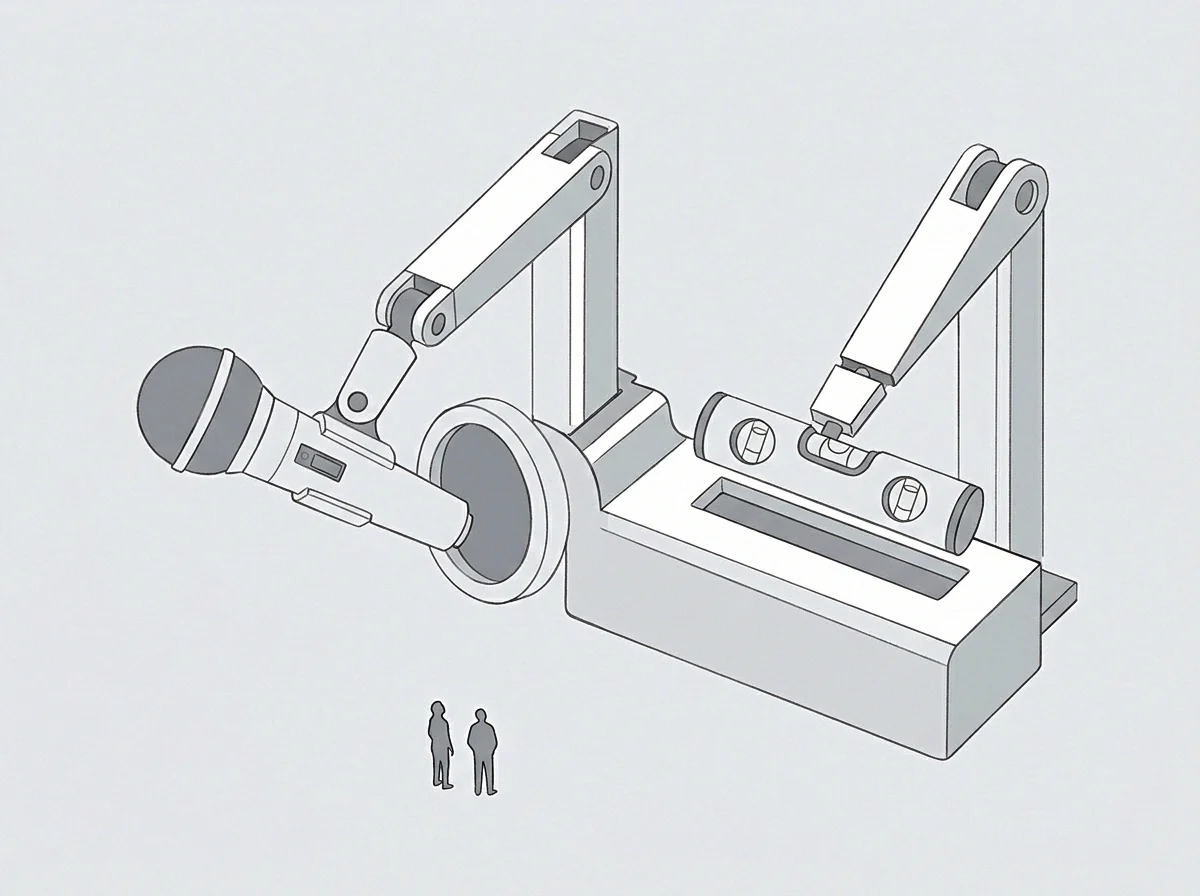
Rig

Physical Test Benches and In Situ Synthetic Generation
Constructing a synthetic reference baseline requires an execution apparatus that isolates software versions from ambient production noise. Engineers implement this isolation through two primary architectural patterns: off-path shadow execution benches and statistical regression twins running directly against active telemetry feeds. The physical shadow rig replicates hardware allocations, replaying captured production requests across both baseline and candidate builds in parallel.
This setup equalizes transit variations, input distribution, and hardware contention between the two software binaries. The off-path rig measures direct comparative divergence while eliminating client-facing side effects by discarding mutation requests or routing writes to ephemeral storage sinks.
Shadow rigs carry operational friction. Maintaining a dual-cluster fleet doubles hosting expenditures, while sanitizing stateful database mutations demands elaborate virtualization layers. Where full hardware parallelization proves prohibitive, statistical synthetic baseline rigs construct reference telemetry through continuous parameter estimation.
These software generators capture high-cardinality metadata from inbound requests, feeding concurrent telemetry signals into a local regression model trained on historical software performance. When active production latency climbs, the statistical generator outputs the baseline expected latency for that specific combination of request volume, payload size, and database row depth. The candidate metric is then read strictly as a deviation from this computed reference curve.
| Evaluation Vector | Physical Shadow Replay | Parametric Regression Model | Stratified Historical Reservoir |
|---|---|---|---|
| Computational Overhead | High infrastructure replication expenditure | Low continuous inference tax | Negligible database indexing allocation |
| Stateful Mutation Handling | Demands write isolation layers | Read-only telemetry processing | Operates solely on emitted metrics |
| Nonlinear Load Fidelity | Preserves full concurrency saturation | Degrades past training distribution limits | Fails during unprecedented load spikes |
| Deployment Latency | Minutes required to warm test environments | Milliseconds per evaluation window | Microsecond historical lookup passes |

Stratification Over Historical Request Profiles
An alternative mechanism to parameter fitting involves stratified metric slicing. Production requests naturally cluster into distinct functional classes: read-heavy queries, bulk administrative imports, lightweight authentication handshakes, and unindexed filtering sweeps. Rather than aggregating all events into an undifferentiated system-wide percentile, the telemetry engine bins events by operational complexity and payload volume.
When system telemetry exhibits instability, the stratification mechanism isolates individual operational bins, evaluating performance shifts strictly within homogeneous request classes.
Stratification succeeds because variance inside a narrow operational profile remains vastly lower than system-wide variance across multiple services. A three-hundred-millisecond response time indicates failure for a session verification call, while the same duration represents optimal throughput for an analytical aggregation endpoint. Grouping traces into stratified reservoirs allows the baseline generator to assemble an artificial reference curve.
The generator samples historical latency distributions from each distinct bin in proportions identical to the incoming traffic mix, assembling an instant synthetic reference profile.
When telemetry distributions are grouped by request payload dimensions, internal metric variance drops substantially across the evaluation window.
If the candidate build consumes unallocated hardware queues during parallel testing, the resulting metric drift compromises baseline validity across both environments.

Twin

Mathematical Formulation of the Operational Counterfactual
The synthetic baseline operates as an operational twin: an algorithmic artifact that outputs expected machine telemetry conditioned on exogenous operational states. Let the observed operational metric, such as ninety-ninth percentile service latency, be designated as a function of software version, internal configuration parameters, and environmental variables including request concurrency, working set memory size, and external network delays. When software version updates, the environmental variables continue their unpredictable trajectories.
The synthetic baseline twin freezes the software version term while continuously updating the environmental variables to mirror active operational reality.
Formulating this counterfactual requires estimating the relationship between input volume and system output under the baseline binary. Linear models rarely capture the sharp inflection points typical of resource exhaustion in distributed software. Telemetry curves typically remain flat across low concurrency, rise steadily across medium utilization, and climb asymptotically once thread pools saturate or memory bus bandwidth hits hardware ceilings.
The baseline generator uses quantile regression or piecewise polynomial approximations to preserve these non-linear saturation characteristics. When production workloads surge, the synthetic twin elevates its expected latency ceiling accordingly, preventing spurious alarm conditions.
The statistical validity of this approach depends entirely on parameter support within the underlying model. An operational twin evaluated outside its observed training parameter boundaries produces extrapolation errors, confusing mathematical artifacts with system degradation. When incoming traffic exceeds all previously recorded concurrency levels, the twin cannot distinguish between natural queuing dynamics and unhandled software bottlenecks.
Careful implementations append uncertainty intervals to the synthetic baseline, expanding confidence bands as operational telemetry enters unexplored hardware regimes.
A sudden change in request payload distributions alters baseline calculations instantly.

Validation Protocols for Invariant Baseline Construction
Assessing whether an operational twin accurately reflects reality requires rigorous invariance testing. The primary diagnostic test consists of evaluating null deployments: running the baseline generator against two identical deployments operating the exact same software version across divergent traffic periods. In an ideal setup, the calculated delta between the observed telemetry and the synthetic baseline remains centered on zero across changing workloads.
If the calculated delta drifts alongside shifting traffic volumes, the synthetic baseline model has failed to capture load dependencies, leaking environmental variance into the evaluation signal.
- Null Variant Calibration confirms model stability by evaluating identical code revisions across divergent traffic volumes, verifying that the computed delta remains zero regardless of ambient load changes.
- Permutation Stress Profiling introduces synthetic request bursts containing skewed payload compositions, checking that the reference curve tracks load fluctuations without exhibiting lag.
- Dimensional Decoupling Verification isolates exogenous metrics from internal failure indicators, preventing application crash loops from artificially shifting expected baseline parameters.
A synthetic baseline that shifts its output during null software deployments indicates incomplete parameter capture within the operational model.
Failure to calibrate the baseline generator against null deployments results in alerting systems that flag phantom performance regressions whenever traffic patterns shift.

Cost

Resource Allocations and Operational Maintenance Overhead
Deploying synthetic reference baselines requires tangible operational expenditure. Beyond the compute resources consumed by parallel test rigs or inference pipelines, the organization pays an ongoing maintenance tax in engineering attention. Operational twin models degrade as infrastructure evolves.
An update to the underlying operating system kernel, a modification in network interface drivers, or a change in database storage engines alters hardware execution dynamics, rendering previously trained telemetry baselines obsolete. Infrastructure engineers must constantly retrain parametric models and rebuild historical reservoirs to prevent synthetic references from decoupling from physical reality.
Teams frequently underestimate the cognitive demands imposed on operators by synthetic telemetry. When an alert triggers on a raw metric threshold, the cause is simple: latency exceeded four hundred milliseconds. When an alert fires on a synthetic delta, the operator must comprehend both the underlying system metrics and the mathematical assumptions embedded in the reference model.
If an engineer distrusts the synthetic twin, they revert to inspect raw traces manually, discarding the analytical utility of the synthetic infrastructure. Synthetic baselines earn operational trust only through transparent error boundaries and consistent predictive accuracy across repeated production incidents.
The engineering group must weigh these operational overheads against the risk of unspotted software regressions. Systems processing erratic, non-stationary traffic volumes face high costs when operating without synthetic baselines: prolonged production outages, unnoticed memory bloat, and defensive over-provisioning of cloud instances to absorb unmeasured performance degradations. Grounding operational measurements in synthetic counterfactuals converts turbulent operational noise into predictable, actionable telemetry deltas.
Will future autonomous infrastructure layers adjust synthetic baseline parameters dynamically without human verification?