
Establishing Solvency Boundaries for Convex Liabilities Without Parametric Estimates in Fat-Tailed Financial Regimes
Non-parametric duality bounds compute worst-case capital buffers across moment ambiguity sets to secure convex balance sheets against heavy-tailed shocks.

Breach
At four in the morning, a risk manager watched twenty screens in a quiet operations room while collateral calls climbed past forty million dollars an hour. The system recorded transactions normally, but cash balances dropped steadily. The firm had sold synthetic protection against liquidity freezes, pricing contracts on historical Gaussian distributions that assumed volatility would hover near a calm mean.
Within ninety minutes, the market moved four standard deviations away from the baseline. Liabilities grew exponentially as underlying prices fell, compounding through non-linear liquidation terms that forced automated buying into dry markets.
Standard accounting models assume that extreme shocks diminish in frequency according to an exponential decay schedule. In actual market regimes, heavy tails govern outcomes through power-law behavior where rare displacements carry heavy weights. When an institution enters contracts where payout schedules scale quadratically or exponentially with respect to an underlying variable, linear hedging rules collapse, forcing liquidations into illiquid venues.
Under a convex contract, each incremental move away from the baseline extracts a larger payment than the previous move, depleting liquid cash before trading desks can recalibrate their exposure.
A convex liability driven by heavy-tailed shocks depletes available capital faster than dynamic rebalancing can replenish collateral reserves.
Conventional quantitative tools rely on parametric estimations, fitting historical return series to student-t, Pareto, or lognormal distributions by extracting parameters for shape, scale, or location. These estimations presuppose that historical samples contain sufficient variance to reveal the true power-law exponent. Financial series present severe tail uncertainty, and the true tail exponent remains unobservable over realistic operational horizons.
A single unobserved event can shift an estimated Pareto alpha from three down to one point four, instantly transforming a theoretically finite second moment into an infinite variance regime where standard deviation loses mathematical validity.

Hidden Tail Acceleration in Leveraged Commitments
Consider credit default swaps with dynamic attachment points, portfolio insurance obligations, decentralized liquidity pool short positions, or margin indemnity agreements. Each displays an asymmetric payout profile. Below a given displacement, the issuer absorbs modest fee income or manageable basis losses.
Beyond that point, obligations surge. When price vectors cross into fat-tailed territory, events do not average out over time; rare, large displacements dominate the aggregate sum, rendering central limit approximations unhelpful in practice.
Trading desks frequently measure risk using Value at Risk or Expected Shortfall calibrated against five-year rolling histories, which creates an operational blind spot. When the empirical window samples an epoch of mild fluctuations, it produces an artificial sense of capital adequacy. Once an exogenous liquidity squeeze arrives, actual drawdowns exceed the parametric boundary by orders of magnitude.
The desk often responds by repeatedly recalibrating distributional parameters, treating structural mismeasurement as a routine fitting error and adjusting the volatility surface while ignoring that the underlying process lacks tractable parametric moments.
Relying on parametric fitting under fat-tailed convex liabilities leaves the balance sheet vulnerable to sudden liquidation runs that can wipe out equity tranches before regulatory interventions materialize.

Limit
Addressing unobservable tail distributions begins by abandoning parametric curve fitting entirely. Chebyshev-type inequalities, generalized by Bienaymé and Markov and extended into higher-order convex hulls by Cantelli and Scarf, establish mathematical ceilings on loss exceedance probabilities that hold regardless of the underlying probability density function. These bounds demand only verifiable operational invariants, such as known structural supports or crude upper bounds on lower-order raw moments, bypassing speculative estimation of tail parameters.
Robust optimization treats solvency determination as a zero-sum game played against nature. Instead of selecting a specific density function, the operator defines an ambiguity set containing every distribution consistent with known physical and regulatory observables. The solvency boundary is then computed as the supremum of expected shortfalls across that entire set.
This dual formulation converts an unstable estimation problem into a tractable semi-infinite convex programming task, yielding a deterministic capital requirement that cannot be breached by unexpected tail shapes.
A solvency boundary derived from ambiguity sets guarantees survival across every distribution that satisfies stated moment constraints.
When liabilities exhibit strict convexity, Jensen inequality asserts that the expected liability exceeds the liability evaluated at the expected shock. Under heavy-tailed dynamics, this gap expands rapidly. Non-parametric bounding replaces point estimates with an envelope generated by extreme order statistics and convex duality, identifying the exact capital allocation below which no distribution within the ambiguity family permits survival.
| Evaluation Vector | Parametric Distribution Fitting | Non-Parametric Ambiguity Bounding |
|---|---|---|
| Distributional Presupposition | Assumes known analytic form with fixed parameters | Admits all probability densities within moment bounds |
| Sensitivity to Convex Blowup | Underestimates catastrophic losses by multiple magnitudes | Calculates the worst-case geometric expectation directly |
| Small-Sample Instability | High parameter drift across moving calibration windows | Monotonic expansion of bounds as sample bounds widen |
| Computational Objective | Maximizes likelihood or minimizes mean squared error | Solves minimax duality via semidefinite programming |
| Capital Allocation Profile | Lean reserves vulnerable to sudden tail jumps | Conservative solvency reserves that prevent ruin |
This comparison outlines the structural trade-off that operating desks confront. Parametric methods consume less capital during quiet regimes, offering high short-term returns on equity at the cost of catastrophic fragility. Ambiguity bounding demands higher upfront reserve allocations, pricing the unspent volume of worst-case tail capacity directly into the liability structure.

Nonparametric Moment Inequalities and Duality Formulations
Practical implementation constructs a minimax optimization problem. Let the liability payout be a convex function denoted by g of an underlying market displacement X. The objective is to compute the infimum over capital C such that the worst-case probability of payout exceeding capital remains below a defined tolerance epsilon across all distributions F inside an ambiguity set P.
- Support Containment Bounds define the contractual or physical domain of asset values, establishing boundaries that prevent liabilities from expanding into infinite theoretical domains.
- Semidefinite Duality Cuts reformulate moment-bounded probability limits into dual linear matrix inequalities, resolving worst-case distributions through polynomial-time convex solvers.
- Order Statistic Envelopes utilize empirical sample extremes without smoothing assumptions, establishing distribution-free confidence bands around tail quantiles through binomial rank transformations.
- Sub-Additivity Verification Tests confirm that capital requirements retain coherent risk measure properties across bundled liability portfolios, preventing diversification penalties from eroding liquidity.
Contract clauses that tie margin calls to verified dual boundaries compel counterparties to post liquid assets prior to market dislocation, converting abstract mathematical bounds into enforceable cash protection.
Wall
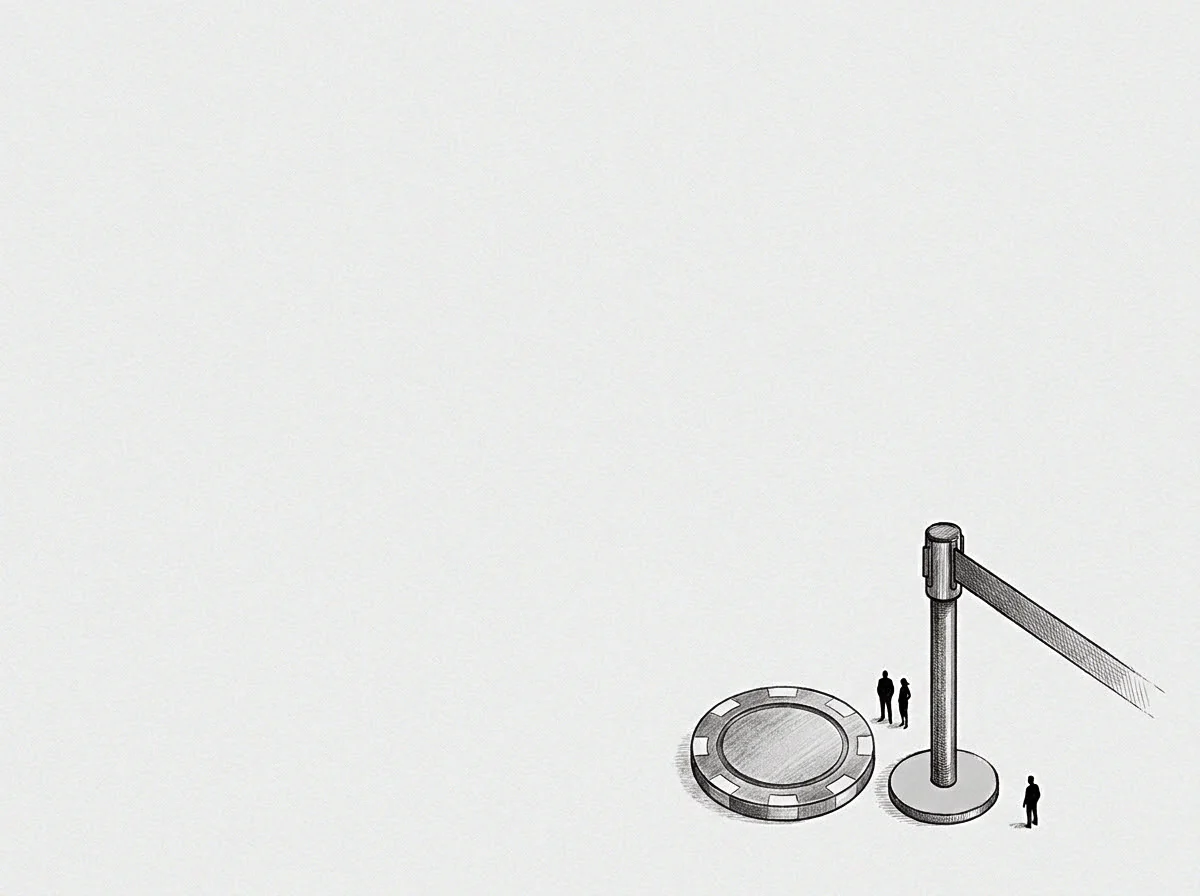
Building a physical capital cushion against convex ruin requires identifying the boundary where operational liquidity fails. In an illustrative quantitative scenario, take a financial institution with five hundred million dollars in net liquid assets, underwriting structured index guarantees that obligate the firm to pay quadratic multiples of equity index drawdowns beyond a fifteen percent threshold. Assume annualized market volatility sits at twelve percent, while realized histories contain fewer than three severe crashes over four decades.
The trading team calculates that a three-standard-deviation event requires eighty million dollars in payout, allocating one hundred million dollars to capital reserves and logging an eighty-million-dollar safety margin. If an actual market crash delivers a thirty-five percent drop exacerbated by illiquidity, the quadratic liability triggers a payout of four hundred and twenty million dollars. The firm faces an immediate margin call that exhausts eighty-four percent of its entire capital base in a single settlement cycle.
Secondary liquidation costs consume another ninety million dollars, driving the firm into terminal insolvency.
A capital buffer calibrated to historical peace operates as a decorative veneer during systemic liquidation cascades.
To establish a valid boundary without parametric tail estimates, the balance sheet must be partitioned into uncommitted reserves and dynamic operational buffers. The operator maps the gradient of liability acceleration against available liquid collateral. Where the rate of liability growth outpaces the liquidation capacity of the treasury desk, the boundary is crossed, marking the structural limit of what the balance sheet can absorb without external restructuring.

Can Nonparametric Bounds Arrest Accelerated Convex Erosion?
Nonparametric bounds prevent ruin only when translated into hard operational stops that restrict transaction sizing before market entry. The capital allocation sequence follows a distinct progression based on defensive positioning rather than revenue projection.
- Baseline Exposure Throttling limits the nominal issuance of convex commitments so that worst-case Cantelli payouts never exceed liquid high-grade treasury assets.
- Dynamic Margin Escalation requires counterparties to post collateral according to Scarf ambiguity boundaries rather than historical implied volatility quotes.
- Liquidity Buffer Ringfencing isolates dedicated cash reserves in segregated accounts, protecting them from internal rehypothecation or operational yield chasing.
- Automated De-Risking Triggers execute contract termination protocols when underlying market markers touch predefined non-parametric quantile floors.
When trading desks ignore these operational barriers, they mistake absence of evidence for evidence of stability. Desks frequently run down the gradient of least resistance, chasing premium income while ignoring the tail risk accumulating behind their balance sheets. Surviving structural market shocks demands maintaining capital reserves that absorb the full convexity of the obligation without requiring market rebalancing during panics.
Capital reserves equal to the worst-case dual bound allow an enterprise to outlast an extended market freeze without liquidating assets at distressed valuations.

Gauge
Monitoring solvency in fat-tailed environments requires an operational dashboard that treats market stability as an unreliable baseline. Standard dashboards display realized profit, variance, and regulatory ratios, none of which provide advance warning when convex exposure approaches critical acceleration. The operator must measure the derivative of the liability with respect to underlying distress: the rate of change of the rate of change.
A functional gauge tracks the distance between current liquid reserves and the non-parametric supremum of potential claims. This metric, termed the solvency distance vector, reveals whether the institution is gaining structural resilience or quietly sliding into fragility. When the distance vector narrows, the firm must curtail new convex underwriting regardless of reported profits or competitive pressures.
Operational discipline under fat tails means shrinking exposure as unmeasured variance rises, preserving cash while competitors deploy leverage.
The institutional cost of maintaining distribution-free solvency boundaries is substantial. The firm holds significant volumes of low-yielding cash equivalents, forgoing leverage during extended market expansions. Partners often view uncaptured upside during quiet periods as lost revenue.
The desk faces skepticism during speculative booms because its capital models flag fatal risks that standard models dismiss as improbable outliers. That drag represents the operational cost of surviving rare events.
Whether institutional governance can sustain the drag of non-parametric capital reservations through multi-year periods of market calm remains an open dispute between survival-focused operators and short-term capital allocators.