
Resolving Local Reference Frame Offsets In Sensor Telemetry
Resolving local reference frame offsets requires estimating spatial lever arms and boresight rotations to decouple platform motion from false kinematic forces.
Datum
An acceleration trace from an offshore utility platform showed six meters per second squared along the vertical channel during a pure harbor turn, despite the vessel having no actual heave. The inertial measurement unit sat four meters above and nine meters forward of the craft center of mass, translating angular velocity into artificial linear force. Telemetry processing pipelines routinely mistake this spatial lever arm for real translation.
When raw readings pass directly to control loops or predictive maintenance logs without compensation, downstream algorithms absorb false acceleration values.
A monitoring terminal displays fifteen milliradians of pitch whenever the vessel throttles forward against the slipway.
Every sensor reports physics relative to its own housing. The accelerometer measures specific force at its silicon proof mass, the gyroscope reads rotation across a vibrating quartz beam, and the optical tracker logs azimuth from the lens focal point. None of these instruments inherently observe the platform coordinate origin.
Transforming these independent observations into a coherent system demands an explicit spatial translation vector and a three-axis rotational sequence relating each instrument case to the primary platform coordinate anchor.
Coordinate Origins Inside Moving Platforms
Physical bodies possess distinct points of mechanical significance. Center of mass governs translational dynamics, center of rotation dictates instantaneous turning maneuvers, and structural hardpoints anchor guidance packages. Selecting one point establishes the master baseline.
When an instrument sits displaced from that chosen reference, every rotational rate sweeps the sensor housing through an arc, generating artificial tangential acceleration and centripetal loads.
Centripetal acceleration equals the cross product of the angular rate vector with the cross product of the angular rate and the lever arm position. Tangential acceleration scales with the cross product of angular acceleration and that same lever arm, producing bias that mimics mechanical tilt. When an estimator interprets these kinematic byproducts as whole-chassis maneuvers, control surfaces deflect incorrectly.
Resolving the offset requires measuring the three-dimensional separation vector between the instrument proof mass and the target baseline, then mathematically subtracting the rotational cross-product terms from incoming data packets before filtering occurs.
Specification of the coordinate rotation sequence fixes whether roll, pitch, or yaw executes first in the transformation matrix, altering numerical reconciliation whenever angular displacement exceeds small-angle linearization boundaries.

Rig
Machined brackets look solid on drafting tables, but in field operations heavy equipment flexes under vibration, thermal expansion, and mechanical shock. Bolting an inertial pack to an engine subframe introduces dynamic angular shifts that defeat static bench calibrations within twenty operating hours, with pitch errors scaling directly alongside lever arm length.
Angular errors multiply across spatial separation until high-frequency vibration disguises itself as platform translation.
Physical mounting discrepancies emerge from predictable mechanical interfaces across any chassis:
- Machining tolerance stack alters nominal bolt hole alignment across structural brackets, shifting instrument orientation by several milliradians from computer-aided design files.
- Thermal structural deflection warps mounting plates during prolonged equipment operation, producing diurnal drift in boresight angles as temperatures climb and drop.
- Elastomeric isolator compliance introduces load-dependent translational travel, causing lever arms to lengthen under high-g acceleration events.
- Torque relaxation along fastener threads permits sensor enclosures to settle unevenly against painted surfaces, introducing permanent zero-point angular offsets after severe impact.
Mechanical Deflection Across Chassis Hardpoints
Engineers often treat the lever arm vector as an invariant mathematical constant, but real platforms bend. When an airframe pulls five gravities in an evasive bank, the wingtips twist relative to the fuselage datum, leaving a sensor mounted inside a wing pod observing an instantaneous reference frame rotated three degrees from the navigation system in the main cabin.
Static models fail under load because the physical separation between observation point and system datum behaves as a spring-mass-damper system during dynamic excitation. High-frequency structural modes leak directly into telemetry channels as aliased inertial peaks. Isolating true vehicle motion from bracket deflection requires evaluating mounting stiffness along each sensitive axis.
Fasteners torqued beyond yield mitigate creep, while machined register pins prevent lateral slippage during sudden reversals.
Ignoring bracket compliance corrupts velocity integration, causing dead-reckoning positions to diverge exponentially over ten-minute operational windows.

Skew
Spatial offsets rarely appear as clean translations along one principal axis, as misalignment mixes channels. A two-degree pitch tilt on a forward-mounted sensor projects vertical heave motion into the longitudinal surge channel, while yaw maneuvers generate spurious roll signals through boresight cross-coupling, causing telemetry streams to diverge under motion.

Where Do Frame Translations Break Sensor Consensus?
Multi-sensor pipelines evaluate parity across redundant measurement channels. When an antenna array, an inertial cluster, and an optical tracker observe the same vessel, each instrument projects a different trajectory if extrinsic coordinates contain unresolved translations—a divergence that accelerates during aggressive maneuvers.
Parallax corrupts direct spatial triangulation. An optical camera fixed two meters to the port side of an inertial reference sees target vectors rotate during pure platform translation, whereas the inertial unit detects zero angular velocity. Without precise frame transformation matrices, residual monitoring routines interpret this geometric parallax as sensor hardware failure, triggering false alarms and dropping operational reliability across autonomous systems.

Boresight Divergence Under Angular Velocity
Consider an autonomous haul truck equipped with a dual-antenna satellite navigation receiver on the cab roof and an inertial unit mounted on the lower suspension rail. With a three-meter vertical displacement and a one-meter lateral offset between the two sensor clusters, both units report identical planar velocities during straight-line transit across flat terrain. When the vehicle enters an eight-degree-per-second sweeping turn over uneven gravel, the roof antennas travel faster along the turn radius than the chassis inertial unit, where kinematic coupling introduces false forces.
| Calibration Strategy | Spatial Accuracy | Computational Demand | Sensitivity to Structural Flex | Operational Downtime |
|---|---|---|---|---|
| Static Optical Metrology | Sub-millimeter baseline | Zero runtime latency | High post-deployment vulnerability | Extensive workshop access |
| Online Extended Kalman Filter | Centimeter level convergence | Moderate real-time execution | Tracks slow thermal drift | Continuous field operation |
| Batch Spline Optimization | Millimeter trajectory fit | Heavy post-processing overhead | Isolates dynamic bending modes | Delayed mission reporting |
A sensor bracket remaining fully tight throughout a shift does not rule out telemetry steering discrepancies caused by unresolved frame translations.

Filter
Estimation algorithms determine unknown extrinsic lever arms directly from recorded platform dynamics. Instead of treating the translation vector and boresight angles as fixed external numbers, the estimation routine appends these parameters to the vehicle state vector, though observability collapses without angular excitation.
Online filters decouple lever arm offsets from inertial biases only when the platform executes multi-axis angular rotations.
Translational accelerations alone cannot separate accelerometer bias from reference frame offset. A vehicle traveling in a straight line at constant acceleration provides zero observability for the lever arm separating the instrument from the platform center of mass. Only when angular velocity and angular acceleration excite the cross-product terms can the filter distinguish between a shifted proof mass and a sensor mounted away from the datum.

State Augmentation For Extrinsic Estimation
Estimating extrinsic parameters requires an orderly progression through filter initialization and convergence stages:
- Stationary zero-velocity updates calibrate internal sensor biases and identify initial gravitational alignment while the platform rests on level terrain.
- Coordinated angular maneuvers expose lever arms to centripetal and tangential forces, generating innovation residuals across complementary telemetry streams.
- Covariance matrix convergence bounds parameter uncertainty as cross-product dynamics decouple physical installation distances from sensor drift.
- Extrinsic state lock freezes the estimated offsets into operational transform matrices once mathematical covariance stabilizes below predetermined mission thresholds.
Planar motion obscures vertical lever arms. A highway automobile maneuvering along flat curves allows an estimator to calculate lateral and longitudinal offsets accurately, but the vertical height coordinate remains mathematically unobservable until the vehicle traverses hills, ramps, or banked roadway surfaces.
Whether structural vibration modes can ever be completely filtered out of rigid-body state estimates remains an open question in dynamic vehicle telemetry.
Consensus
Telemetry pipelines maintain structural integrity by comparing predicted sensor outputs against incoming physical values. When all frame transformations accurately reflect physical reality, innovation residuals stay centered on zero with Gaussian noise profiles while tracking relative displacement. Any uncompensated reference offset acts as a permanent lever arm, injecting deterministic errors proportional to the square of angular velocity.
A persistent nonzero mean in the innovation residuals reveals an uncalibrated lever arm rather than random instrument noise.
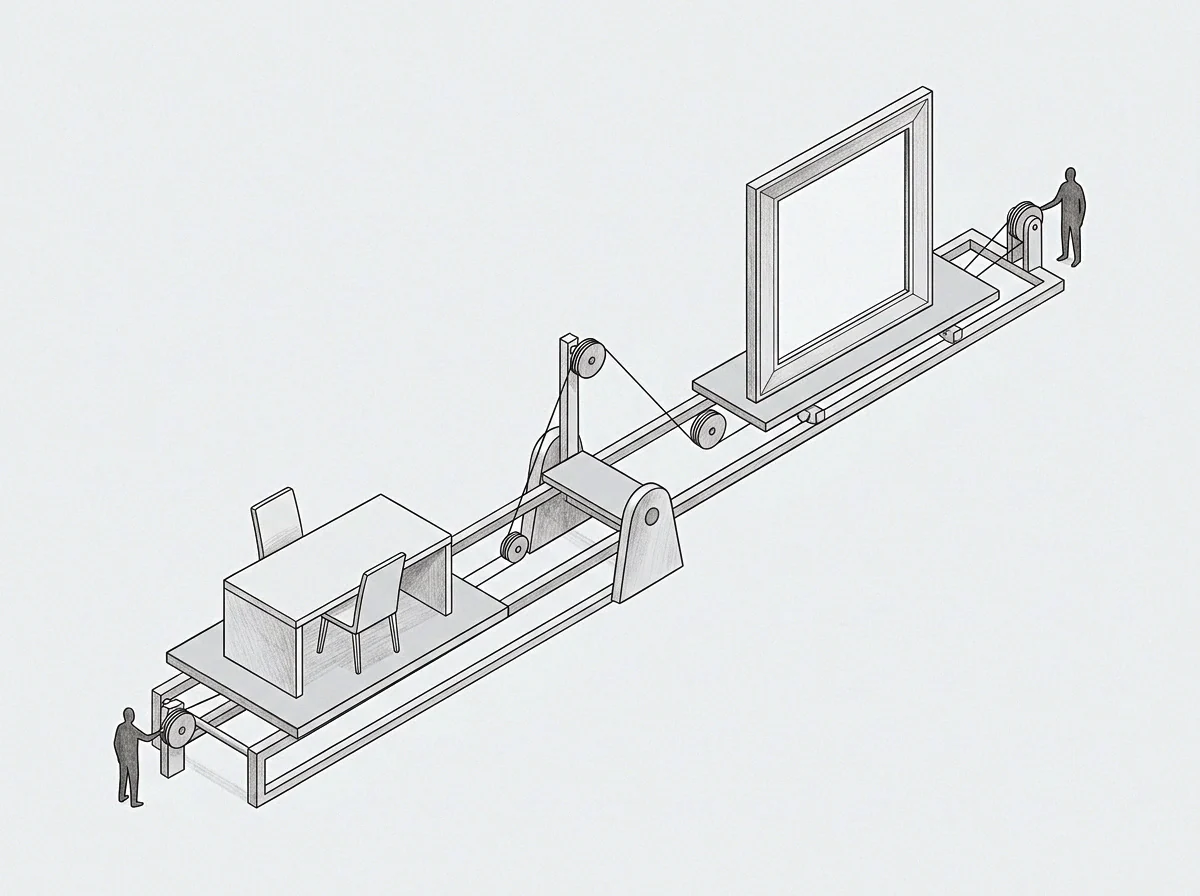
Resolving these discrepancies defines the working boundary of the vehicle state model, beyond which sits physical elastic deformation where rigid-body assumptions fail and joints yield under torque. In marine vessels, offshore drill strings, and heavy industrial cranes, the distance between two telemetry instruments varies continuously under operational load. The estimation model reaches its limit when mechanical flexure exceeds the magnitude of the static spatial offset.
Residual Parity And Structural Boundaries
Engineers working on telemetry systems often discover that increasing the algorithmic complexity of a rigid-body estimator yields diminishing returns once chassis compliance dominates the signal path. A cross-disciplinary parallel appears in civil infrastructure monitoring, where long-span suspension bridges undergo thermal expansion and wind loading that continuously warp the baseline geometry between reference strain gauges. Structural deflection must be recognized as dynamic geometry rather than sensor malfunction.
When discrepancies climb along unexcited degrees of freedom, the system reaches the edge of its descriptive capacity. Resolving local reference frame offsets succeeds completely when instruments sit upon rigid mountings, but it demands structural elasticity modeling the instant operational loads deform the baseline between the sensor and the datum.
Rotational maneuvers reveal geometric offsets that static calibrations leave hidden.