Meaning
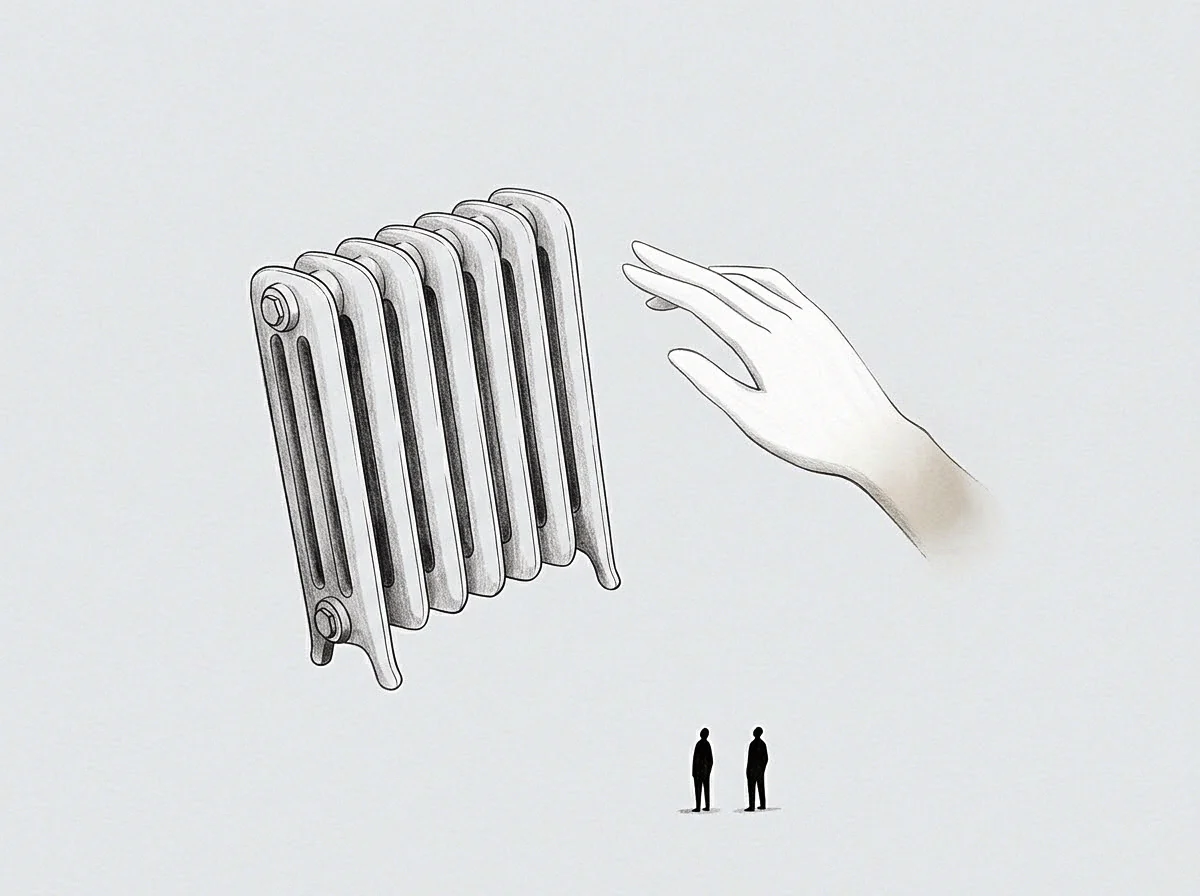
Systematic observational divergence occurs when an instrumented transducer captures environmental or mechanical readings that deviate consistently from true bulk process conditions due to physical location within non-uniform fields. Industrial monitoring installations evaluate sensor placement bias to correct for localized microclimates, wall effects, convective eddies and thermal radiation interference. The metric occupies a cardinal scale expressed in physical units of delta, representing the offset between local probe values and volumetric bulk averages.
Quantification relies on multipoint array sampling or numerical simulation cross-referenced against stationary sensor data. The concept stops applying in perfectly mixed isotropic environments where spatial measurement gradients equal zero.
Spatial Gradient
Geometric boundary conditions create steep environmental variations across fluid conduits and reaction vessels. Fluid flowing through a pipe exhibits a parabolic velocity profile, meaning a pitot tube positioned near the pipe wall produces severe sensor placement bias by measuring retarded boundary flows rather than core velocity. Thermal sensors mounted near external casings encounter ambient heat loss, reporting lower process fluid temperatures than exist in the uncooled pipe center.
Wake turbulence behind structural supports causes pressure sensors to register artificially suppressed static pressures. Accurate process modelling requires mapping these gradients across the entire cross-sectional plane.
Sampling Error
Localized dead zones and recirculation eddies create false signals that do not reflect bulk thermodynamic reality. Uncorrected sensor placement bias causes control loops to adjust fuel valves or cooling circuits based on localized anomalies rather than true system states. Overcorrection follows, destabilizing operating loops and inducing process oscillations.
Multi-element sensor rakes resolve this issue by averaging measurements across diverse spatial coordinates.
Calibration Correction
Computational correction algorithms adjust single-point transducer readings using empirical transfer functions. Understanding sensor placement bias allows operators to reconstruct bulk parameters mathematically without redesigning internal pipe routing. Mathematical adjustments lose validity when process flow regimes shift from turbulent to laminar conditions.