
Mathematical Vector Mechanics for Resolving Multi Layer Operational Divergence
Operational divergence is resolved by calculating cross-layer vector transformations and applying gradient realignment to friction coordinates.

Axis
An executive allocation team sets a direction vector in three-dimensional state space with coordinates for capital expenditure, system throughput, and product feature deployment. Simultaneously, an infrastructure engineering unit moves along a trajectory rotated forty-five degrees away, spending velocity on technical debt mitigation and platform stabilization. Neither team observes a formal breakdown in communications.
Dashboard metrics record steady activity, hours are fully billed, and quarterly objectives receive surface compliance. Operational divergence manifests as the geometric distance between these two trajectories over time. The divergence rate equals the vector difference between the intentional trajectory specified by governance and the actual trajectory executed by operational units.
Operational layers operate within distinct coordinate systems. Governance operates in a strategic space defined by financial return, market positioning, and capital efficiency. Middle operational management translates these vectors into tactical allocation spaces bounded by resource utilization, team bandwidth, and quarter-by-quarter deliverables.
Execution layers work inside technical or logistical spaces where the primary axes represent ticket resolution times, code reliability, material throughput, and operational safety. Divergence occurs when transformation matrices between these coordinate spaces introduce rotational tilt or scale distortion.
Operational divergence accelerates when governance matrices project objectives onto non-orthogonal tactical sub-spaces.
When an executive vector demands rapid customer acquisition speed without allocating capacity for system scalability, the execution vector cannot mirror the intended direction. The physical laws of the technical state space force the execution trajectory to decay along a path of least resistance. That path preserves baseline operational stability at the expense of strategic intent.
The magnitude of this divergence expands as a function of time and resource expenditure.

Multi Layer Coordinate Spaces in Operational Systems
Mapping operational state spaces demands establishing explicit, quantifiable value axes. Each layer in an enterprise maintains an independent coordinate baseline based on its primary constraints.
- Governance Baselines carry vectors defined by financial yield, market share growth, and regulatory risk boundaries.
- Tactical Baselines project directional energy across resource scheduling, cross-departmental throughput, and milestone completion velocity.
- Execution Baselines track direct physical or digital outputs including unit production cost, continuous uptime, and defect rates.
A vector defined at the governance layer undergoes transformation as it passes downward through tactical and execution layers. If the transformation matrix contains uncalibrated scaling factors, the execution layer receives an altered instruction vector. Vector length represents allocated resource magnitude.
Vector direction represents operational intent. Misalignment between intended and transformed vectors creates continuous operational friction.
Measurement of cross-layer vector alignment demands projecting execution outputs back onto governance coordinate axes. When the dot product of the governance vector and the projected execution vector falls below unity, operational energy is lost to internal friction. The missing magnitude represents unspent operational potential or wasted structural effort.

Defining Strategic and Tactical Direction Vectors
Strategic direction vectors establish the intended trajectory of the system over extended time horizons. Tactical vectors execute local adjustments intended to keep the system on that trajectory. Divergence occurs when local tactical vectors prioritize local slope minimization over global objective alignment.
A localized operational team optimizes its immediate working slope, steering away from difficult cross-departmental integration tasks. The local system finds a local minimum. Strategic objectives remain unfulfilled on the broader horizon.
This structural misalignment leaves open the fundamental question of whether asymmetric operational state vectors can ever maintain permanent alignment without constant, energy-intensive coordinate remapping across every layer.

Drift
Directional gradient variance measures how rapidly an operational vector deviates from its baseline path across consecutive operational cycles. When a project steering group specifies a multi-month product rollout, the initial direction vector points directly toward market delivery. As execution proceeds, unmeasured technical constraints introduce lateral force vectors.
These lateral forces alter the net trajectory. Each operational cycle compounds this directional offset, producing state drift.
Systems route energy around areas of elevated operational resistance. A wall of administrative overhead or technical complexity redirects active work toward easier paths. Avoidance acts as a coordinate marker.
The precise location where operational work bends away from the designated trajectory marks the exact position of unprocessed system friction. The magnitude of the deflection corresponds directly to the internal cost of pressing through that friction.
The magnitude of system avoidance directly bounds the latent technical debt accumulated behind operational friction.
Ignoring state drift leads to structural divergence across functional units. The executive layer assumes execution follows the original strategic vector. Meanwhile, execution teams build parallel systems to bypass operational bottlenecks.
The two layers operate in separate reality fields, linked only by aggregated performance reports that mask directional skew. The true cost of this divergence surfaces when cross-functional integration fails during high-load operational events.

Quantifying Directional Gradient Variance Across Operational Layers
Gradient variance reflects the difference in slope between intended strategic progress and actual execution speed. Tracking this variance demands calculating the directional derivative of operational value along the trajectory path. A steep negative slope indicates rapid value erosion caused by systemic inefficiency or misaligned resource allocation.
Operational drift degrades capacity. The system spends force maintaining lateral adjustments rather than advancing along the core value axis. Resource consumption rises while effective output drops.

Avoidance Coordinates and Unprocessed System Friction
Mapping operational avoidance requires identifying recurring procedural workarounds. Operational teams routinely invent informal mechanisms to bypass dysfunctional sign-off chains, inadequate tooling, or conflicting directives. These workarounds mark high-friction boundaries within the organizational state space.
Every workaround consumes extra operational energy. The system compensates for structural friction by increasing labor expenditure. Bypassing a broken validation step requires manual cross-checking.
Bypassing an inadequate software service requires manual data transformation. These extra steps form an unrecorded operational load that consumes baseline capacity.
Systemic drift stabilizes only when management intervenes directly on the underlying operational gradient, treating local operational workarounds as precise diagnostic markers rather than mere policy violations.

Grid
Evaluating multi-layer operational vectors demands a unified mathematical matrix comparing alignment mechanisms, coordinate systems, and resource costs across organizational tiers. Systems operating without continuous matrix transformation suffer from structural distortion, where strategic priorities translate into contradictory execution mandates.
The matrix below outlines four standard alignment mechanisms utilized across governance, tactical, and execution layers. Each mechanism imposes specific computational and operational energy costs while generating distinct failure modes when misapplied.
| Alignment Mechanism | Primary Vector Layer | Operational Coordinate System | Computational Energy Cost | Misalignment Consequence |
|---|---|---|---|---|
| Linear Projection Mapping | Governance to Tactical | Capital Expenditure vs Delivery Time | Low initial expenditure, high drift rate | Rotational skew in tactical priorities |
| Gradient Descent Adjustment | Tactical to Execution | Resource Allocation vs Friction Slope | Moderate continuous monitoring load | Local minima trapping without strategic oversight |
| Orthogonal Vector Realignment | Execution to Infrastructure | Technical Capacity vs Throughput | High short-term operational disruption | Systemic freeze under rigid boundary conditions |
| Feedback Loop Calibration | Cross-Layer Integration | State Vector Delta vs Time Window | Continuous medium-level oversight cost | High-frequency oscillations from delayed metrics |
Selecting an alignment mechanism demands assessing the structural flexibility of the target layer. Applying rigid linear projection to fluid execution environments creates severe rotational skew. Conversely, relying solely on local gradient descent causes operational teams to settle into inefficient local minima, completely missing global strategic objectives.

How Does Vector Realignment Alter Local Resource Slopes?
Realignment forces recalculation of local gradient slopes across every operational unit. Injecting a corrective vector into a tactical layer alters the path of least resistance. Work routines that previously minimized effort now face elevated friction thresholds, forcing teams to adopt new operational trajectories.
Systematic realignment requires shifting resource distribution along calculated ascent gradients. Capital, engineering hours, and operational focus must flow directly toward points of maximum friction reduction. This targeted force application changes the local operational potential, enabling execution teams to move in alignment with global goals without increasing total labor expenditure.
Linear projection matrices distort operational realities whenever execution constraints violate the independence of strategic basis vectors.

Projection Matrices across Strategic and Execution Layers
Projection matrices translate multidimensional strategic intent into lower-dimensional execution tasks. A multi-faceted strategic initiative involving market expansion, technical modernization, and organizational restructuring must be flattened into daily action items for front-line teams. Information loss occurs during this dimensionality reduction.
When the projection matrix fails to preserve key vector relationships, critical dependencies vanish from execution planning. The execution layer optimizes for the visible, projected coordinates while inadvertently destroying value along unmeasured dimensions. Preserving geometric fidelity across layer boundaries requires carefully calibrated transformation matrices that explicitly account for operational constraints.
Misapplying linear projection matrices to non-linear operational friction generates structural failure, forcing peripheral teams into unrecorded workarounds that further distort operational metrics.
Joint
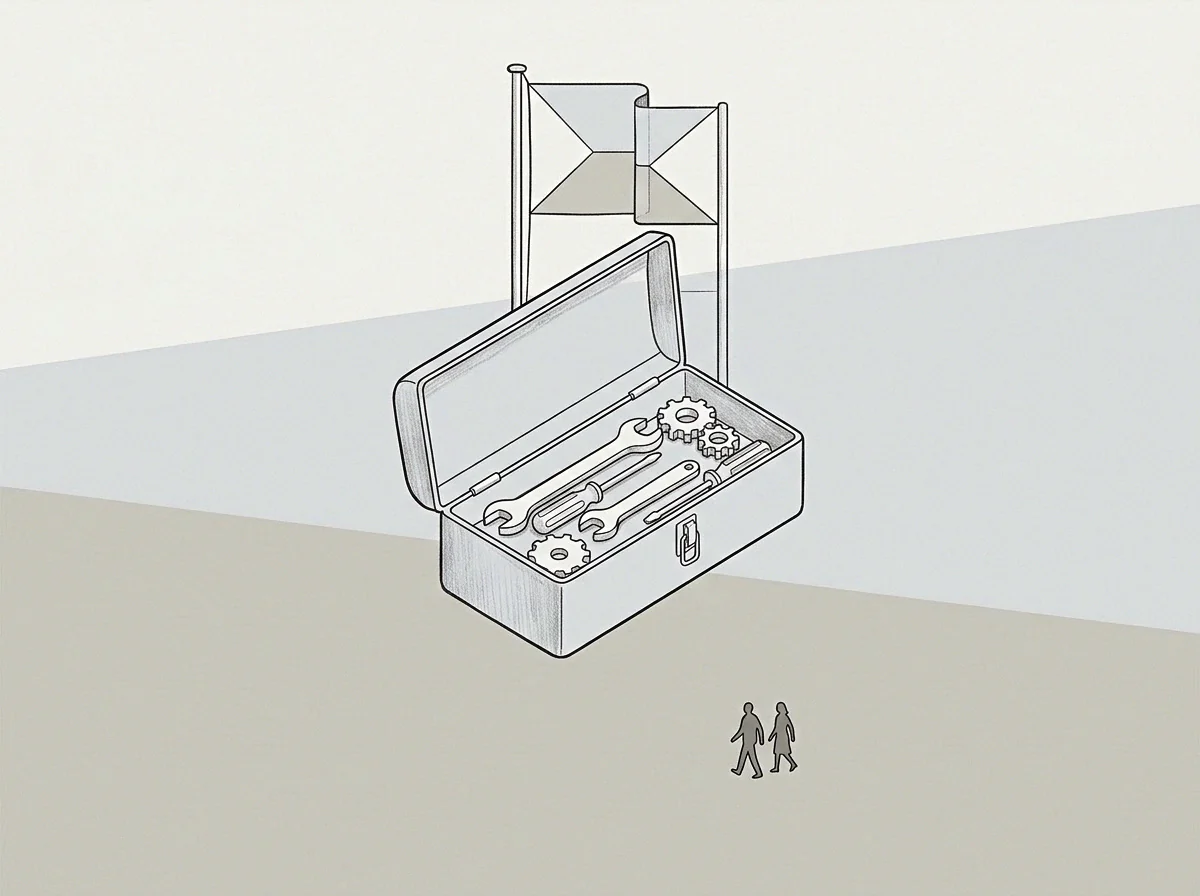
Vector resolution mechanics restore alignment by applying corrective forces at structural operational junctions. Consider an enterprise unit operating across three distinct functional tiers under fixed quarterly delivery goals. The executive layer issues an instruction vector calling for a sixty percent increase in platform feature output.
The tactical management layer translates this mandate into accelerated sprint schedules. The execution layer, bound by legacy platform constraints, cannot sustain the required output rate without exceeding safety parameters.
Applying uncalibrated force to force execution along the original vector accelerates systemic degradation. System defect rates increase, infrastructure stability drops, and key technical personnel face burnout. Vector resolution mechanics resolve this divergence by recalculating the achievable trajectory matrix, factoring in real execution boundaries and friction gradients.
Corrective intervention begins by measuring the scalar product of the strategic mandate and actual system capacity. Where divergence exceeds structural tolerance, a secondary resolution vector must be introduced to absorb lateral friction and stabilize output quality.

Gradient Ascent and Corrective Force Application
Realizing structural realignment requires navigating complex operational ascent gradients. Moving a system out of an inefficient local minimum demands driving it up a steep slope of elevated resistance. This process requires deliberate, sustained energy input.
Operational ascent requires clear sequence structure to prevent resource exhaustion during realignment phases.
- Establish baseline value axes across governance and execution units.
- Compute directional derivatives for local resource allocations.
- Apply targeted vector offsets at points of maximum cross-layer shear.
- Measure residual vector divergence to verify alignment convergence.
Executing this sequence ensures that corrective force aligns precisely with the path of maximum value restoration. Unfocused interventions dissipate energy across non-critical operational channels without shifting the baseline system trajectory.
Gradient ascent along operational value slopes demands continuous measurement of directional derivatives across every active layer.

State Realignment in Multi Tiered Systems
Multi-tiered system realignment depends on synchronized force application. Correcting execution alignment while leaving tactical incentives unchanged creates immediate structural relapse. Tactical managers continue driving execution along old paths because their internal performance metrics reward local efficiency over global alignment.
Effective realignment requires altering incentive vectors at the tactical layer simultaneously with technical adjustments at the execution layer. Aligning performance metrics with the rectified global vector eliminates internal cross-currents that drive operational state drift.
Realignment effort expended at the governance layer changes nothing on the shop floor while the local resource gradient continues to favor routine workaround maintenance over systemic retooling.
Ceiling
Mathematical vector resolution operates within hard physical constraints set by organizational capacity, time limits, and cognitive bandwidth. Every operational system possesses a maximum capacity ceiling beyond which vector alignment mechanics yield diminishing returns. Pressing an operational unit past its structural threshold introduces non-linear system turbulence, destroying alignment faster than corrective mechanics can restore it.
Discomfort serves as a precise signal during alignment operations. It measures computational load during active trajectory shifts. When an organization modifies its operational vectors, established routines break down, requiring intentional cognitive processing from management and execution personnel.
This operational friction signals active model adaptation rather than structural failure.

Structural Constraints and Model Boundaries
Operational models fail when extended beyond their valid boundary domain. A linear vector model assuming constant resource availability breaks down during market contraction or talent turnover. Attempting to enforce exact vector mathematical paths under severe resource constraints destabilizes the operating core.
Boundary surveying maps these non-computable limits. Identifying structural capacity ceilings allows leadership to establish realistic vector boundaries, preventing system overload and operational breakdown.

Unspent Latent Capacity and Non Computable Operational Friction
Behind every operational avoidance path lies unspent latent capacity. When teams divert energy around systemic friction, that misdirected energy represents latent potential that could be harnessed under correct alignment. Mirroring the negative gradient above the operational baseline reveals the exact volume of unspent capacity locked within inefficient routines.
Capturing this latent volume demands systematic removal of structural friction points. Rather than forcing personnel to work harder along misaligned vectors, systemic re-engineering flattens the friction gradient, enabling operational energy to flow naturally along the target strategic trajectory.
Enforcing exact vector orthogonality across operational units freezes cross-functional capacity whenever local variance exceeds the designed error threshold.