Meaning
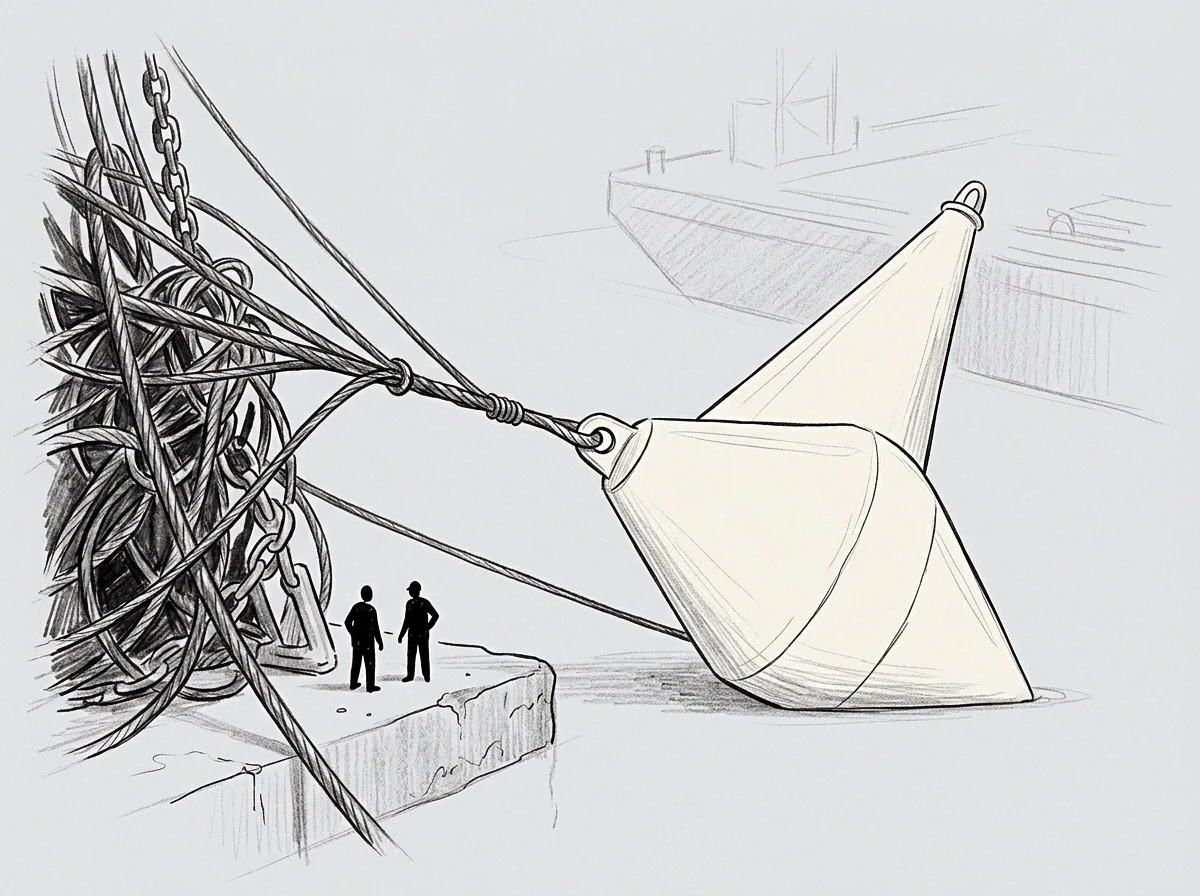
Strategic targets exhibiting structural interdependence represent directional vectors whose achievement trajectories mutually distort or constrain one another. Within formal organizational planning, non-orthogonal objectives quantify the extent to which progress along one defined vector forces an involuntary compromise or displacement along another. The condition stops applying when targets occupy entirely isolated operational spaces that do not draw upon common constraints or shared resource pools.
Interference Mechanics
Directional vectors rarely exist in pure structural isolation. Committing capital toward extreme speed in product development inevitably introduces drag on near-term balance sheet stability, proving these targets operate as non-orthogonal objectives. When the mathematical inner product of two strategic mandates yields a non-zero value, advancing one metric modifies the velocity of the second.
Misidentifying coupled goals as independent targets generates perpetual managerial friction. Resource allocation becomes a continuous exercise in hidden trade offs.
Frictional Drag
Strategic incoherence compounds when executive teams evaluate operational performance as though targets were distinct variables. Pursuing two non-orthogonal objectives simultaneously forces front-line operators to arbitrate unacknowledged trade offs without explicit systemic backing. Four common failure modes recur under these conditions, including covert resource redirection, conflicting public metrics, depleted operator stamina and degraded operational quality.
The lack of clean dimensional separation creates organizational paralysis.
Vector Orthogonalization
Clean separation of execution horizons decouples conflicting targets into manageable sequential stages. Resolving non-orthogonal objectives demands explicit priority ranking, translating simultaneous trade offs into disciplined chronological milestones. One target serves as an uncompromised constraint while the second functions as a secondary optimization metric.
Structural clarity eliminates hidden friction across competing organizational units.