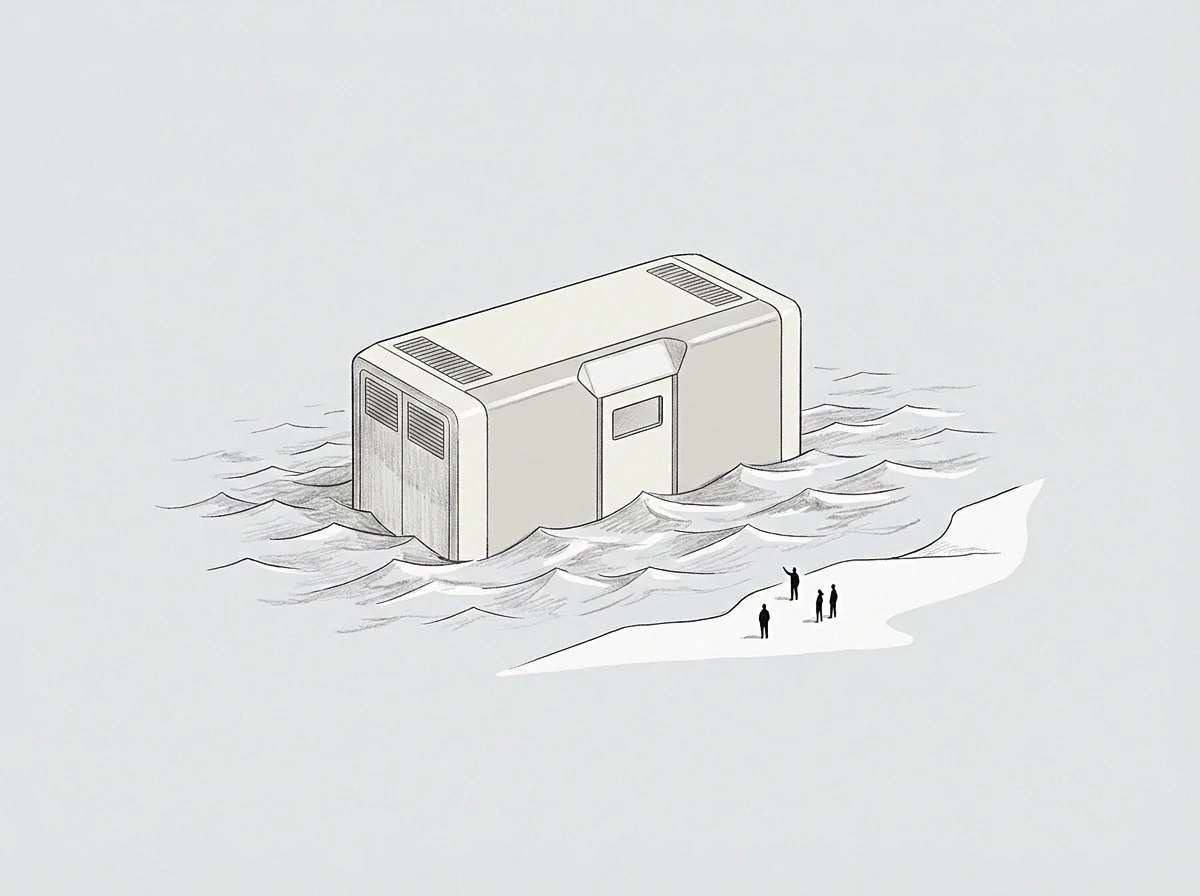
Meaning
Optimization trajectory exiting a zero-gradient stationary point with mixed positive and negative curvature directions restores functional progress on non-convex operational landscapes. Multi-variable operational modeling uses saddle point escape to describe the deliberate operational realignment that moves an organization away from stagnant equilibrium states where marginal progress has halted across some dimensions while remaining unstable across others. The measurement occupies a multi-dimensional state space quantified by eigenvalues of the local Hessian matrix and directional gradient norms.
It governs decision loops addressing enterprise stagnation, strategic indecision and product-market deadlocks. The mechanism becomes irrelevant in globally convex optimization environments where every stationary point represents a true global optimum.
Perturbation Mechanism
Stagnation at saddle points occurs when operational gradients drop to zero while the underlying cost surface remains unstable. To initiate saddle point escape, an organization must introduce directional perturbations across capital deployment, resource distribution or operational structure. Calculating the negative eigenvalues of the local Hessian reveals the exact operational vector that slopes downward toward superior performance regimes.
Aligning organizational adjustments directly with this negative curvature vector allows rapid exit from the stagnant plateau. Without deliberate structural shifts, teams often remain locked in low-efficiency stationary configurations for extended operational intervals. Perturbations must exceed noise thresholds to successfully exit the stationary plateau.
Eigenvalue Geometry
Mathematical analysis of stagnant operational states exposes contrasting internal vectors. Some parameter adjustments produce instant operational resistance, characterized by positive local eigenvalues, while others offer unobstructed paths to improved margins through negative eigenvalues. Mapping these mixed curvature parameters clarifies why generalized resource increases fail to generate operational movement.
Precision realignment along verified descending vectors guarantees an exit from the plateau without wasting organizational energy.
Convex Flattening
Highly commoditized operational environments with purely convex economics cannot support saddle geometry. When marginal costs scale monotonically across all operational inputs, saddle point escape ceases to operate as an analytical category. Across complex enterprise systems, the ability to escape saddle points provides the primary mechanism for breaking prolonged strategic deadlocks.