
Measuring Long Term Capability Loss Against Immediate Solvency Demands In Capital Starved Enterprises
Solvency drains technical capability by forcing cardinal cash trades that permanently destroy unpriced, ordinal operational capacity.

Load

Payroll Deadlines And The Liquidation Of Method
The bank account balance drops below the upcoming Friday payroll obligation, forcing an immediate reallocation of engineer hours toward bespoke customer customisation invoices. A software enterprise with three months of operational reserves routinely halts internal product architecture development to build manual export scripts for a single paying sponsor. Cash arrives within forty-eight hours to clear the wire transfers.
The product repository absorbs five thousand lines of unmaintainable procedural routines that degrade subsequent release cycles for six quarters. Immediate solvency operates as a cardinal demand denominated in currency units with fixed collection dates, whereas technical competence resides on an ordinal scale of coordinated problem solving capacity. Treating these two quantities as convertible on a flat exchange rate obscures the structural attrition taking place in the enterprise.
Capital starvation alters the operational setpoint of an enterprise by narrowing the temporal horizon to the next disbursement batch. When liquidation pressures mount, leadership views every latent asset through its near-term monetary liquidation yield. Experienced senior builders get assigned to basic customer onboarding triage because onboarding fees bill out immediately.
The cardinal price received covers office lease payments and cloud server minimums. Meanwhile, the unrecorded internal cost accrues in depleted engineering momentum, deferred technical maintenance, and team attrition.
A solvency crisis forces cardinal cash trades that permanently consume unpriced, ordinal operational capability.
Every allocation of enterprise capacity under severe capital constraints represents a multi-attribute cost vector containing distinct components. These components include currency spent or collected, developer hours consumed, cognitive attention drained, and organizational capacity permanently surrendered. When an enterprise trades developer hours for immediate service billings, the currency component shows a positive inflow.
The capacity and attention components register severe negative magnitudes that do not reflect on statutory financial statements.
The consequence of treating immediate cash inflows as an unencumbered recovery is the rapid transformation of a high-leverage product organization into a low-margin bespoke consultancy incapable of returning to its original industrial mandate.

Gear
Attrition Of Tooling And Organizational Muscle
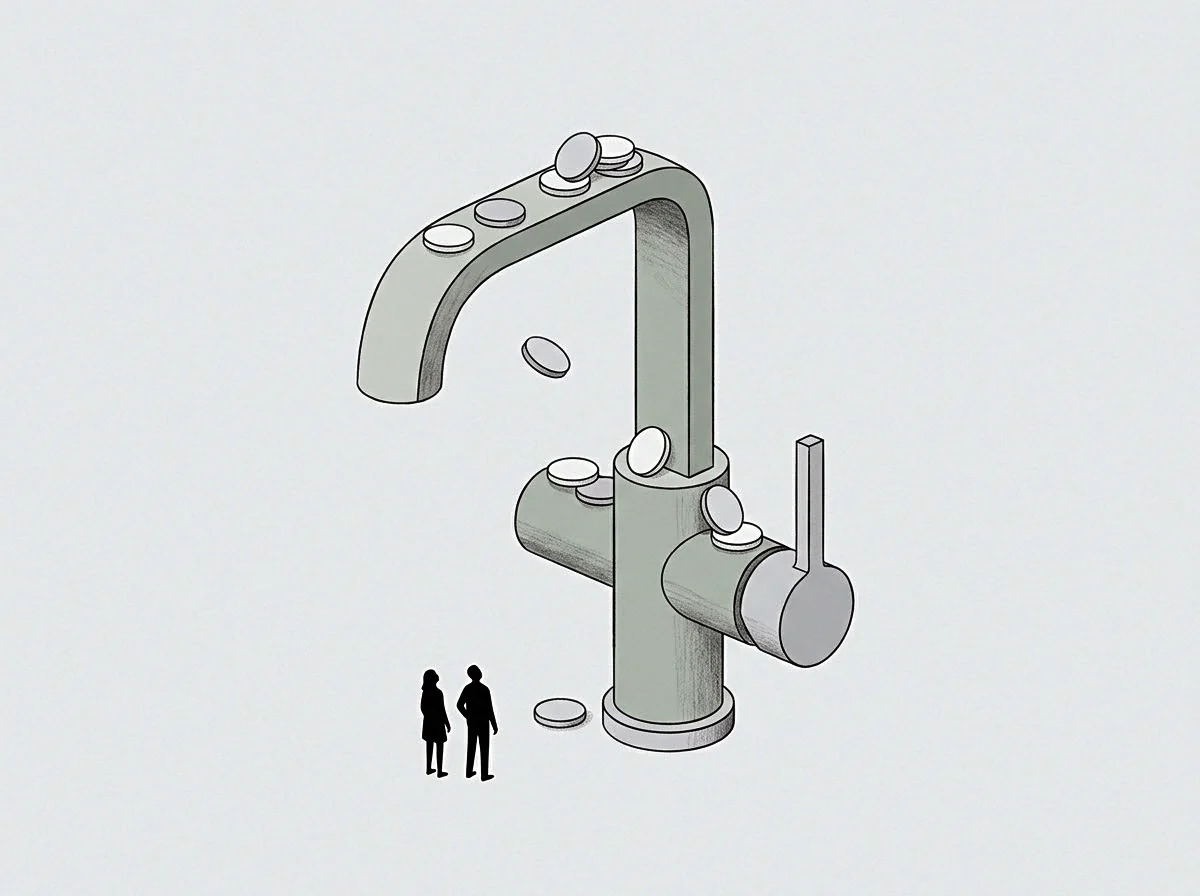
Machinery, internal tooling, and specialized workflow habits decay when maintenance budgets reach zero. An industrial fabricator facing short-term liquidity deficits defers preventative maintenance on high-precision numerical control lathes to conserve six thousand dollars of quarterly lubricant and calibration spend. The machines continue spinning metal for three additional months, clearing backlog orders and securing critical receivables.
By month four, spindle tolerances drift by three hundredths of a millimeter, ruining one out of every five complex parts produced. The cardinal savings of six thousand dollars creates an ordinal descent in fabrication reliability that closes out defense subcontracts permanently.
Postponed infrastructure upgrades exert an identical mechanical toll inside digital enterprises. A distributed systems team freezes internal platform automation refactoring to preserve operational runway during protracted financing rounds. Senior engineers spend fifteen hours every week manually rebooting dropped connections and patching corrupted database indexes to avoid paying for commercial managed infrastructure.
The cardinal cash burn slows by eight thousand dollars per month. The actual cost registers as three hundred hours of expert attention diverted into operational janitorial duties, followed by the resignation of two principal systems architects.
| Short-Term Action | Cardinal Cash Yield | Ordinal Capability Cost | Reversibility Index |
|---|---|---|---|
| Bespoke client feature detour | Immediate service billing | Core architecture roadmap frozen | Moderate friction to resume |
| Senior engineer triage assignment | Avoided technical support hire | Research and tooling stalled | High team attrition risk |
| Deferred database infrastructure update | Reduced cloud hosting expense | Data corruption and manual patches | Compound technical debt |
| Precision equipment maintenance freeze | Conserved operating liquidity | Physical machine tolerance decay | Irreversible component wear |
Enterprise competence does not reside in documented procedural binders. Competence sits in the neuromuscular habits of the operating staff, the finely tuned calibration of physical gears, and the automated test harnesses built over years of unbroken attention. Liquidating these routines to harvest transient cash reserves leaves behind an empty shell of legal entities and office desks.
Let capital dry up completely, and the shop floor retains its tools while losing the human judgment that once made those tools productive.
Price

What Survives A Payroll Liquidation?
When an enterprise attempts to communicate its internal operational stress to external financiers, internal ordinal degradation converts poorly into cardinal figures. A founder sitting across from a secondary lender can state the exact cardinal interest rate of twenty-four percent required to service bridge notes. That same founder cannot translate the exact loss of systemic problem-solving velocity into an audited spreadsheet cell.
External capital markets price money, physical real estate, and secured accounts receivable with standard cardinal metrics. They systematically discount the unpriced ordinal vector of technical capability that deteriorates during the transaction.
The communication barrier between internal capability and external balance sheets forces destructive transactions during recapitalizations. Consider an enterprise with twelve engineers developing proprietary automated inspection hardware, facing thirty days of cash runway. A corporate acquirer tenders an offer to purchase the existing customer book and inventory while terminating the advanced development division.
The purchase price satisfies senior creditors and clears bank debt in full. The cardinal ledger registers complete solvency recovery, yet the primary technological capacity of the organization is liquidated to zero.
When internal degradation leaves the enterprise, its ordinal cost converts into an artificially discounted cardinal price.
The translation of internal technical competence into external commercial currency always extracts a steep discount. Internal capacity possesses compounding properties that disappear the moment an asset gets pulled from its native working environment:
- Tacit operational cohesion dissolves when team members scatter into disconnected contract assignments.
- Proprietary hardware calibration protocols lose all productive utility without the original technicians who adjusted the sensors.
- Continuous deployment discipline collapses into unmaintainable software branches once automated regression testing ceases.
- Customer problem domain mastery degrades into generic sales scripts when direct developer interaction ends.
The external counterparty evaluates the purchased assets as isolated components, pricing them at liquidation recovery values rather than compounding industrial engines. The enterprise accepts the cardinal liquidation price because legal solvency demands cash settlement, leaving the long-term technical value abandoned in the transaction room.
If the intellectual property transfer agreement stipulates immediate release of all unpatented operational notes, the acquirer absorbs the blueprints while the living capability to iterate on those blueprints vanishes.
Scale

Ordinal Vectors Against Single Numbers
Measurement theory defines an ordinal scale as an arrangement of states along a consistent direction without uniform distance between ranks. Cardinal scales, conversely, possess stable intervals and support standard mathematical addition and division. Cash reserves, weekly burn rates, debt maturities, and payroll obligations exist strictly on cardinal scales.
Technical velocity, architectural resilience, operational focus, and team cohesion exist on ordinal scales. Attempting to balance a cardinal cash shortfall by running simple arithmetic against ordinal capability creates severe analytical errors.
An operator cannot run an optimization equation where cardinal currency sits on the left side and ordinal engineering capacity sits on the right. When cash drops by fifty thousand dollars, the enterprise does not drop fifty thousand dollars of capability. It shifts from rank-order operational capability state A, where the group invents novel technology, down to state D, where the group barely maintains legacy database connections.
State D cannot be multiplied by an integer to recover state A. Operational capacity behaves as a discontinuous vector containing hours, attention, and technical context.
Assume an enterprise burns forty thousand dollars monthly and holds eighty thousand dollars in reserve, granting sixty days of survival. Leadership contracts out two senior software architects at three hundred dollars per hour to an external enterprise to generate thirty thousand dollars in monthly gross margin. Cash burn drops from forty thousand dollars to ten thousand dollars per month, extending runway to eight months on paper.
The cardinal calculation demonstrates a fourfold expansion of organizational lifespan. The ordinal reality shows the architects spending fifty hours per week immersed in external codebases, destroying internal architectural development entirely. The internal project does not advance slowly; it stops.
Protecting the cardinal balance sheet at the expense of unmeasured ordinal vectors produces an enterprise that survives only as an empty administrative shell.
Every operational intervention in a starving business requires decomposing the vector into its genuine constituents rather than defaulting to gross financial aggregates. The operator monitors the hours vector to verify whether core builders retain unfragmented blocks of creative focus. The operator tracks the capacity vector to ensure internal tooling remains functional under production loads.
When leadership reduces organizational survival to cardinal runway metrics, the enterprise frequently runs out of core technical competence months before it runs out of cash.
The client paying the consulting invoice will simply tell you that they purchased three hundred hours of professional engineering services and expect the deliverables completed on schedule.

Room
Preserving Minimum Operating Space
Surviving capital starvation without destroying long-term technical competence requires establishing uncompromised operational space. The enterprise separates its activities into two isolated zones: a containment zone designed to harvest survival currency, and a protected zone dedicated to preserving core capability. Mixing these activities within the same seats guarantees that immediate cardinal solvency demands consume all remaining ordinal focus.
An engineer cannot context-switch between twenty-minute emergency support tickets and deep algorithmic optimization without losing the continuous thread of attention required for difficult problem solving.
A physical machine shop facing debt collection handles this division by dedicating one manual milling machine exclusively to cash-on-delivery repair jobs, while keeping its advanced multi-axis prototype setup undisturbed. Digital enterprises implement this separation by assigning a single rotating operator to handle custom client requests while the remaining technical staff proceeds on primary platform development behind an administrative barrier. The enterprise willingly accepts slower collection cycles or smaller client contracts to prevent commercial interruptions from invading the core development space.
The cost of this defensive separation is stark and immediate. The enterprise turns down high-paying service contracts that demand bespoke modifications across the entire technical architecture. Choosing survival through capability preservation often requires operating on razor-thin cash cushions that keep the business within days of financial failure.
The operator acknowledges that running out of money ends the enterprise, but liquidating the core capability vector hollows out the enterprise prior to the closing of the ledger.
Keep the core technical apparatus separated from transactional cash extraction, and the enterprise retains its capacity to compound value the moment capital constraints loosen.