
Quantifying Background Cognitive Overhead in Retainer Pricing Models
Retainer pricing models fail when cardinal fees suppress ordinal cognitive costs, creating unbilled background overhead that displaces internal capacity.

Leak
An incoming notification at four in the afternoon on a Friday consumes working focus long before any execution occurs. A request sent via instant message demands immediate triage, forcing an operator to evaluate urgency, scan active project status, and determine whether action can wait until Monday. The actual response may take forty seconds to write.
The background awareness triggered by that interaction lingers for hours, fragmenting mental bandwidth and maintaining an open loop across the weekend. Open loops drain operational capacity.
Retainer agreements frequently price explicit output while giving away implicit awareness. A client paying a flat monthly fee for advisory services or engineering maintenance often assumes that background availability comes attached to the contract. The firm delivering the service absorbs the operational noise of continuous monitoring without reflecting that load on any invoice.
The resulting imbalance erodes technical effectiveness far faster than direct billable work.

Components of Unbilled Background Attention
Retainer contracts routinely ignore the cognitive work involved in maintaining readiness. When a team remains responsible for a domain, members carry that domain in working memory even during quiet periods. This operational tax manifests across distinct channels:
- Asynchronous Availability Pressure creates continuous monitoring habits, forcing engineers or strategists to check incoming message queues at irregular intervals throughout the workday.
- Context Memory Maintenance forces professionals to keep structural details, past decisions, and active client environments stored in active mental caches rather than clearing them after project milestones.
- Micro-Interrupt Accumulation fragments long uninterrupted focus blocks into shallow work segments, sharply reducing the capacity for complex problem solving.
A monthly retainer that buys total availability for a fixed fee converts all strategic focus into reactive monitoring.
The cost of this mental retention expands as client accounts multiply. Managing three retainers simultaneously does not merely triple the background tracking load; it creates an intersecting web of priorities that elevates baseline operational stress. Context switching destroys deep focus.
Each transition between client domains leaves an attention residue that degrades performance on the subsequent task. When retainer pricing covers only direct advisory hours, the provider subsidizes the client’s operational peace of mind by depleting internal technical reserves.
“The agreement pays for twelve hours of advisory work each month, so sending a quick question across a chat channel should draw no extra bill.”

Scale
Evaluating operational expenditure demands a clear distinction between distinct modes of measurement. Financial accounting relies on cardinal figures, where dollars are additive, uniform, and precisely countable. Human attention operates along an ordinal scale, where open loops, context switches, and readiness stress can be ranked in severity but cannot be summed into neat numerical totals.
Ordinal costs defy simple averages.
A retainer pricing model that converts client accessibility into a flat monthly cardinal figure assumes a linear relationship between hours spent and resource exhaustion. Ten hours spent writing code during a scheduled window imposes one level of operational friction. The same ten hours spent answering sporadic questions across a two-week period imposes a vastly higher operational cost.
Cardinal prices compress multi-dimensional vectors.
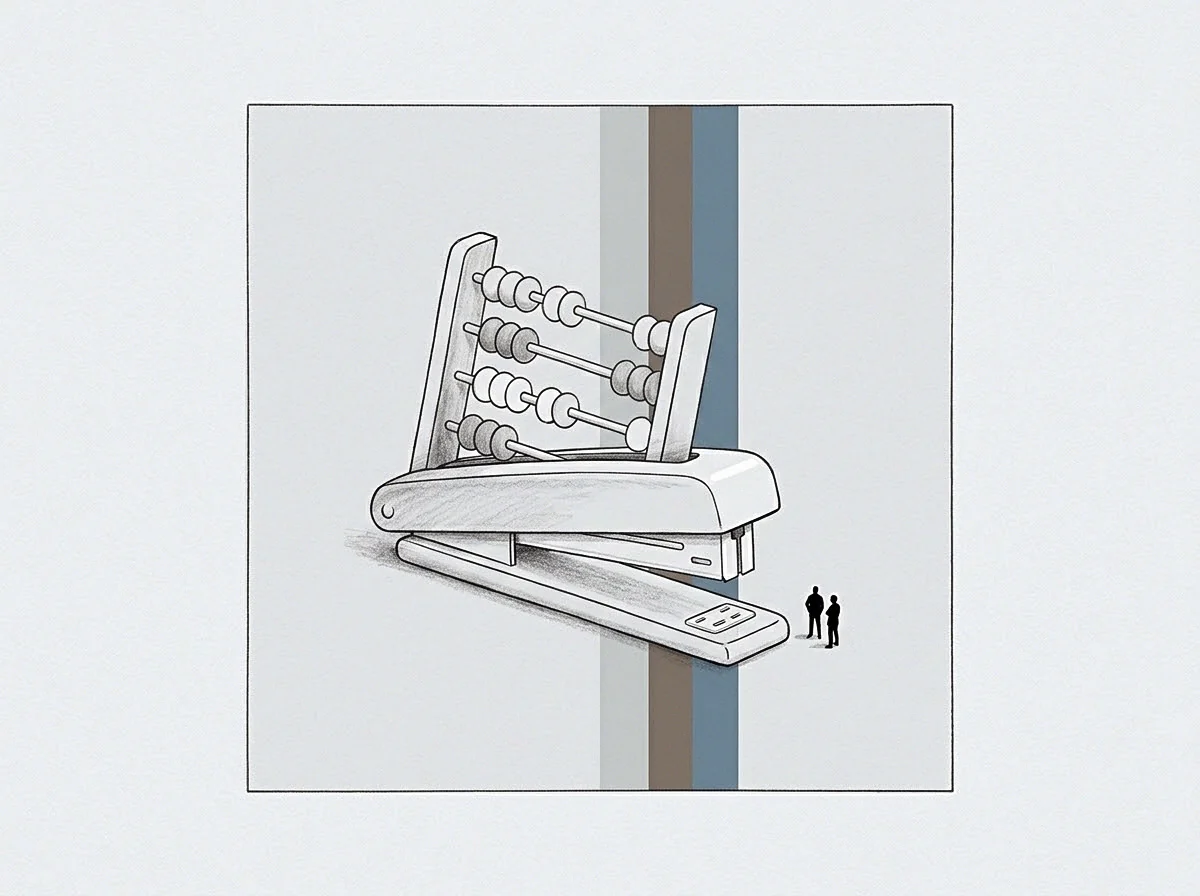
Converting Ordinal Burden to Cardinal Pricing
Internal capacity loss accumulates along qualitative axes that resist simple mathematical addition. A decision to maintain continuous client readiness introduces several distinct cost vectors simultaneously:
The first vector involves direct hours consumed in execution. The second vector measures attention fragmentation, calculated by the frequency of context switches required during a standard workday. The third vector tracks capacity displacement, representing the strategic projects deferred because key personnel must remain available for urgent triage.
Availability carries a heavy price.
When cognitive load increases along an ordinal vector, forcing that cost into a flat cardinal fee compresses operational capacity until delivery fails.
Pricing models that collapse these distinct vectors into a single hourly rate or flat monthly retainer obscure the true cost of client service. The cardinal price on the invoice remains static while the ordinal cost vector rises. Over time, the provider experiences margin compression that does not register on conventional time tracking software.
Reactive work displaces long-term development. The firm continues to meet contractual deliverables, yet its internal capacity to build new assets or innovate operational workflows steadily degrades.
Absorbing unstructured client awareness within a fixed financial fee depletes the internal energy needed to build high-margin capabilities, leaving the firm stuck in operational stagnation.

Table
Different commercial arrangements impose dramatically variable demands on internal focus. Evaluating pricing models requires analyzing how explicit service expectations map directly to background attention consumption and internal capacity loss.

Retainer Pricing Models Compared Against Attention Drain
A structured evaluation highlights how specific client expectations degrade technical focus. The operational load varies dramatically depending on whether accessibility is explicit, bounded, or continuous.
| Retainer Archetype | Response Latency Expectation | Open Loop Overhead | Capacity Displacement |
|---|---|---|---|
| Unstructured Access | Under 1 hour | Severe continuous tracking | High strategic displacement |
| Scoped Hours Baseline | Same business day | Moderate active monitoring | Moderate strategic displacement |
| Windowed Advisory | 48-hour scheduled slots | Low localized tracking | Minimal strategic displacement |
| Asynchronous Milestone | 72-hour batched response | Negligible open loops | Zero strategic displacement |
The unstructured access model creates the highest level of background noise while returning the lowest margin per unit of focus. Clients operating under short response latency expectations treat the provider as an internal employee, sending incomplete thoughts and expecting real-time collaboration. Unstructured access creates immediate noise.
This dynamic destroys the provider’s internal schedule, forcing engineers and consultants to work in fragmented bursts between incoming client inquiries.
Transitioning toward windowed advisory or batched asynchronous communication restructures the operational vector. Latency expectations dictate cognitive load. By enforcing a minimum forty-eight-hour window for non-emergency inquiries, the firm eliminates the requirement for continuous queue monitoring.
Staff members clear client context entirely between designated advisory blocks, restoring uninterrupted focus for core development.
Inserting a mandatory twenty-four-hour response latency clause shifts the burden of urgent triage back to the client, preserving operational focus for execution.

Margin
Unused mental bandwidth carries a hidden price tag that steadily reduces total productivity. When a firm commits reserved capacity to a retainer client, it surrenders the flexibility to deploy those technical resources elsewhere. Setpoints drift toward continuous monitoring.
This reservation of capacity creates a structural setpoint shift. The organization establishes an operational baseline designed around constant readiness rather than deep production. As a consequence, internal standards for uninterrupted execution drop.
Team members adjust their output expectations downward, accommodating the inevitable interruptions built into the client relationship.

How Does Reserved Capacity Consume Operational Attention?
Holding open operational slots for potential client requests prevents deep concentration on primary deliverables. Reserved capacity limits deep execution. The loss occurs through three distinct operational mechanisms:
First, decision fatigue accumulates as staff continuously evaluate incoming queries against existing priorities. Second, domain ownership tax forces leads to maintain active familiarity with client infrastructure, attending status meetings and reviewing updates for projects that may never launch. Third, opportunity cost mounts as high-value internal R&D or fixed-fee product development gets pushed aside to maintain the availability buffer.
Reserved capacity that sits unbilled creates more operational friction than active project execution.
The financial return on a retainer may appear acceptable when measured purely against active execution hours. When measured against total capacity consumption, the real profit margin often turns negative. The firm trades high-value strategic optionality for low-margin financial predictability.
Over several quarters, this trade manifests as technical stagnation, rising staff burnout, and an inability to execute larger strategic initiatives.
The remaining operational problem is whether an organization can measure background awareness accurately before setting an annual pricing baseline.

Anchor
Protecting internal working capacity demands concrete commercial provisions. Retainer agreements establish clear parameters for availability and response times to keep background cognitive overhead inside acceptable bounds.
A firm can protect its technical bandwidth by converting implicit availability into explicit contractual terms. These provisions establish structural barriers that protect team focus without compromising client satisfaction.

Contract Terms for Preserving Technical Capacity
Contractual limits protect technical focus. Converting background cognitive load into cardinal financial models requires enforcing clear operational boundaries:
- Establish explicit communication windows that cluster client interactions into dedicated hours.
- Enforce minimum response latency thresholds to prevent real-time notification monitoring.
- Define strict boundaries for background domain tracking in the master agreement.
A contractual surcharge on real-time messaging latency protects operational focus by forcing asynchronous query batching.
Batching queries restores internal focus. Implementing structural surcharges for emergency access or real-time messaging channels changes client behavior instantly. When real-time access carries a distinct financial premium, clients naturally consolidate their questions into batched asynchronous updates.
The firm regains control over its operational schedule, protecting its technical capacity while maintaining predictable retainer revenue.
Pricing structural availability rather than billable execution hours prevents background focus from eroding internal capacity.