
Technical Capability Degradation From Equity Heavy Compensation Packages
Substituting unvested equity for cash wages rewards risk avoidance over technical mastery, causing active engineering skills to degrade across multi-year cycles.

Wedge
A technical lead sits before an architectural dispute and chooses the path of minimum friction. The production infrastructure runs on deprecated libraries, database write locks accumulate during peak traffic, and the ingestion pipeline drops records during traffic spikes. Resolving the debt demands thirty consecutive nights of refactoring and immediate career risk if the cutover breaks billing.
That engineer holds an option package that vests quarterly over four years, priced during a high valuation round. Liquid cash represents sixty percent of market compensation, while paper equity represents the rest. The math of the seat dictates inaction.
Stepping forward exposes the grant to operational failure, while letting the architecture rot preserves the vesting schedule.
Payroll models in young technology firms frequently replace liquid compensation with future paper ownership. This substitution alters the operating priorities of an engineering department. Cash compensation pays for current output, contemporary problem solving, and immediate delivery of working software.
Illiquid ownership awards turn the employee into a passive asset holder whose primary financial incentive is the preservation of company valuation rather than active engineering excellence. The engineer begins to think like an illiquid minority shareholder. Bold architectural interventions threaten enterprise stability, and enterprise stability protects paper wealth.
A compensation split that substitutes illiquid equity for current cash turns an active builder into a passive asset protector.
Staffing outcomes reflect the risk appetite of candidates who agree to defer financial compensation. Highly proficient builders with marketable proficiencies command immediate cash premiums in competitive labor markets. Engineers who accept below-market cash packages paired with large equity allocations often fall into two camps: early-career developers with unproven skills, or tenured professionals seeking an unchallenging position to vest unexercised grants.
The compensation design acts as a self-reinforcing recruitment filter. Over twenty-four months, the engineering department accumulates staff whose financial well-being depends on tenure rather than technical velocity.
The operational cost lands on technical execution. The team preserves stability on paper while the software deteriorates beneath it.
When an organization substitutes illiquid paper for competitive cash, it systematically selects for individuals who prioritize asset retention over technical execution, leaving the core systems vulnerable to sudden operational failure.

Seat
A developer in the thirty-sixth month of an initial award protects their calendar from disruptive refactoring. The codebase contains modules that no active employee understands, yet nobody proposes replacing them. Rebuilding those modules requires deep concentration, extensive integration testing, and the distinct possibility of introducing regressions that surface during quarterly executive reviews.
The equity grant creates a holding pattern. The individual stays in the chair to collect stock awards while deliberately minimizing technical output that could invite scrutiny.
Employment duration aligns with scheduled stock distributions rather than technical milestones. Golden handcuffs in software organizations produce an environment of protective stagnation. The incentive structure rewards presence over performance.
An engineer who stays four years without shipping major initiatives receives the exact same stock distribution as one who rewrites the storage engine and doubles throughput. Rational actors respond to this payoff structure by reducing their expenditure of personal energy. They attend standups, review low-risk pull requests, and decline ownership of unmapped components.
The dynamic produces specific behavioral shifts across the technical roster:
- Scope Avoidance manifests through the systemic rejection of ambiguous architectural assignments that lack clear executive backing.
- Consensus Engineering replaces individual technical initiative with prolonged committee debates that dilute personal accountability for failures.
- Tooling Indifference establishes a pattern where engineers tolerate antiquated development workflows because upgrading them creates uncompensated delivery friction.
- Ticket Padding expands minor bug investigations into multi-week tasks that satisfy surface activity metrics without improving system durability.
The tenure clock kept running. System modifications carry uncompensated downside for individuals holding substantial illiquid paper. In public technology companies, researchers have documented that retention schedules driven by deferred equity produce measurable declines in patent output and code commits among senior individual contributors.
The finding rests on corporate patent filings and version control commit logs evaluated across tenured technology firms during public market expansions. The finding would shift if comparable datasets from contracting markets demonstrated that unvested grants motivated developers to undertake risky architectural upgrades to maintain firm viability. Present evidence indicates that unvested stock paper acts as an insurance policy that workers protect through caution.
A vesting schedule without performance gates turns technical seats into waiting rooms.
The senior engineer declined the rewrite. The cost landed on capacity.
The project can wait six months until the next tranche clears, because taking down production right now risks the entire equity position.

Wear
Hands-on software craft decays through disuse when production pressures subside into maintenance routines. Software development is an athletic proficiency. Maintaining high competency requires regular immersion in production incidents, complex system debugging, and the implementation of clean abstractions under tight constraints.
When engineers transition into protective postures to safeguard unvested equity, their practical skills experience rapid atrophy. They lose touch with modern toolchains, forget the subtleties of distributed debugging, and retreat into procedural administrative tasks.

Where Does Technical Erosion Surface First?
Code reviews reveal the earliest drop in rigor through accepted workarounds and deferred migrations. Senior contributors stop challenging brittle implementations submitted by junior staff. Approving a mediocre pull request takes four minutes, whereas coaching a junior developer through a clean redesign takes four hours and risks personal friction.
Over several quarters, the engineering bar lowers across the entire group. Technical standards erode quietly from the inside out, long before outages appear on executive status screens.
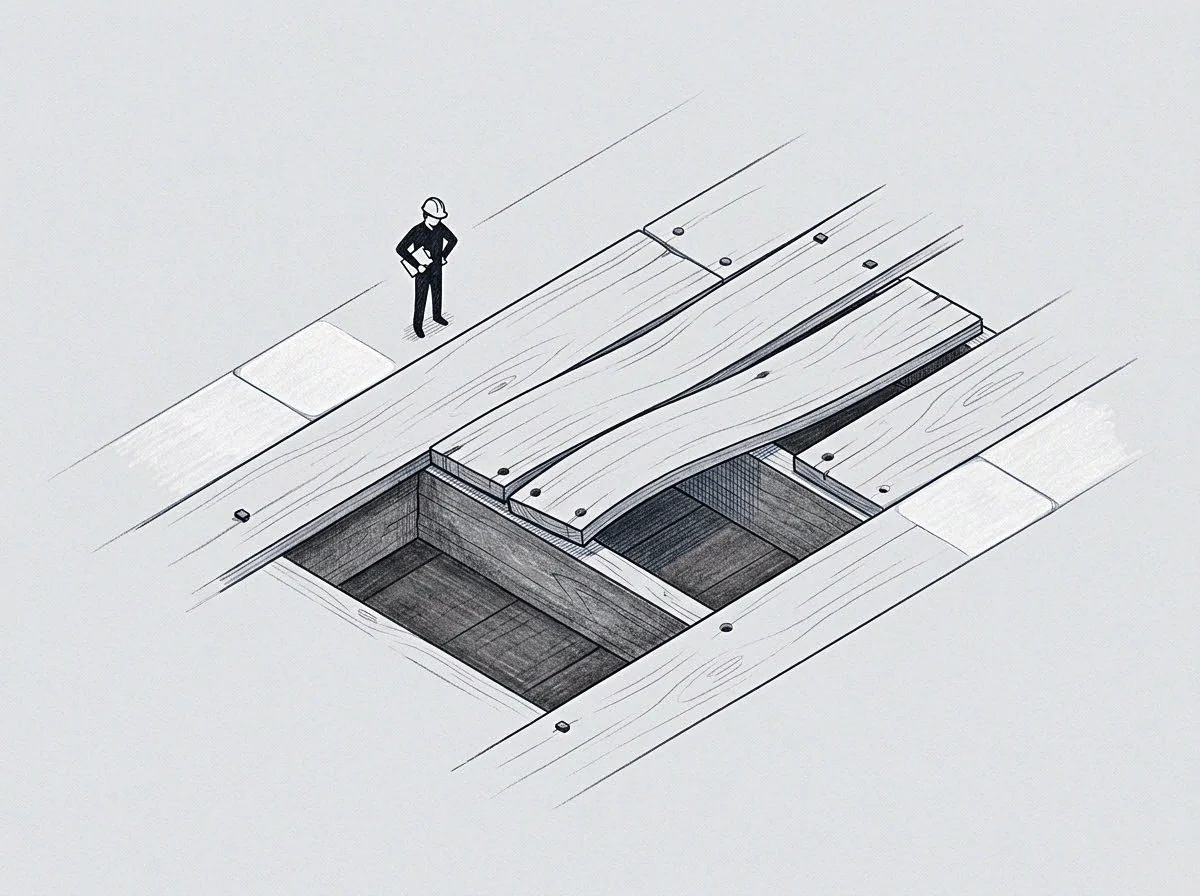
The calculation stayed private. Organizations shift engineering hours toward operational patches rather than greenfield design. Teams spend their workdays reacting to alerts, restarting services, and writing brittle glue scripts to keep legacy applications alive.
This defensive routine creates an illusion of high productivity. Calendars fill with triage meetings and release coordination sessions, while the foundational architecture continues to degrade.
In commercial aviation, pilots who spend years on automated flight paths slowly lose manual stick-and-rudder responsiveness during severe weather. Industrial machinery shows the same progression when operators oversee automated feeds rather than setting tool paths by hand. Software engineers subjected to low-demand holding patterns undergo the same functional degradation.
They lose the instinct for operational risk and the muscle memory required to resolve high-stress production outages.
The pipeline stalled. The cost landed on competence.
An engineer who stops breaking production code eventually forgets how to rebuild it.
Margin
Financial spreadsheets record equity distributions as non-cash compensation expenses with minimal current balance impact. Finance teams treat equity grants as free leverage that conserves working capital while attracting senior candidates. This accounting convention ignores the multi-dimensional cost vector borne by the engineering organization.
True operational expense includes lost velocity, architectural fragility, wasted capacity, and the degradation of collective technical competence. Equity grants convert an explicit cardinal wage into an opaque ordinal cost that compounds over multiple years.

Ordinal Loss Against Cardinal Accounting
Internal operational trade-offs resist simple reduction to corporate ledger entries. Laboratory experiments in multi-attribute decision theory indicate that individuals struggle to calculate trade-offs between liquid immediate rewards and uncertain deferred assets, leading to severe behavioral distortions. This observation relies on controlled decision games conducted with technical specialists.
The conclusion would change if longitudinal empirical field data revealed that engineering teams accurately price option volatility into their daily code contribution decisions. In practice, operators treat paper equity as a lottery ticket, decoupling their daily technical exertion from their long-term financial expectations.
| Evaluation Vector | Cash-Dominant Base Structure | Equity-Heavy Deferred Model |
|---|---|---|
| Primary Candidate Incentive | Market rate cash compensation for immediate delivery | Valuation preservation and scheduled tenure completion |
| Willingness to Refactor Fragile Code | High, driven by continuous performance accountability | Low, driven by personal downside avoidance |
| Skill Evolution Rate | Active adoption of contemporary engineering standards | Stagnation inside proprietary legacy workarounds |
| Attrition Pattern | Underperforming engineers exit via clear standards | Competent engineers leave while passive collectors remain |
| True Organizational Expense | Predictable cardinal cash overhead | Compounding ordinal debt in technical infrastructure |
The architectural risk went untaken. Take an organization splitting twenty developers across two separate operational structures for forty-eight months. Group Alpha receives eighty-five percent of total compensation in cash, with short-term incentives tied to verified system milestones.
Group Beta receives forty percent of total compensation in cash, paired with a massive illiquid stock grant vesting over four years with a one-year cliff.
Group Alpha maintains high production velocity. Members know their employment depends on active technical contribution. They replace outdated services, pay down database technical debt, and keep system documentation accurate.
Group Beta operates defensively. Because the paper grant represents their financial upside, they prioritize tenure over innovation. They delay migrations, avoid taking on unmapped components, and allow their technical skills to rust in place.
At the end of four years, Group Alpha possesses a modern, maintainable system and sharp engineering personnel. Group Beta possesses an unmaintainable legacy system and a roster of developers whose technical proficiencies have fallen years behind the industry frontier.
Cardinal accounting measures the cash saved on payroll while blinding leadership to the ordinal destruction of engineering capacity.
A four-year vesting schedule without explicit technical milestones awards tenure rather than output, guaranteeing the atrophy of active engineering mastery.

Yield
Restoring technical proficiency demands an explicit adjustment to compensation mechanics and milestone definitions. The organization must reconstruct the link between day-to-day engineering output and financial compensation. Relying on massive, multi-year paper grants to subsidize below-market cash pay purchases passive presence at the expense of technical velocity.
Reclaiming operational prowess requires reallocating capital toward competitive cash bases paired with tightly bounded performance rewards.
The team delayed deployment. Leadership resets operational incentives by elevating liquid base pay while contracting grant horizons. Shorter vesting cycles tied to delivered software milestones prevent developers from treating the firm as an illiquid holding company.
The exact monetary threshold where equity dominance shifts from an incentive to an active deterrent of skill development remains unquantified across private technology companies. Under this uncertainty, prudent leadership establishes short review intervals with liquid cash bonuses tied directly to shipping operational infrastructure, minimizing the deadening effect of unvested paper.
Converting unvested option grants into cash bonuses exposes the firm to immediate payroll overhead. That conversion represents an honest price. Paying cash forces leadership to evaluate whether an engineer produces genuine technical output every single month.
Eliminating the fog of paper equity exposes the reality of system health. Competent builders stay because their current contributions receive tangible compensation. Passive asset collectors depart for companies still willing to trade equity for complacency.
A team that pays in current cash demands current competence.
The code remained untouched. The vector pointed downward.
Whether an engineering culture that has normalized passive equity accumulation can ever regain its original building cadence remains an open empirical question.