
Deriving Mechanical Ascent Gradients From Operational Avoidance Patterns
Reversing an operational avoidance vector yields a mechanical ascent gradient whose magnitude equals the computational cost of the unperformed work.
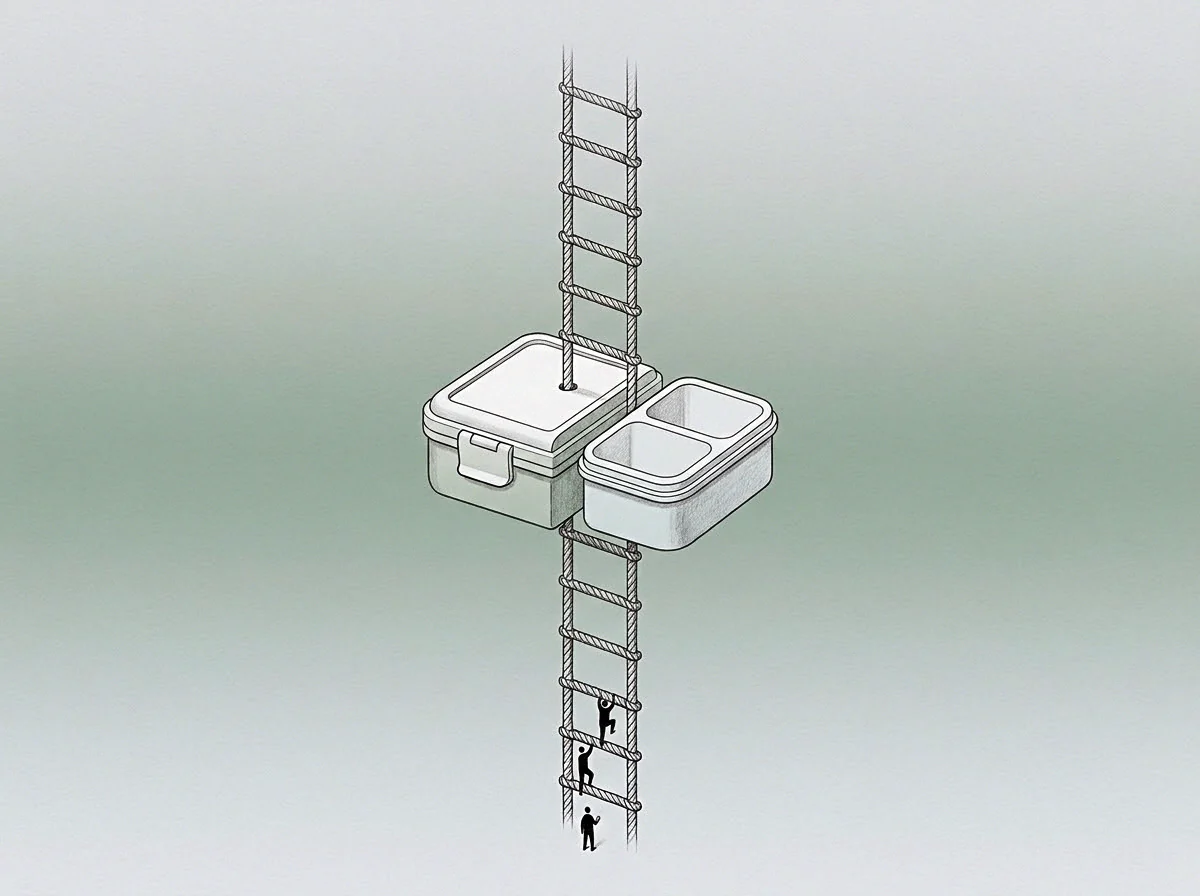
Ledge
A software deployment sits untouched for eleven months while the developer rewrites the surrounding telemetry pipeline four times. The telemetry suite records nineteen distinct metrics on database latency, ingestion throughput, and memory pressure, monitoring an intake pipeline that moves zero commercial volume. The balance sheet reflects the wage drain of four engineers across three calendar quarters, while the ledger records no incident report or formal deferral ticket.
The person directing the codebase describes the pending deployment as awaiting complete automated verification, a delay that traces a clear vector of structural risk.
When an operating system avoids an action, it traces the exact boundary of its existing model. Descent remains the path of least mechanical resistance: water selects a depression in the rock face without calculating hydraulic balance, and a small company functions under the same physics. The organization defaults along slopes that demand minimal real-time computation.
Reaching into uncharted technical debt or terminating a non-performing distribution contract demands substantial attention, nerve, and capital, so the operational loop takes a detour instead, adding automated tests to an already stable subsystem or convening another review on pipeline throughput to preserve immediate organizational equilibrium.
A repeated operational diversion establishes the precise coordinate where the existing operational routine refuses to expend energy.
The avoidance pattern marks a negative slope. In classical optimization, a loss surface maps configuration states against an objective output, with an agent computing the steepest gradient downward to reach minimum friction. Human systems run this same routine automatically.
The avoidance pattern records where the system judged the slope too steep to climb directly; by cataloging the operations an organization circles without touching, an observer maps the topography of the avoided work.
The observer identifies three separate mechanics in this pattern:
- Ordinal task substitution occurs when an operator consistently places low-friction activities ahead of a high-friction mandate despite formal priorities to the contrary, filling the daily calendar with low-stakes administrative maintenance.
- Deflection through instrumentation manifests as an obsession with measurement systems that observe a stalled process without ever intervening in its execution, expanding the data collection layer while the core engine idles.
- Proxy dispute creation routes organizational strain into peripheral debates about protocol or tool selection, avoiding direct confrontation with structural insolvency.
Each mechanic leaves a clear trail: the daily schedule shows the substitution, the monitoring tool displays the deflection, and the issue tracker records the proxy dispute. None of these records require subjective interpretation to show the system choosing the downhill path.
Treating these avoidance coordinates as moral failings destroys their diagnostic utility. The system simply acted on its perceived loss surface, where the detour registers real friction and the ascent gradient is derived by inverting that negative vector.
Deflection
Every systematic diversion creates a measurable shadow. In behavioral control theory, an error signal arises from the discrepancy between a reference setpoint and an observed state. When an executive cannot close that gap through direct execution, they adjust the operational perimeter so that avoidance becomes the setpoint stabilizer, expending real energy to sustain a diversion that functions as a mechanical damper.
Which Coordinate Marks The Inversion Point?
The location appears where the detour intersects the model boundary. Take an engineering firm with twelve staff members that refuses to enter direct commercial renegotiations with its primary client, whose contract sits thirty percent below market rates. Instead of scheduling a pricing review, the firm devotes forty hours weekly to internal workflow refactoring, burning capacity simply to insulate itself from a tense commercial conversation while leaving the pricing untouched.
The firm maintains an operational loop around the client review while refactoring projects consume engineering attention and the team designs abstractions for services that will never scale beyond current utilization. These diversionary architectures trace the exact silhouette of the avoided commercial risk.
Operational avoidance expends substantial energy to protect a broken operational equilibrium.
The inversion point reveals itself when the cumulative maintenance cost of the workaround exceeds the one-time cost of direct confrontation. Up to that threshold, the system stays within the workaround; beyond it, the workaround collapses under its own operational weight. Mapping the vectors of deflection allows an observer to locate this threshold before the collapse occurs.
A structured audit compares the evasive routine against the avoided core task across measurable operational dimensions:
| Operational Dimension | Evasive Operational Routine | Direct Ascent Intervention |
|---|---|---|
| Primary Capacity Drain | Recurring, weekly operational drag through peripheral tasks | High initial expenditure of executive nerve and immediate focus |
| Systemic Visibility | Masked as normal operational governance and maintenance | Isolated as an explicit operational risk event |
| Information Yield | Zero new environmental data; reinforces internal confirmation | Immediate empirical signal regarding external market resistance |
| Long-Term Equilibrium | Fragile; vulnerable to sudden external supply shocks | Resilient; resets the operational baseline at higher capacity |
The table isolates the functional trade-offs. An evasive routine buys short-term calm at the price of recurring systemic drag, whereas direct intervention requires immediate capacity while yielding clean environmental data. A system stuck in avoidance trades future structural resilience for present comfort.
This dynamic operates identically in technical development, commercial pricing, and partnership governance. A team writes extensive documentation to avoid building an intimidating feature, or an owner buys another software license to avoid renegotiating an internal boundary with a co-founder. In each case, the avoided move carries the actual expansion potential of the enterprise.
An operator who misreads deflection will add resources to the workaround, bringing more headcount into the maintenance cycle. The system hardens the detour into standard operating procedure, and real operational capacity decays while the administrative layer reports full process adherence.

Inversion
Deriving the ascent gradient requires taking the vector of lowest resistance and rotating its heading by one hundred and eighty degrees. Just as inverting a descent vector in mathematics yields the trajectory of steepest ascent, the operational ascent gradient points directly toward accumulated organizational debt and core friction, climbing back up the surface the system slid down.
Consider two partners running an enterprise logistics service. For eighteen months, both founders spent four hours every Monday auditing manual warehouse discrepancies caused by a broken database integration installed by an early employee who remains a close personal acquaintance. Fixing the integration requires replacing the employee or confronting their technical limitations, but neither partner touches the conversation.
Balancing the tables by hand every week across seventy-eight consecutive Monday audits has become their descent path.
The audit consumes three hundred and twelve hours of partner attention annually, capacity permanently locked in an administrative detour. The ascent vector is mechanical: terminate the manual audit, unseat the legacy contractor, and rewrite the integration module. The magnitude of that ascent vector equals the three hundred and twelve hours currently burned to protect the avoidance.
Latent potential equals the unspent volume trapped inside the workaround. If an operation expends twenty percent of its gross capacity running detours, that twenty percent represents an immediate mechanical gradient upon inversion, functioning as unspent volume waiting behind an artificial dam.
Inverting an avoidance vector converts recurring maintenance friction into directional mechanical work.
The operator executes the inversion by applying a sequential translation:
- Boundary identification isolates the exact condition triggering deflection across repeated operational cycles, revealing where the current organizational model terminates.
- Energy tallying records the total ordinal capacity consumed by defensive maintenance across a fixed window, quantifying the scale of available latent volume.
- Vector negation constructs an operational mandate aimed directly at the avoided condition while stripping all proxy tasks to eliminate the detour.
- Setplate reconfiguration establishes a hard operational limit prohibiting secondary compensatory mechanisms, forcing the system to either solve the direct friction or halt.
This translation sequence strips away the comfort of the detour and forces the system to compute the new state directly. The resulting operational discomfort represents computational load rather than system failure; the nervous system simply registers the ascent as friction because it demands novel energy expenditure.
The contract clause states clearly that failure to deliver API access within five business days constitutes a material breach, voiding the exclusivity provision entirely.
Fulcrum
Every operational ascent gradient eventually terminates at a hard mechanical limit: the boundary of the existing model. Beyond it lies territory the current architecture cannot compute without fundamental restructuring. Reversing an avoidance pattern inevitably brings an operator to this structural interface, where the work shifts from clearing deferred debt to designing new capability.
Discomfort marks the transition from automatic retrieval to real-time calculation. An evasive routine operates entirely on retrieved habits that require little real-time thought, but turning toward the ascent gradient causes retrieval to fail. The team must calculate each step from basic principles, creating an instant spike in cognitive and operational resistance that serves as a diagnostic gauge for the rate of new structural learning.
Opinion in the field divides over whether every avoidance pattern contains latent potential. One view holds that avoidance always conceals high-leverage capacity that requires only the resolve to invert the vector. The opposing view notes that some avoidances represent sensible structural refusal: a small firm avoids bidding on sovereign defense contracts because it lacks the legal capitalization to survive regulatory exposure.
Inverting that avoidance produces immediate structural collapse rather than an ascent gradient, making it essential to distinguish between friction avoidance and existential capacity limits.
This distinction rests on reference-class calibration. If similar market operations regularly execute the avoided task at reasonable cost, the avoidance marks uncomputed friction. If no comparable operation can survive the task without bespoke capital structures, it marks a genuine systemic boundary.
Inverting a boundary without the requisite structural mass yields failure, while inverting a friction vector yields explosive mechanical progress.
A software team can rewrite a stalled data engine because similar teams execute that work routinely, just as a firm can renegotiate an asymmetrical commercial contract because commercial peers maintain balanced margins. Fear of relational tension or technical complexity represents friction rather than a structural limit, and the unspent volume remains accessible on the other side of that conversation.
The operational move remains straightforward: identify the route the system circles, measure the hours, capital, and attention burned to sustain its perimeter, invert the vector, strip the proxy work entirely, and direct the reclaimed volume straight up the slope toward the center of the avoided work.
Whether an avoidance pattern reflects temporary hesitation or accurate structural self-preservation remains unresolved until the system actually presses its weight against the boundary.