
Resolving Structural Capacity Atrophy When Enterprise Procurement Enforces Unlimited Review Windows
Enterprise procurement review stalls erode engineering capacity by holding operational resources captive without financial compensation.

Desk
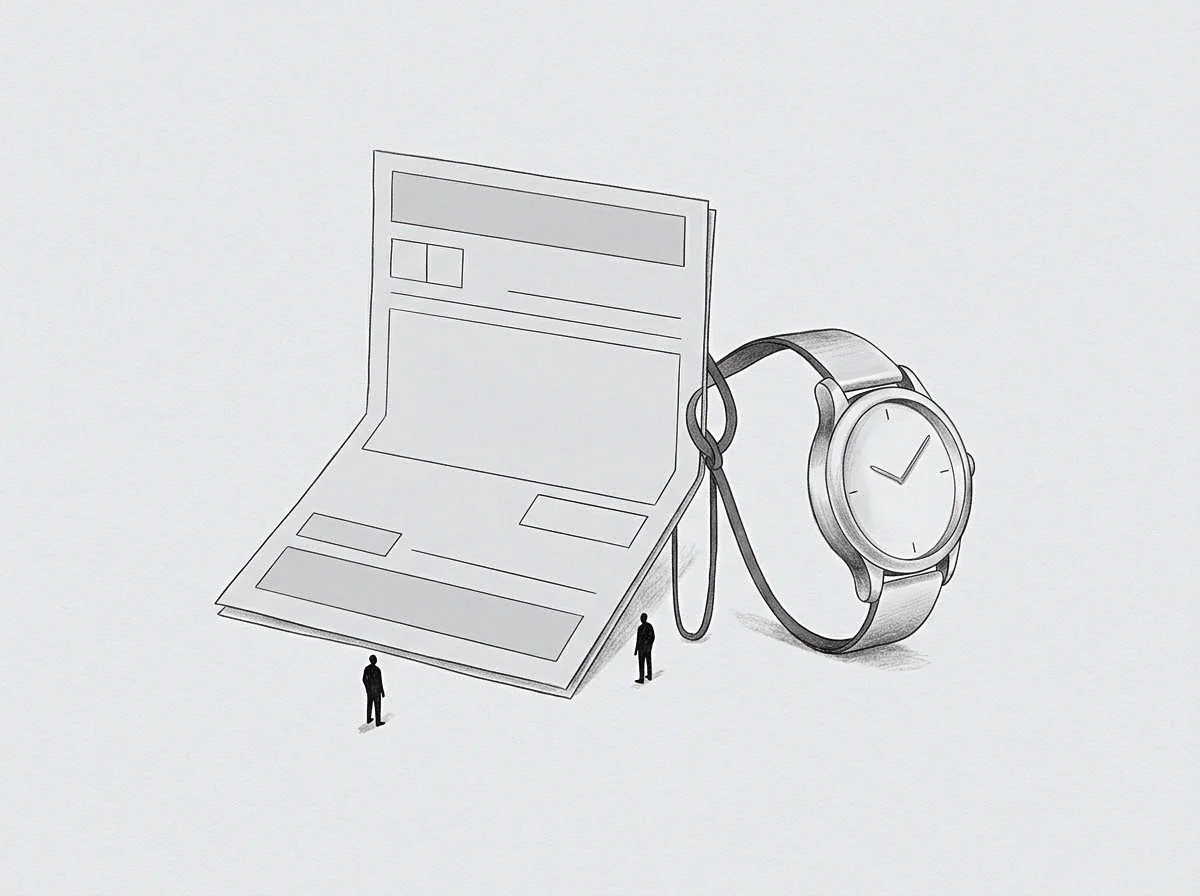
An enterprise procurement officer delivers a service contract containing open-ended review windows, requiring four layers of internal sign-off before a milestone releases. The delivery team completes the initial phase on schedule, submits the work product, and pauses execution to await approval. Days turn into weeks while corporate stakeholders evaluate minor revisions, hold asynchronous internal debates, or reprioritize departmental focus.
The contract stays frozen. During this period, senior engineers remain tied to the account because the client may respond at any moment demanding immediate iterations. The vendor cannot safely reassign these personnel to revenue-generating accounts without risking project delay upon the buyer’s eventual response.
Standing operational capacity deteriorates rapidly under un-capped approval periods. While the contract sits idle in procurement review, payroll obligations, software licensing overhead, and core administrative costs continue uninterrupted. The primary financial metric of the project degrades daily because fixed overhead consumes the eventual milestone payout.
Context vanishes rapidly. Engineers familiar with the codebase lose momentum, forcing expensive re-boarding cycles whenever the buyer provides feedback. The vendor absorbs the hidden toll of standing availability while the client experiences zero financial consequence for delaying sign-off.
An un-capped approval window converts committed delivery teams into uncompensated standing reservation units.
Operational friction intensifies as the review period stretches into months. Enterprise buyers often treat vendor capacity as a free option, assuming that contractual delivery dates remain binding on the vendor regardless of how long internal evaluation takes. Delay eats capacity.
When corporate procurement isolates evaluation timelines from financial penalties, project teams suffer structural capacity atrophy. Key staff members become unmotivated by prolonged downtime, leading to higher turnover among senior specialists. The loss of specialized institutional knowledge further compounds the cost of resuming work once approval finally arrives.
“The sign-off remains with compliance, and the project squad will receive an update once legal clears the second pass.”
Vector
Decomposing the operational damage of un-capped evaluation windows involves examining cost as a multi-component quantity. Money lost represents only one element of the overall expenditure. When enterprise procurement holds project approvals in suspense, the total burden expands across several distinct dimensions: billable hours lost, attention capital drained, domain context degraded, and strategic capability foregone.
Viewing this drain through a single accounting metric obscures the compounding nature of operational decay.
Every extended review cycle imposes specific components of operational consumption on the vendor team:
- Context switching overhead represents the cognitive focus consumed when technical staff pause primary delivery tasks to handle fragmented, intermittent buyer inquiries during review periods.
- Attention drift magnitude measures the gradual loss of deep work focus across senior personnel who monitor dormant communication channels for client sign-offs.
- Uncompensated availability commitment captures the fiscal value of locked capacity that cannot be deployed to secondary contracts due to contractual availability guarantees.
- Capability growth stagnation tracks the loss of skill development opportunities suffered by technical specialists forced into administrative holding patterns.
Internal operational losses operate on an ordinal scale, where various forms of overhead register through relative severity rather than immediate cash balances. Attention turns toward secondary tasks. The client views the transaction purely through a cardinal figure: the agreed milestone price.
This disconnect allows enterprise buyers to capture internal vendor value without recording an expense on their own ledger. Silence costs energy. Converting ordinal internal loss into cardinal financial price requires explicit contractual mechanisms that assign a monetary rate to client delay.
Costs accumulate behind the scene. When a vendor accepts un-capped evaluation timelines, the opportunity cost of reserved capacity rises exponentially relative to the fixed price of the contract. The ability to innovate, pursue new enterprise accounts, or refine internal product tooling vanishes while resources remain tied to inactive projects.
Measuring capacity atrophy as a vector enables management to identify the precise moment when holding open availability for a slow enterprise buyer turns an otherwise profitable project into a net loss.
Unbounded review schedules convert soft client delay into hard operational losses, burdening the seller with uncompensated capacity debt and eroded domain context.

Bench
Who Bears The Internal Expense Of Enterprise Delay?
When delivery staff remain tied to stalled accounts, internal resource distribution breaks down across the entire firm. Management faces a difficult operational choice: keep senior personnel on standby at full cost, or reassign them to active client streams and accept the risk of client friction when the review finishes. Senior engineers wait on approval.
Reassigning staff leads to rapid onboarding friction when the buyer returns unexpectedly with short turnaround demands. Retaining staff on standby, conversely, burns operational capital without generating progress toward the next milestone payment.
Scope drifts during idle periods. The following table illustrates the structural trade-offs between operating under an unlimited enterprise review model versus enforcing a capped review window with capacity reservation terms:
| Allocation Variable | Unlimited Review Model | Capped Window Model |
|---|---|---|
| Resource Allocation Status | Held in uncompensated standby | Reassigned or billed via reservation fees |
| Financial Overhead Liability | Absorbed entirely by the vendor | Transferred to the buyer upon window expiration |
| Team Context Preservation | Degrades over prolonged downtime | Protected through predictable delivery cycles |
| Project Schedule Control | Dictated by buyer procurement speed | Governed by fixed contractual milestones |
Operating under un-capped review windows creates an asymmetric risk profile that heavily favors the buyer. The buyer gains the flexibility to review deliverables at an unhurried pace, cross-reference work product across multiple internal divisions, and delay milestone disbursements. The team holds the line.
The vendor absorbs the financial burden of standing payroll, administrative maintenance, and delayed cash flow. Over time, recurring enterprise delays drain vendor liquidity and erode operating margins across the entire client portfolio.
A strict ten day review window forces procurement to choose between automatic milestone sign-off and explicit scope re-estimation.
To offset this vulnerability, growing vendors establish baseline utilization standards for dedicated project benches. When client delays cause bench utilization to drop below economic baselines, leadership must enforce contractual protections. Failing to address uncompensated review windows creates a culture of perpetual fire-fighting, where technical talent spends more time managing client delays than building core competencies.
Holding open delivery capacity without a formal calendar boundary guarantees that primary skills idle while routine upkeep consumes available focus.
Clause
Translating internal capacity drain into clear commercial terms protects engineering operations during enterprise negotiations. Enterprise procurement officers standardise approval clauses to minimize buyer liability, often introducing vague conditions such as client satisfaction or complete stakeholder sign-off without specifying approval durations. Review cycles demand constant monitoring.
Vendors must replace these open-ended conditions with firm temporal boundaries and automatic sign-off triggers.
Enterprise buyers rarely move fast. Implementing structured commercial terms requires a clear, step-by-step escalation protocol embedded directly within the master services agreement:
- Explicit acceptance countdown windows trigger automatic sign-off upon expiration.
- Capacity holding fees activate immediately when buyer evaluation passes stated thresholds.
- Resource re-allocation clauses permit shifting primary engineers to active client streams.
- Onboarding restart fees apply whenever suspended reviews exceed thirty calendar days.
Enterprise buyers extend review cycles when delay carries zero financial or operational penalty for their own division.
The schedule expands without limit. A deemed acceptance clause represents the most direct mechanism for resolving indefinite review windows. This term specifies that if the buyer fails to deliver written, itemized feedback within a defined timeframe—typically ten business days—the milestone is legally acknowledged as accepted, and the corresponding invoice becomes due.
Deemed acceptance forces enterprise procurement to organize internal feedback loops efficiently, aligning client incentives with vendor delivery timelines.
When enterprise clients refuse deemed acceptance terms, vendors introduce capacity reservation fees to price client delay directly. If a review window exceeds contractual limits, the buyer incurs a daily or weekly standing fee to retain dedicated team access. This term converts uncompensated availability into a predictable revenue stream, compensating the vendor for held capacity while giving the client explicit financial motivation to complete sign-offs.
A mandatory deemed acceptance provision transfers approval risk back to the buyer by converting evaluation silence into formal milestone authorization.
Audit
Evaluating structural capacity decay across protracted client pauses involves tracking operational baselines before, during, and after evaluation stalls. Most organizations fail to quantify the true cost of client delay because internal accounting systems classify standby hours as general administrative overhead. Capacity decays under idle waiting.
Establishing specific tracking tags for idle review time isolates client-induced downtime, making operational loss visible on executive reporting dashboards.
Monitoring the decay of engineering momentum requires continuous measurement of key performance indicators across active and paused accounts. The invoice sitting unpaid creates friction. Key metrics include average approval latency, re-onboarding hours per restart, context switching frequency, and the ratio of billable to non-billable standing time.
Tracking these metrics reveals the true margin profile of enterprise accounts that appear profitable on paper but consume excessive operational attention through approval stalls.
Measuring team context decay across protracted review intervals reveals the exact point where standing capacity turns into net liability.
During a notable operational pass, a software firm tracked resource consumption across a major enterprise contract subject to periodic sixty-day review stalls. While direct labor hours during active execution met target budgets, the team spent hundreds of unbilled hours managing administrative alignment, maintaining dormant staging environments, and re-learning project requirements after each pause. Incorporating these hidden hours into account profitability metrics reduced nominal project margins from thirty-five percent to negative twelve percent.
The finding forced management to institute mandatory capacity holding fees on all subsequent enterprise contracts.
Establishing operational feedback loops ensures that procurement history directly informs future pricing strategies. When historical review latency data demonstrates that a specific enterprise client consistently exceeds approval windows, sales teams adjust future bids by incorporating standing reservation buffers into baseline milestone costs. Pricing early delay risks directly into commercial agreements protects vendor liquidity, eliminates capacity atrophy, and maintains team focus across core operations.
Whether enterprise procurement departments will broadly accept capacity reservation penalties without demanding offsetting reductions in baseline project pricing remains an unresolved question across commercial contract negotiations.