
Standardizing Ordinal Friction Scales for Enterprise Intake
Enterprise intake standardization converts qualitative review drag into ordinal friction vectors to prevent cardinal evaluation errors and resource misallocation.
Wall
Enterprise intake architectures evaluate incoming projects through formal approval barriers. Cardinal duration measures the total elapsed days between submission and approval. Ordinal cost records the relative sequence of operational hurdles an intake applicant traverses to reach a decision point.
Conflating elapsed calendar time with internal friction distorts governance evaluations. A sixty-day calendar delay containing two simple form submissions creates minor operational drag. A five-day window requiring four concurrent cross-functional approvals consumes critical executive attention.
Intake drag operates as a vector. The components include administrative labor, context switching, capability locking, and cognitive capacity spent waiting for departmental handoffs. Measuring only calendar duration treats every day of delay as identical in weight.
An applicant sitting idle while waiting for an automated security scan incurs negligible operational cost. The same applicant spending eight hours rewriting architectural notes to satisfy conflicting review committees incurs heavy structural cost. Ordinal scales capture this difference by establishing relative severity ranks rather than false cardinal equivalents.
Ordinal cost orders operational hurdles. The sequence dictates internal drag. Attention decays under repeated handoffs.
Intake stalls at administrative seams.
Intake systems preserve operational momentum when governance hurdles reflect true ordinal priority rather than arbitrary calendar deadlines.
When enterprise governance teams mandate standardized intake forms, they often assume uniform applicant effort. Enterprise intake procedures create distinct friction profiles across different operational domains:
- Administrative Interruption takes attention away from execution while teams prepare specialized status submissions for governing committees.
- Technical Reverification forces engineering leads to re-state architectural assumptions whenever baseline security requirements update mid-intake.
- Capacity Reservation locks operational resources in unapproved intake queues, preventing those units from engaging active work streams.
- Context Dissipation occurs when multi-week review pauses force intake applicants to rebuild domain familiarity before responding to inquiries.
Evaluating these distinct impact types using single cardinal figures obscures the root causes of intake stagnation. A high monetary budget approval price might mask negligible internal effort, while a zero-dollar process modification can consume entire quarters of specialized engineering capacity. Applying arithmetic operations to raw queue duration obscures systemic bottlenecks and misallocates operational capacity across enterprise teams.
Axis
Establishing standardized intake evaluation demands clear mathematical boundaries around qualitative data. Measurement theory classifies scales into nominal, ordinal, interval, and ratio levels. Intake friction ratings belong strictly to ordinal scales.
Assigning numerical values such as one through five to intake difficulty categories does not convert qualitative friction into cardinal data. The distance between a friction score of one and two rarely matches the distance between four and five.
Ordinal Levels of Operational Drag
System architects classify intake friction along ordered categories to maintain mathematical integrity. Ranking approval requirements from minimal drag to critical blockade allows governance boards to compare disparate intake requests. A legal risk assessment might rate as higher friction than a brand consistency check.
This comparison holds true without requiring an exact cardinal multiplier between the two activities.
Operations on ordinal data remain constrained to order-preserving transformations. Monotonic transformations preserve the relative ranking of intake hurdles without generating false metrics. Calculating the arithmetic mean of ordinal intake scores produces invalid statistical conclusions.
A project encountering two tier-two friction hurdles does not match the operational impact of a single tier-four friction blockade. The tier-four blockade halts progress entirely, whereas tier-two hurdles permit parallel execution.
The Failure of Arithmetic Averaging
Enterprise organizations frequently generate intake dashboards that calculate average approval difficulty across business units. Averaging ordinal scores creates phantom metrics that mislead operational leadership. An intake pipeline showing an average difficulty score of three can contain either ten uniform moderate requests or five frictionless submissions paired with five total operational stoppages.
The aggregate figure hides the systemic risk introduced by the severe blockades.
| Friction Level | Dominant Component | Operational Impact | Conversion Feasibility |
|---|---|---|---|
| Form Completion | Negligible Context Loss | Direct Hours Conversion | |
| Single Discretionary Approval | Scheduled Attention Interruption | Estimated Labor Price | |
| Multi-Departmental Sign-Off | Active Resource Allocation Pause | Broad Opportunity Range | |
| Architectural Re-Engineering | Complete Capability Lock | Indeterminate Cardinal Cost |
Instead of averaging ordinal scores, governance teams track ordinal mode and median positions across intake categories. Tracking the median friction rank highlights baseline operational resistance across intake paths. Identifying friction rank shifts alerts leaders to emerging bureaucratic drift before calendar metrics reflect execution failure.
Scale boundaries protect operational clarity. Rank order governs triage choices. Aggregating qualitative metrics destroys information.
Tier jumps signal structural shifts.
Operational capacity degrades rapidly when intake gates evaluate qualitative friction through cardinal averages.
Consider an enterprise intake queue evaluating fifty concurrent software integration requests. Assume each request receives an ordinal friction rating from low to extreme based on security impact, compliance scope, and infrastructure dependency. Computing an average score across all fifty requests yields a meaningless float value.
Grouping the requests by their maximum ordinal friction tier isolates the structural blockades immediately. Ten requests sitting at extreme friction account for eighty percent of total queue stagnation. Isolating those ten requests allows operational leaders to address governance policy bottlenecks directly rather than attempting broad, ineffective process adjustments across all intake tiers.
Establishing a strict monotonic ordering across intake criteria locks review thresholds and prevents teams from substituting calendar compliance for technical verification.

Price
Internal cost components convert to cardinal price values when intake friction must cross organizational boundaries. Inside an enterprise team, friction remains an ordinal vector comprising engineering hours, cognitive focus, and queue delay. When an internal team bids for external vendor support or negotiates service level agreements, those ordinal components convert into cardinal financial terms.
Price represents the simplified cardinal figure synthesized from complex internal cost vectors for external transmission.

Converting Internal Drag to Monetary Terms
Translation from ordinal cost to cardinal price involves precise baseline assumptions. An intake delay of three weeks represents an ordinal holding penalty internally. To price that delay for external contracts, the organization calculates the carry cost of unallocated capital, delayed revenue generation, and team idle time.
This cardinal calculation discards qualitative nuances to produce a single monetary figure suitable for contract negotiation.
Converting ordinal friction into cardinal price degrades information quality while enabling transactional clarity. The precise nature of the internal context switching gets lost during conversion. What remains is a broad financial penalty or billing rate adjustment.
Transmission demands simplification. Financial markets require cardinal figures. Internal teams operate on ordinal priorities.
What Converts Ordinal Delay into Capacity Loss?
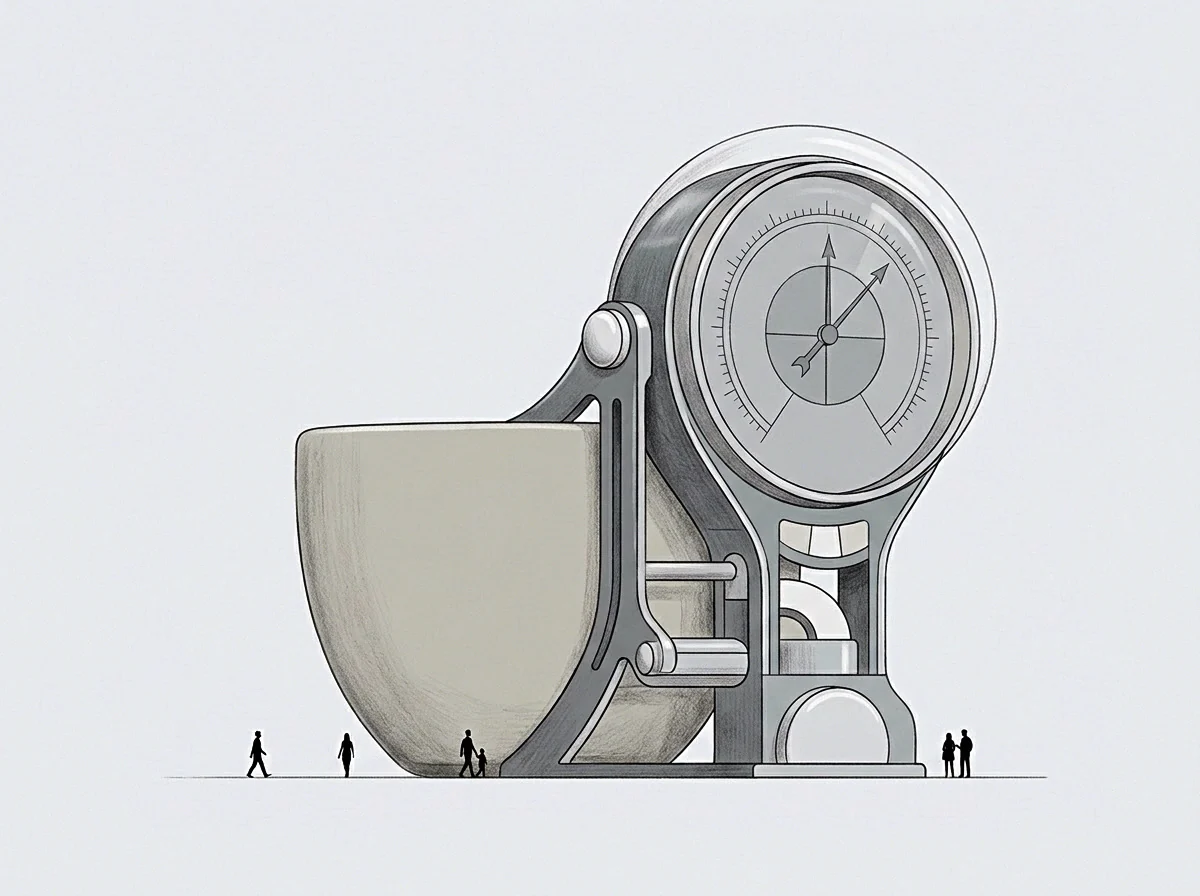
Capacity loss occurs when intake delays pass the temporal boundary where planned execution windows collapse. An intake approval sitting idle for ten days consumes zero material resources directly. When that ten-day pause forces an engineering team to miss its dedicated deployment sprint, the idle delay transforms into severe capacity destruction.
The original ordinal delay converts into lost operational capability.
Tracking the exact inflection point where friction converts to capacity loss requires real-time monitoring of team availability schedules. Governance architectures that ignore capacity boundaries suffer from unexpected resource bottlenecks. When multiple intake approvals arrive simultaneously after extended review delays, operational execution units experience immediate overload.
Queue clearance rate governs throughput. Resource availability limits intake speed. Batching sign-offs creates downstream surges.
Converting internal friction into explicit contract value exposes hidden operational drag before enterprise commitments bind.
Enterprise intake standardization requires intake applicants to declare expected friction components alongside project proposals. Stating expected context switching hours, cross-departmental dependencies, and potential governance hurdles upfront establishes a clear operational vector. Early declaration enables intake boards to evaluate resource demands before committing organizational capacity.
Delayed declaration forces teams to absorb unexpected friction mid-execution, driving up operational costs and causing schedule slippage.
The vendor notes that each additional compliance questionnaire adds twenty thousand dollars to the initial contract term.

Shelf
Unapproved requests accumulate on governance shelves like physical inventory in a warehouse. Queue holding cost measures the operational drag incurred while an intake submission awaits review. Sitting on an intake shelf consumes organizational bandwidth even when no active work takes place.
Applicants periodically check status, update expired metrics, and re-allocate execution timelines. The shelf itself generates continuous background friction.
- Submissions enter the primary triage queue where initial governance classification occurs based on declared scope.
- Technical teams evaluate dependencies, assigning an ordinal difficulty score based on architectural exposure.
- Compliance officers verify regulatory requirements, holding the request until evidence files pass validation.
- Operational leads match intake requirements against active resource budgets to determine execution timing.
Intake queue length acts as an ordinal proxy for enterprise governance health. A expanding intake queue signals structural imbalance between intake submission volume and review capacity. As queue depth increases, context dissipation accelerates.
Applicants lose familiarity with submitted proposals, requiring secondary context recovery efforts when reviewers finally open the file. Holding time inflates operational drag exponentially rather than linearly.
Shelf decay affects technical proposals faster than administrative ones. Software dependencies update, infrastructure architectures evolve, and market conditions shift while requests sit in intake queues. A technical intake request approved after six months on a governance shelf often requires immediate re-work to align with current operational baselines.
The approval granted matches past realities rather than active conditions.
Unapproved intake requests consume queue space long before operational teams assign explicit work hours.
Mitigating queue decay requires setting hard temporal boundaries on intake shelf residence. Submissions exceeding designated holding thresholds must automatically trigger priority escalation or process rejection. Automatically expiring stale intake submissions clears queue noise and forces applicants to re-validate operational assumptions before re-submitting.
Active queue management preserves review capacity for high-priority initiatives.
Intake queues clear fastest when governance gates evaluate resource commitment prior to technical review.
Shift
Redesigning enterprise intake systems demands a structural shift from gatekeeping to ordinal threshold routing. Traditional intake architectures funnels every request through identical sequential review gates regardless of scope or friction profile. Threshold routing evaluates incoming requests against predefined ordinal metrics, automatically directing low-friction items along accelerated approval paths while reserving deep governance reviews for high-friction submissions.
Implementing threshold routing requires defining explicit ordinal boundaries for security, financial, and operational risk vectors. A project requesting standard infrastructure components with minimal data access rates as low friction, bypassing specialized architectural committees entirely. A project introducing external code bases or processing protected data triggers multi-stage review protocols automatically.
Systemic automation replaces discretionary triage. Clear criteria reduce administrative ambiguity.
The shift to standardized ordinal friction scales transforms intake from an unpredictable administrative obstacle into a quantifiable operational pipeline. Operating teams gain visibility into expected intake lead times based on the ordinal classification of their requests. Governance boards optimize review resource allocation by focusing specialized expertise strictly on high-friction submissions.
Enterprise execution velocity increases as lower-friction initiatives move into production without unnecessary administrative delays.
Measuring intake success requires tracking the correlation between initial ordinal friction assessments and actual post-approval execution drag. When requests assigned low friction ratings consistently encounter heavy operational hurdles downstream, governance teams recalibrate their ordinal intake criteria. Continuous calibration aligns intake evaluation protocols with changing operational realities, ensuring long-term organizational agility and systemic resilience.