
Translating Internal Multi Component Ordinal Resource Vectors Into External Cardinal Fixed Contract Prices
Internal multi-component resource vectors convert to external cardinal prices by scaling baseline labor costs against the highest ordinal strain component.

Scale

Measurement Properties of Resource Accumulation
Internal cost evaluation operates on ranked preferences instead of uniform counting units. When an operator assesses what a project demands, five streams move at once: baseline hours, cognitive attention, operational capacity, long-term capability gained, and immediate opportunity cost. These factors form an ordering where Task A depletes more attention than Task B, and Task B consumes more capacity than Task C. Yet no mathematical formula collapses these five distinct dimensions into a single arithmetic average without introducing arbitrary assumptions about their relative importance.
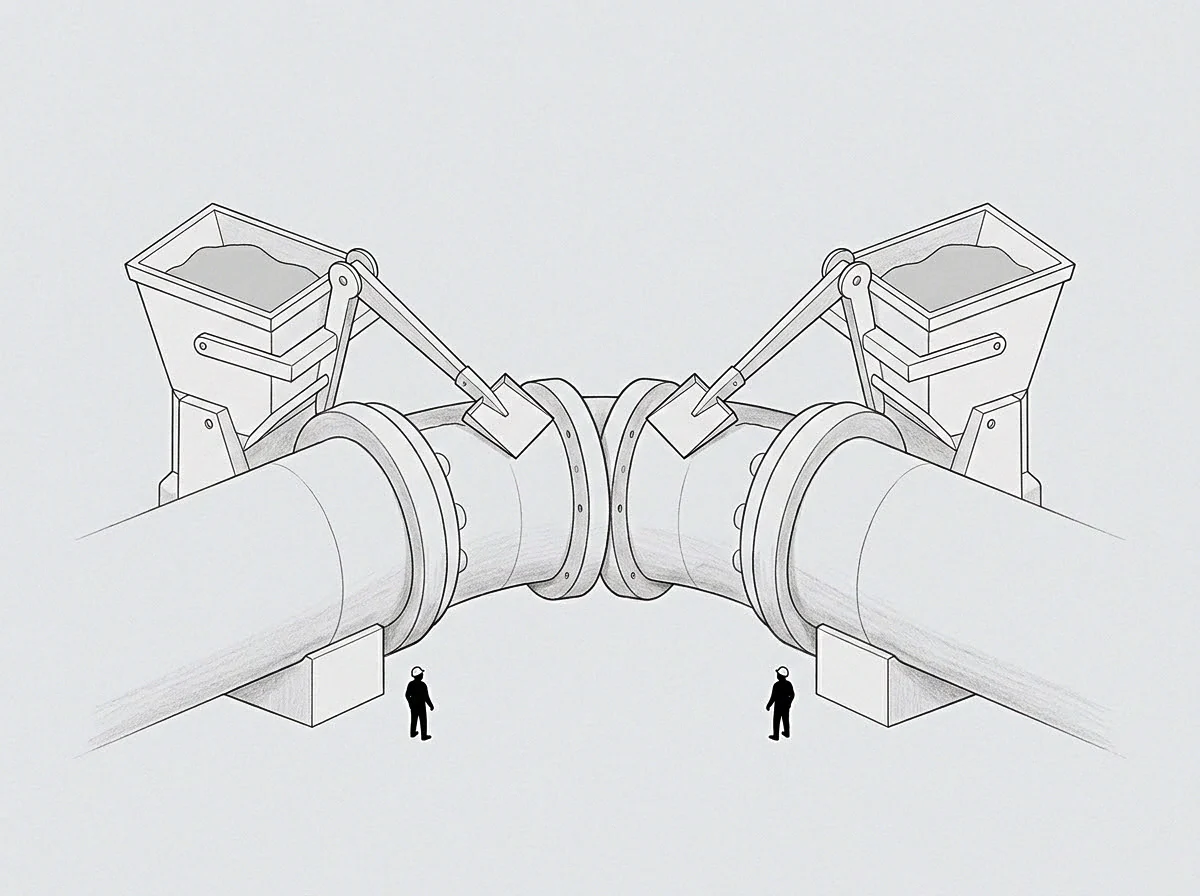
Cardinal pricing demands a different structure entirely. An invoice requires a single numerical figure expressed in a standardized currency, because the external market requires a scalar number rather than an ordinal vector of internal strains. The translation forces a multi-dimensional ranking into a one-dimensional count.
When this translation happens too early or without a systematic conversion method, the cardinal price fails to reflect the underlying resource consumption.
Internal depletion ordered across different resource dimensions cannot be added into a single figure without introducing arbitrary weighting assumptions.
Operational decisions made inside an enterprise rely on ordinal vector comparisons to preserve precision. A team can readily determine that taking on a complex custom integration creates greater capacity drain and attention strain than delivering three standard software modules, even if the direct labor hours remain identical. The evaluation maintains these distinct categories to prevent hidden operational deficits until an exchange forces a scalar projection.

Array

Decomposing Multi Component Resource Vectors
A complete assessment of internal strain divides resource drain into distinct physical and psychological dimensions. Direct labor hours represent only the most visible layer. Operational capacity dictates how much simultaneous work an organization can sustain before execution speed degrades, while attention bandwidth measures the cognitive overhead imposed on key leadership and technical talent.
Capability acquisition tracks whether the work leaves behind reusable infrastructure, institutional knowledge, or refined skills, and opportunity cost measures immediate alternative uses of those same resources.
Two distinct projects can each require precisely forty hours of engineering work over a two-week period. The first project involves routine maintenance on well-documented systems, requiring minimal cognitive context-switching and zero executive oversight. The second involves troubleshooting an unfamiliar legacy architecture under active customer escalation, consuming four times the cognitive attention, blocking strategic availability, and reducing overall team capacity for concurrent tasks.
Evaluating both projects solely by direct labor hours treats unequal internal drain as identical.
Unordered resource streams manifest across distinct organizational layers:
- Direct execution hours measure the calendar time technical and operational personnel spend performing assigned project duties.
- Cognitive attention bandwidth represents the concentration, strategic focus, and mental context-switching extracted from key talent.
- Immediate operational capacity reflects the reduced availability of organizational assets to absorb sudden work spikes or parallel client demands.
- Long term capability yield tracks the cumulative technical infrastructure, procedural knowledge, and skill assets retained after project completion.

Which Resource Vector Component Controls Cardinal Margins?
Determining which specific vector element governs financial sustainability depends entirely on the operational bottleneck of the organization. In early-stage or highly specialized technical teams, cognitive attention and executive bandwidth routinely act as the binding constraint. When attention becomes fully saturated, taking on additional work creates compounding error rates across all existing projects, regardless of how much physical labor time remains available on the calendar.
When cognitive load dominates an internal cost vector, setting a fixed price based on labor hours leaves the operational deficit unhedged.
Misaligning the primary internal vector component with external price calculations causes severe structural margin erosion over time. Pricing a contract on simple direct labor hours when attention or capacity is the true binding constraint leads to structural underpricing, where operational strain accumulates internally and reduces overall throughput while the financial ledger shows a misleading paper profit.

Table

Worked Conversion Dynamics Across Deliverable Types
Take an enterprise software firm evaluating two prospective client agreements, assuming both engagements are structured as fixed-price contracts of fifty thousand dollars. Project Alpha involves deploying a standard software package with minor configuration adjustments. Project Beta requires building a custom integration layer between two legacy enterprise systems.
Both projects are estimated to consume two hundred direct technical hours, suggesting identical engagements on paper even though their internal resource vectors differ completely.
Analyzing Project Alpha reveals a low attention drain, minimal capacity reduction, and a moderate capability yield, as the configuration work uses standard internal tools. Project Beta extracts extreme cognitive attention, locks down senior technical leadership, severely restricts total organizational capacity, and provides zero reusable capability yield due to client-specific legacy constraints. Converting both projects into identical external cardinal prices creates a stark imbalance in net operational return.
| Contract Archetype | Primary Resource Vector Strain | Vector Scale Property | Translation Multiplier | Calculated Cardinal Price |
|---|---|---|---|---|
| Standard Integration Deployment | Direct Hours (200h), Low Attention, High Capacity Availability | Linear, Predictable Interval Spacing | 1.2x Base Labor Floor | $36,000 Fixed Contract |
| Legacy Custom Infrastructure | High Attention, Extreme Capacity Drain, Zero Capability Yield | Non-linear Ordinal Spike Across Components | 2.5x Base Labor Floor | $75,000 Fixed Contract |
The table illustrates how applying a uniform hour-based calculation to non-linear internal vectors produces flawed pricing decisions. Project Beta requires a significantly higher cardinal price to offset severe attention drain and lost capacity, even though direct execution hours match Project Alpha. Because the market demands cash figures, translating ordinal vectors accurately requires applying a translation factor that accounts for the highest-strain component within the internal vector.
A fixed fee converts variable internal strain into an explicit cash barrier whenever scope boundaries remain rigid.
The scope was delivered as defined in the schedule, so the internal staffing adjustments remain an internal matter for the vendor.
Rate

Conversion Arithmetic and Vector Projection
Bridging the gap between multi-component internal vectors and fixed cardinal prices requires a structured conversion methodology. Instead of attempting a direct mathematical sum of incompatible units, the operator establishes a step-by-step translation protocol. This anchors the base price to direct financial costs while scaling the final figure based on the most constrained ordinal vector components.
A systematic conversion workflow follows a clear sequence:
- Identify the binding internal resource vector component among attention, capacity, and direct labor hours.
- Calculate the baseline monetary floor using explicit direct expenses and standard labor rates.
- Apply a non-linear scaling coefficient derived from the ordinal ranking of cognitive attention and capacity drain.
- Subtract the estimated monetary value of long-term capability gains retained by the organization.
- Establish fixed scope boundaries and explicit trigger conditions that mandate cardinal price adjustments if internal vector assumptions are breached.
Setting fixed prices without building in risk buffers based on internal vector strain forces an organization to absorb operational volatility privately. When unforeseen technical complexity expands cognitive drain, a rigid cardinal contract prevents the vendor from adjusting charges even as the strain lands internally. Establishing explicit adjustment clauses inside the contract structure protects the enterprise from non-linear vector expansions during project execution.
The specific contract adjustment clause conditions set the exact threshold where an ordinal vector expansion automatically triggers a revised cardinal fee structure.

Contract

Preserving Margin Under External Term Rigidities
External fixed-price agreements freeze the cardinal financial figure while leaving internal resource vectors subject to real-world execution pressures. When client requirements shift slightly or communication friction increases, direct hours may remain relatively stable while cognitive attention and capacity drain skyrocket. If the agreement lacks dynamic re-pricing triggers, the provider experiences severe operational margin compression despite maintaining the agreed delivery timeline.
Stating costs early in negotiation protects both parties from unhedged resource depletion. By explicitly defining the resource vector assumptions underlying a fixed price, the service provider creates a rational basis for scope management. When a client requests changes that shift the primary internal strain from routine labor hours to intensive leadership attention, the provider points to the underlying contract terms to adjust the external price accordingly.
Unstated internal strains inevitably re-emerge as operational default during execution.
Managing the translation of multi-component internal costs into external cardinal prices requires continuous alignment between operational reality and commercial commitments. Fixed contract figures provide market clarity, but operational survival depends on reading the internal vector accurately before signing the agreement. What remains unresolved is whether external fixed-price markets will eventually adopt standardized multi-dimensional indexing clauses to automate this internal-to-external resource translation directly within commercial contracts.