
Evaluating Reversible Execution Path Decay During Protracted Product Launches
Reversible execution paths decay during extended product launches as soft dependencies, context loss, and schema divergence continuously elevate reversion costs.

Rung
A feature flag set to toggle off after fourteen days remains active on day one hundred eighty. Every night at midnight, a custom script transfers records between the primary database and a secondary staging engine to prevent soft-launch queries from dropping transactions. The engineering team created this bridge during the initial trial phase to shield legacy payment services from unexpected schema changes.
Six months later, the bridge remains necessary because two downstream reporting pipelines now depend directly on the schema transformations generated by that nightly script. What began as a temporary, fully reversible execution path has anchored itself into the permanent architecture of the enterprise.
Protracted product launches extend the time window between initial deployment and full operational consolidation. During this extended window, teams implement temporary scaffolding: dual-write database adapters, manual reconciliation procedures, static feature toggles, and human-in-the-loop validation steps. These structures are built under the explicit assumption that they will be removed once the launch reaches full momentum.
When launches stall or stretch across multiple quarters, these execution paths remain active long past their intended expiration. The path does not fail immediately; it functions smoothly while quietly transferring operational reliance from the new architecture back to the temporary bridge.
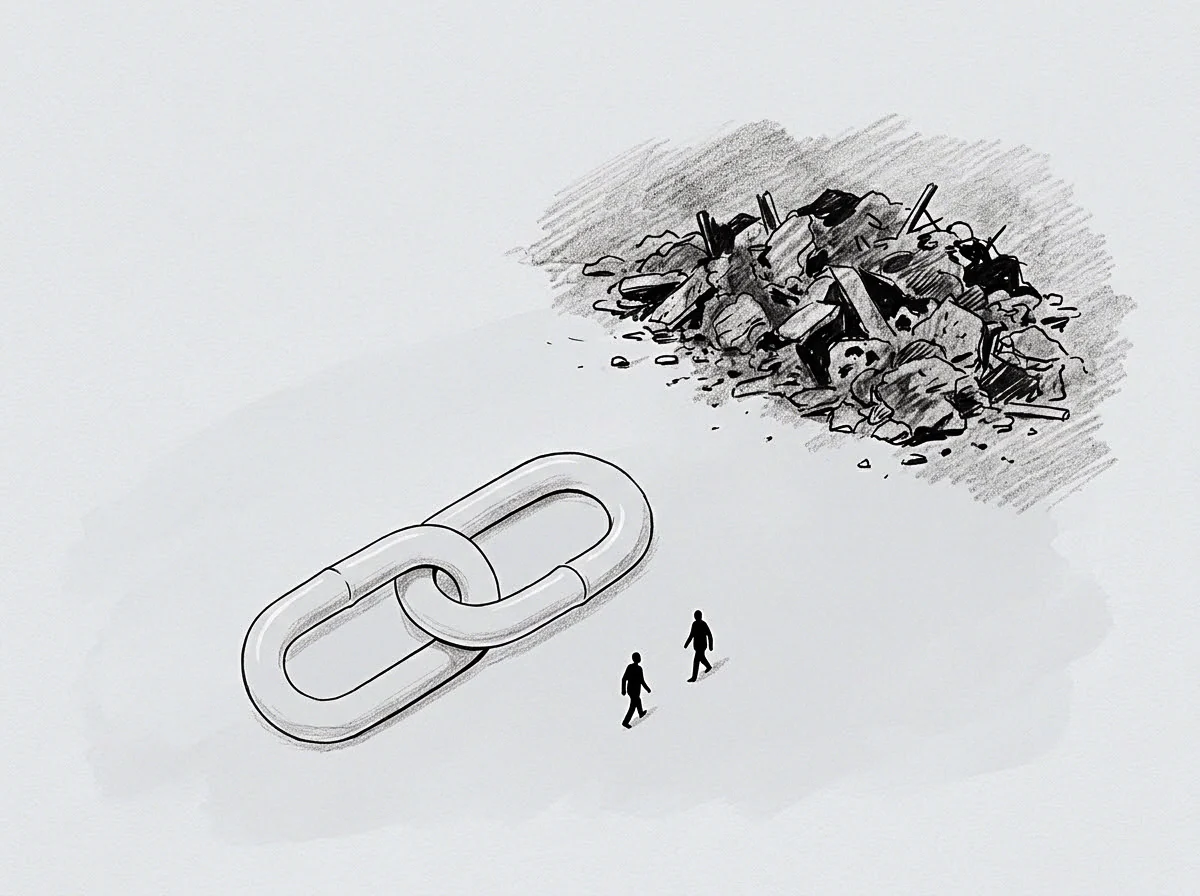
Temporary Invariants and Reversible Fallbacks
The initial creation of a temporary execution path relies on a clear operational invariant. Engineers write fallback paths with explicit boundaries, assuming the system will return to the baseline or advance to the target architecture within a predictable timeframe. System components maintain clean separation because the temporary adapter isolated the two states.
Capacity remains unencumbered, and the engineering cost to sever the fallback stays low.
System state remains elastic during early launch stages. Reversing a release requires flipping a single configuration key or re-pointing a domain name. The operational cost of returning to the pre-launch baseline stays minimal because state mutations remain strictly contained within isolated tables or flagged environments.
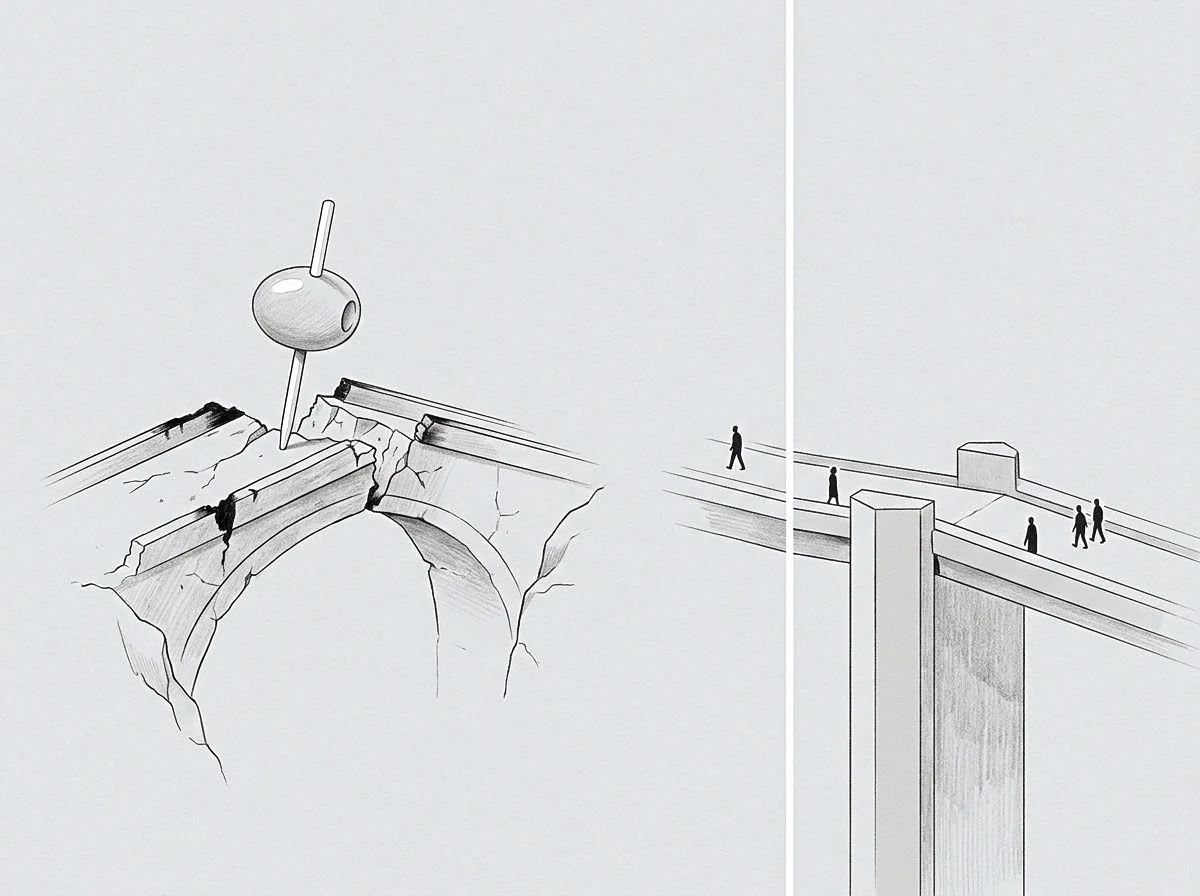
Accumulation of Soft Dependencies
As launch timelines stretch, neighboring engineering groups observe the temporary execution path and build operational reliance upon it. Data analytics teams discover the intermediate database table created by the reconciliation script and write automated dashboards directly against its contents. Customer support agents learn that manual intervention routines exist to override stalled account provisioning, integrating those routines into daily workflows.
The temporary path ceases to be isolated.
The reversibility of an execution path decays in direct proportion to the number of external systems that integrate with its temporary state.
Every soft dependency shifts the exit vector. What required an hour of engineer time to dismantle during month one demands cross-departmental alignment, pipeline rewrites, and migration testing by month six. The fallback path transforms from an isolated contingency into a structural joint.
The team maintains the temporary mechanism because disabling it disrupts operational workflows that were never part of the original product design.
The team will eventually explain that removing the temporary adapter risks breaking downstream reporting and daily support operations.

Vector
The transition from a reversible execution path to an irreversible architectural constraint follows a distinct decay vector along the value axis. This decay is driven by context loss, team turnover, implicit schema coupling, and the continuous erosion of operational baseline elasticity. The path does not lose reversibility due to software degradation; it loses reversibility because the computational and human cost of returning to the origin continuously increases while the knowledge required to execute the return dissipates.

Context Dissipation Along Launch Timelines
Engineers who designed the temporary fallback understand its precise limitations and edge cases. When a product launch stretches from two months to eighteen, staff turnover and internal reassignments separate the original authors from the live production system. Documentation written during the launch setup reflects initial intentions rather than the accumulated modifications made to keep the temporary path operational.
Subsequent operators treat the temporary execution path as a black box. Lacking the complete context of why specific conditional branches exist, they avoid refactoring or removing the code. The path becomes preserved through organizational caution.
The perceived risk of modifying a legacy shim exceeds the visible cost of maintaining it, driving the system further down the path of least resistance.

Structural Anchoring of Manual Interventions
Human operational inputs introduce rapid path decay. During extended launches, manual interventions are introduced to patch edge cases that the new software does not yet handle automatically. Operations teams execute manual CSV uploads, force manual database updates, or run batch validation scripts twice weekly.
- Interface Coupling Drift occurs when external services build direct API integrations against temporary data representations exposed during early launch phases.
- Context Loss Through Turnover erodes the detailed understanding of edge-case handling within fallback loops as original authoring engineers leave the project.
- Implicit Telemetry Dependence arises when alerting and monitoring frameworks begin using temporary fallback metrics as baseline operational indicators.
These manual interventions create an unmonitored human feedback loop. The software appears stable because human labour absorbs the runtime failures. The energy spent sustaining these manual steps is rarely factored into product launch accounting, masking the true operational debt.
The execution path ossifies because the business normalizes the human overhead required to maintain the baseline state.
System state returns to baseline only when the cost of maintaining temporary fallbacks exceeds the single operational cost of full architectural severance.
System capacity shrinks under the weight of these ongoing operational compensations. When the team finally attempts to complete the migration or roll back to the original baseline, they discover that the pre-launch state no longer exists in a functional form. Data schemas have diverged permanently, legacy interfaces have been decommissioned by adjacent teams, and the operational capacity required to perform a clean reversion has been spent on daily maintenance routines.

Beam
Evaluating execution path decay requires systematic comparison across operational parameters as launch timelines stretch. The decay trajectory varies depending on how the temporary path was implemented and how deeply external systems have coupled to its runtime state. Identifying whether an execution path remains reversible involves assessing coupling depth, schema divergence, and the exact capacity required to execute a reversion protocol.
The table below compares four distinct execution path states across protracted launch windows, evaluating their structural parameters and reversion costs.
| Execution Path State | Coupling Depth | Reversion Cost | Operational Elasticity |
|---|---|---|---|
| Soft Launch Bridge | Isolated within primary service module | Low: single flag toggle and cache clear | High: state mutations strictly isolated |
| Parallel Processing Shim | Dual-write dependencies across two data stores | Moderate: requires backfill and queue draining | Moderate: schema changes require dual updates |
| Feature Flag Abstraction | Conditional logic embedded across multiple repositories | High: extensive code refactoring and regression testing | Low: branch complexity creates subtle runtime paths |
| Legacy Fallback Loop | Deep integration with external analytics and support tools | Prohibitive: complete cross-departmental migration effort | Negligible: system locked into dual-path execution |
A soft launch bridge represents the ideal initial state where reversibility remains intact. Reversion costs remain bounded as long as external systems interact strictly through versioned interfaces. Once dual-write shims and feature flag abstractions spread across multiple service boundaries, operational elasticity declines rapidly.
The system reaches a point where running the temporary fallback consumes more compute and engineering attention than running the target product architecture directly.
When conditional feature branching spans more than three service boundaries, clean execution path reversion is functionally lost.
Take an enterprise software platform extending its new billing engine launch across four quarters. To maintain compliance during the transition, the team implements a parallel processing shim that sends transactions to both the legacy payment gateway and the new billing service. The architecture assumes the legacy gateway will be disconnected once auditing validates the new engine.
By quarter three, regulatory updates demand changes to the primary transaction schema. Engineers update the new billing service but apply a minimal patch to the legacy shim to avoid delaying the launch further. The schema divergence forces the parallel processing shim to perform real-time data translation on every transaction.
The translation layer increases system latency by eighty milliseconds per call, while memory utilization on core app servers rises by twelve percent.
The operational capacity consumed by real-time translation represents a continuous tax on core infrastructure. If the launch is paused, the organization faces two expensive choices: spend six engineering weeks updating the legacy engine to match the new schema, or commit to full cutover to the new billing service despite incomplete audit sign-off. The path has lost its middle ground.
The condition of the parallel processing shim now dictates engineering priorities rather than the product launch schedule.
When an engineering team enforces a strict time-bound boundary condition on temporary execution paths, the path retains its reversibility across extended launch schedules.

Trace
Measuring path decay requires quantitative tracking of operational metrics over time rather than relying on subjective team assessments. The decay gradient can be calculated from value axes that measure code branching density, automated test coverage for fallback paths, and the age of live feature toggles. Monitoring these coordinates reveals the precise trajectory of system decay long before an emergency rollback fails in production.

When Does Execution Path Reversibility Expire Completely?
Reversibility expires at the exact intersection where data written through a temporary fallback path cannot be ingested by the legacy system without manual transformation. This boundary marks the shift from automated technical rollback to structural data loss. Measurement frameworks must track the age and volume of records processed through secondary paths.
- Count active conditional feature branches present within primary application repositories that exceed ninety days of production age.
- Measure the volume of data records modified exclusively by temporary fallbacks that lack backwards-compatible schema transformers.
- Calculate the ratio of engineering hours spent maintaining transition adapters against hours spent developing core target functionality.
Research across distributed software systems demonstrates that fallback execution paths experience higher defect rates than primary paths. Controlled empirical studies show that code blocks executed under feature toggles receive thirty-five percent less automated testing coverage on average compared to baseline routines. This coverage deficit accelerates structural decay, as unmonitored edge cases accumulate quietly within the fallback logic.
A temporary fallback path left unmonitored for ninety days will accumulate unhandled edge cases at twice the rate of primary application code.
This empirical finding rests on telemetry data collected from continuous integration pipelines across enterprise web applications. The measured outcome depends directly on whether automated integration suites run test matrices against all permutation combinations of active feature flags. When engineering organizations disable automated test runs for legacy fallback states to cut build times, undetected integration errors increase sharply.
Uncertainty remains regarding the precise organizational threshold where human operational memory breaks down during extended launches. Field observations suggest that project teams experience a sharp decline in architectural context retention after four months of launch delay, though controlled experimental data on organizational memory decay in software maintenance remains limited. Operators must establish explicit diagnostic checkpoints rather than assuming legacy context persists across team transitions.
Code base complexity scales exponentially with the count of unpruned conditional execution branches.

Reset
Restoring execution path reversibility demands active structural interventions before decay forces an involuntary lock-in. The goal is to clear accumulated operational debt and systematically sever soft fallbacks that no longer serve their core isolation purpose. A clean reset protocol requires firm expiration bounds, explicit boundary definitions, and dedicated capacity allocations decoupled from launch milestones.

Enforcing Hard Expiration Windows
Reversibility cannot survive indefinite operational timelines. Teams must attach absolute calendar expiration dates to all temporary shims, flags, and manual reconciliations at the moment of creation. These dates must operate as strict operational limits rather than soft targets.
When a temporary execution path reaches its expiration date without product launch completion, the default action must be immediate system cutover or total reversion to baseline. Allowing an expired fallback to persist without explicit executive re-authorization guarantees path decay. Hard time limits force product stakeholders to confront launch delays directly rather than offloading structural costs onto core infrastructure teams.
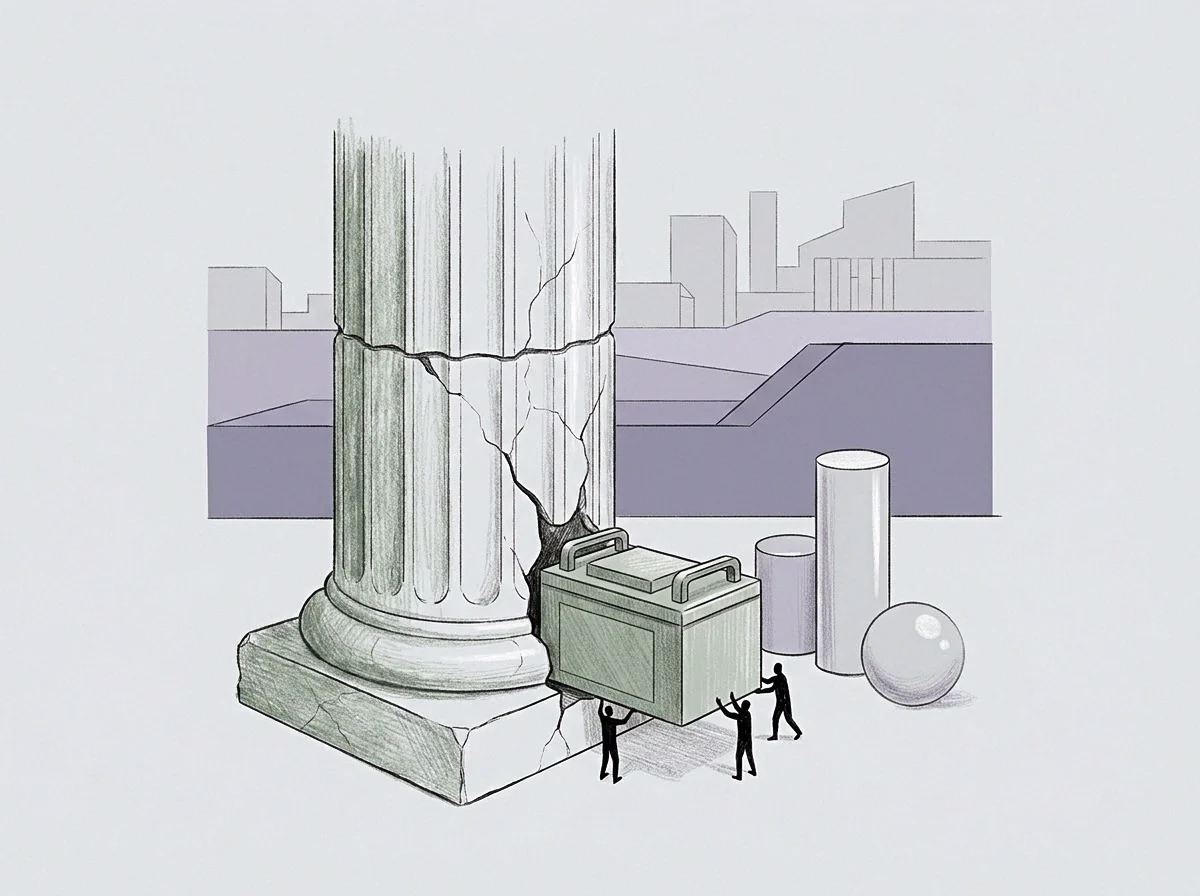
Active Decoupling of Soft Fallbacks
Restoring elasticity requires isolating the temporary path from secondary consumers. Systems teams must review all data access logs to identify external services reading from transition tables or intermediate caches. Once identified, these secondary access points must be severed or redirected through standardized API adapters.
The engineering team must explicitly schedule technical health sprints dedicated entirely to removing transitional code blocks. The capacity required to clean up temporary adapters must be budgeted as a primary launch cost during project planning rather than deferred to post-launch optimization phases.
Removing obsolete feature branches reduces code cognitive load, restores baseline automated test coverage, and prevents accidental execution of deprecated logic paths during production incidents. The wall is reached when the system can no longer be updated without triggering cascading failures across unmapped transition adapters.
How much operational capacity will the organization commit to spend on restoring execution path elasticity before a critical system failure forces an emergency cutover?