
Identifying Structural Friction Thresholds That Reduce Incremental Return Rates In Multi Segment Organizations
Incremental return rates collapse when cross-segment coordination queues expand faster than revenue, demanding structural decoupling of shared units to restore velocity.

Drag
A fourth division added to the operating sheet produced three hundred thousand dollars in gross receipts during its initial quarter while collective administrative expense rose four hundred and eighty thousand dollars across the same ninety days. The ledger showed positive division revenue, yet consolidated enterprise margins deteriorated. Capital deployed into additional product lines often encounters resistance hidden inside cross-allocation accounting.
When three units share sales channels, engineering pools, or legal clearance staff, adding another product introduces coordination tasks that consume more capacity than the line generates. The return on each added dollar of payroll declines because staff spend growing blocks of time managing dependencies rather than producing work.
Each unit addition increases internal communication pathways exponentially. Two operational units maintain a single line of liaison. Ten units maintain forty-five pathways.
At twelve units, sixty-six pathways demand scheduling, sign-offs, and mutual adjustments. Operational hours spent on internal alignment scale along this quadratic curve. Work slows as dependencies accumulate across divisional walls, and output flattens while frontline staff wait on external clearances before shipping deliverables.
Incremental returns turn negative when cross-divisional synchronization hours expand faster than the revenue produced by the newly introduced line.
The organization routes around unowned shared dependencies. Teams invent localized tracking methods and informal chat groups to circumvent formal queueing—this workaround signals building structural friction. Diminishing returns follow because capital feeds the coordination apparatus rather than customer delivery.
Enterprise leadership often mistakes this slowdown for execution failure and adds further reporting controls, which introduce approval nodes into existing queues and accelerate the margin compression they were meant to stop.
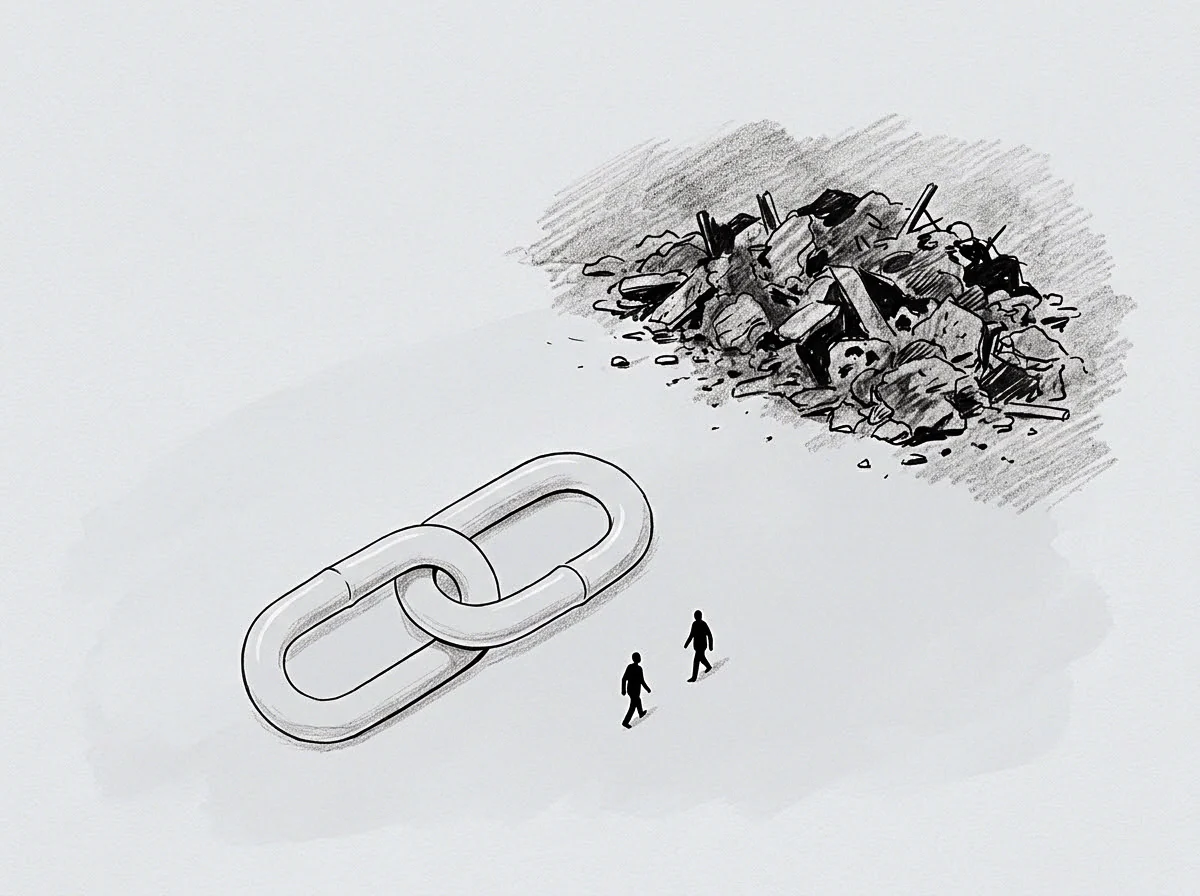
Coordination Loads and Segment Velocity
Internal transactions carry an overhead that grows with organizational breadth. Every cross-segment request brings dispatch delays, priority negotiation, and format reconciliation. A marketing team serving four divisions must arbitrate four distinct product deadlines, prompting divisions to build shadow marketing capacity to bypass internal queues.
Total headcount climbs across the organization while individual division velocity contracts.
Capital productivity decays along an identifiable trajectory. Initial segment additions deliver economies of scope by spreading baseline administrative infrastructure over wider revenue bases. Past a certain scale, that infrastructure becomes the bottleneck.
Divisional operators spend mornings securing concurrence from peer units, and the enterprise consumes free cash flow defending previous gains through internal meetings while subsequent segments go unfunded.
Uncorrected friction converts growing organizations into stagnant administrative holding companies where every new segment cannibalizes operational cash flow.

Joint
Interfaces between divisions act as collection points for organizational inertia. When segment leaders negotiate operational handoffs, friction concentrates wherever incentives fail to align. A product division requires custom adaptations for enterprise buyers, while the central software group optimizes for broad stability across common accounts.
Work halts at the border between their mandates. The central unit deprioritizes custom requests, and the product division constructs redundant engineering groups to regain schedule autonomy.
Shared support pools create invisible rationing systems. Human resource recruiters, procurement attorneys, and site reliability engineers divide attention across competing business units without clear pricing mechanisms. Requests accumulate in undifferentiated ticketing systems, where early submissions languish behind emergency escalations from larger segments.
Operational progress slows to the speed of the slowest centralized queue.
A centralized administrative queue with uniform prioritization creates artificial project starvation in fast-moving commercial segments.
The enterprise develops structural bypasses to survive centralized latency. Units hire external contractors under discretionary consulting budgets to bypass corporate procurement timelines. Segment leads build parallel infrastructure that mirrors corporate shared functions, consuming segment margins while masking the dysfunction of the central interface.
The organization routes around official channels to meet customer delivery dates.

Friction Points at Segment Boundaries
Structural impedance manifests across distinct organizational touchpoints:
- Resource Allocation Queues enforce uniform wait times on uneven commercial opportunities, choking early revenue experiments before return rates materialize.
- Transfer Pricing Disputes trigger protracted executive negotiations over paper profits, consuming weeks of operational leadership time for zero market value.
- Cross-Divisional Prioritization Deadlocks freeze critical product releases while divisional directors argue over shared engineering dependencies.
- Siloed Data Definitions force manual reconciliation across reporting databases, producing persistent reporting delays and conflicting operating metrics.
These border conflicts consume executive capacity that belongs on customer acquisition. Leadership spends weekly alignment reviews untangling conflicting calendars, and operational focus shifts to settling jurisdictional disputes between division general managers. Production delays ripple downstream, pushing customer delivery dates out by months.
The project sits stalled because the request lacks executive clearance from the central shared group.
Verge
Identifying the tipping point where added segments diminish enterprise returns requires measuring marginal yields. Mathematical analysis of operational queues shows that processing delays do not scale linearly with system utilization. When an internal service unit operates at seventy percent capacity, requests move through predictable queues.
As utilization approaches ninety percent, wait times explode. Segment additions that push shared support services into high utilization cause catastrophic delays across all dependent product divisions simultaneously.
The marginal return rate drops precipitously past this limit. Capital investments in customer acquisition yield lower revenue because delivery gets trapped in cross-unit handoffs. Sales compensation climbs to overcome delayed shipping cycles, and return on invested capital decays while inventory and unbilled service hours sit trapped between divisional sign-offs.
When queue utilization in shared services crosses ninety percent, wait times expand by a factor of ten and destroy division operating agility.
The system routes around overloaded central gates through unauthorized shadow spending, which serves as the primary operational marker of this threshold. When operating units write checks to third-party providers for services already funded on the corporate ledger, the structural limit has been breached and the organization is paying twice for single functional outcomes.

Which Allocation Signals Reveal The Friction Inflection?
Disproportionate coordination drag surfaces through measurable variance across operating units. Tracking the ratio of cross-segment approval hours against total delivery hours isolates the friction coefficient. When administrative coordination claims more than one-fifth of functional engineering or design time, incremental returns flatline.
| Coordination Structure | Interface Complexity | Queue Wait Multiplier | Marginal Return Inflection | Shadow Expense Ratio |
|---|---|---|---|---|
| Centralized Shared Services | Low Direct Paths | High Delay Multiplier | Three Business Units | Elevated Off-Ledger Spend |
| Matrixed Divisional Staff | Quadratic Scaling | Severe Deadlock Potential | Five Business Units | Extensive Redundant Talent |
| Decoupled Segment Units | Minimal Shared Nodes | Negligible Cross-Wait | Nine Business Units | Near-Zero Shadow Spend |
| Federated Platform Hubs | Defined Service Contracts | Moderate Bounded Wait | Seven Business Units | Contained Discretionary Spend |
Physical production systems illustrate this constraint cleanly. A multi-spindle lathe running four distinct parts through a shared tooling block maintains high efficiency until changeovers exceed cutting time. Once retooling claims sixty percent of a shift, adding another part design reduces total daily finished parts.
The machine spends its shift swapping cutters rather than shaping metal. Multi-segment corporate offices behave identically when divisional changeovers consume the working day.
Every segment added beyond the processing capacity of the shared bottleneck reduces the absolute cash flow of the enterprise.

Check
Measuring internal friction requires auditing communication channels, unbilled coordination hours, and delivery cycle times. Traditional accounting systems conceal friction by classifying cross-unit meetings and alignment reviews as routine operating expenditure. Financial statements show standard payroll lines without illuminating what fraction went toward settling internal jurisdictional disputes.
Auditing coordination friction demands inspecting operational calendars, ticket aging distributions, and cross-divisional service requests.
Calibrating these diagnostic tools reveals structural blockages. Segment managers must track the lifecycle of cross-unit requests from submission to final delivery. A request requiring fifteen days of work that spends seventy days in transit across internal queues demonstrates an eighty percent friction ratio.
High friction ratios highlight broken organizational joints that suppress incremental capital returns.
Leadership teams should execute structured diagnostic assessments:
- Map Cross-Unit Request Latency by recording timestamps at every cross-divisional handoff point to expose structural queue bottlenecks.
- Audit Shadow Service Budgets by reviewing divisional credit card slips and discretionary consulting lines for unauthorized duplicate spend.
- Quantify Calendar Alignment Load by calculating the total hours department heads spend in internal alignment meetings rather than commercial client execution.
Evidence gathered from software engineering organizations demonstrates that team interdependency scales communication costs while decreasing individual commit frequency. Field findings show that doubling cross-team dependencies quadruples integration defects while halving feature velocity. This finding rests upon data from mid-sized technical firms operating unified code repositories across divergent commercial units.
Altering repository architecture toward modular, isolated components with documented APIs invalidates the dependency penalty, restoring team speed despite segment growth.
An unresolved ambiguity persists regarding the durability of centralized brand equity versus the autonomy of separate business units. Market brand consolidation suggests shared branding lowers customer acquisition costs across segments, yet operational evidence shows that maintaining centralized brand guidelines imposes severe friction on specialized market offerings. In the face of this uncertainty, prudent operators measure customer conversion velocity directly against the administrative delay of central brand clearance reviews.
Instituting mandatory internal service level agreements where shared units either fulfill divisional requests within five business days or forfeit budget authority to divisional discretion instantly eliminates queue stagnation.
Recoil
Correcting structural friction demands deliberate structural decoupling. General managers must break shared bottlenecks by devolving administrative functions back into individual operating segments. Decentralizing legal, marketing, and recruiting functions raises segment overhead while instantly removing systemic coordination drag.
The resulting structural velocity recovers operating margins that far outpace the localized cost of duplicated administrative headcount.
Decoupling operational units eliminates the quadratic growth of communication pathways. Each segment controls its own critical path to market. Operating units purchase shared infrastructure through explicit commercial contracts rather than competing for unpriced shared internal queues.
Capital allocation shifts from central political lobbying toward market-tested return rates within distinct operating units.
Operating velocity rebounds the moment business unit leaders obtain unilateral authority to purchase services from external markets.
The system routes around previous stagnation by restoring localized autonomy. Units cease building covert administrative bypasses because structural hurdles no longer impede product releases. Freed from internal coordination duties, operational teams reallocate hundreds of monthly hours toward customer fulfillment.
Incremental return rates rise back toward original unit economics.
This restructuring uncovers latent capacity across existing business divisions. Segments that appeared unprofitable under heavy central corporate overhead charges suddenly demonstrate strong cash generation when measured on direct operational contributions. The organization sheds administrative deadweight, transforming sluggish holding companies into nimble operational fleets.
Whether enterprise scale can ever produce genuine administrative efficiency across distinct operating segments without triggering terminal coordination drag remains an unresolved question for corporate architects.