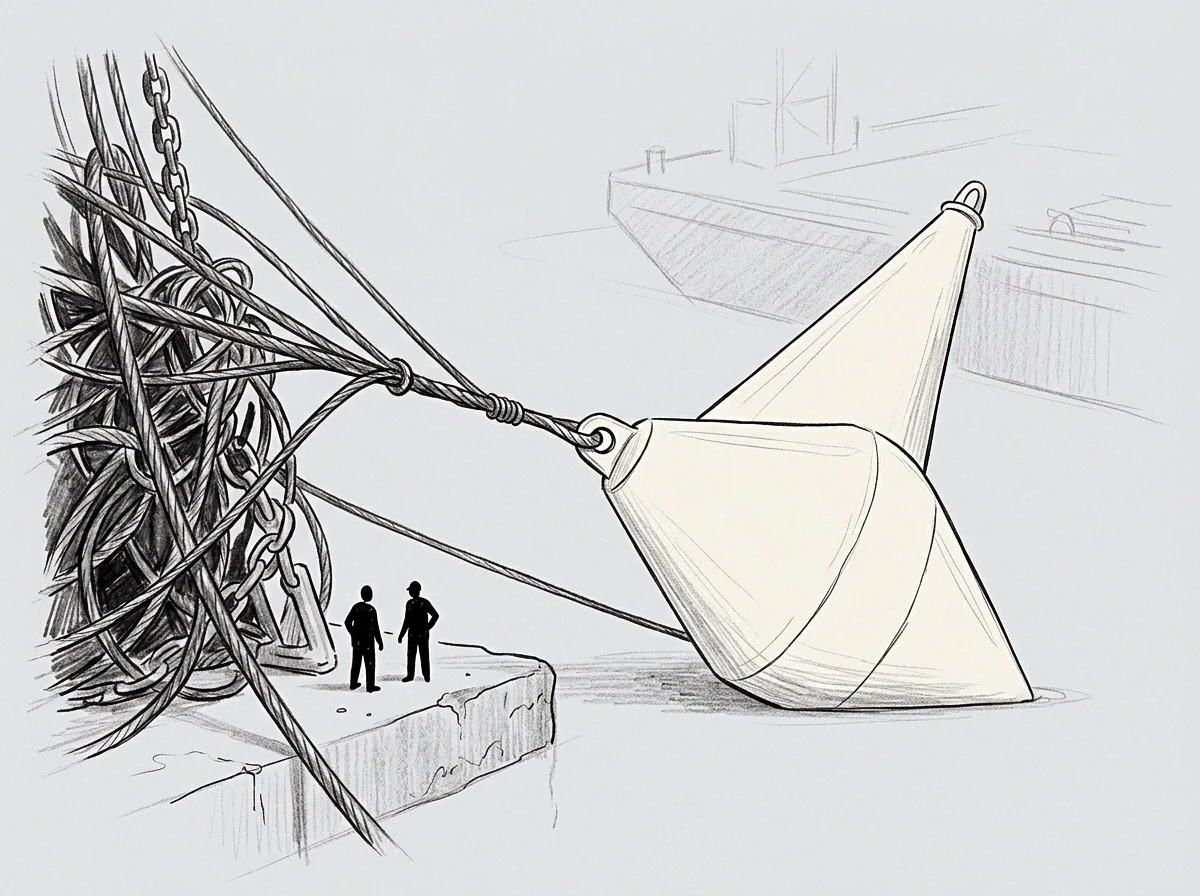
Meaning
Friction in collective output arises when individual labor within a firm requires more time for alignment than for execution. Coordination drag represents the delta between potential throughput and actual realized gains as headcount increases. Internal layers create communication overhead that slows decision cycles.
This phenomenon stops applying when a group size remains small enough for direct contact.
Internal Friction
Complexity grows nonlinearly as organizations add staff. Every new connection between roles demands maintenance to prevent errors. Communication becomes a cost of capacity that eats into project velocity.
Managers find that adding staff creates a feedback loop where more time goes to status updates than to technical tasks.
Measurement Logic
Cardinal values define the hours lost to administrative synchrony. Analysts count the number of meetings and message threads per completed output. This metric acts as an ordinal gradient showing when team density exceeds the speed of information transfer.
Efficiency decreases as the distance between the decision source and the action increases.
Structural Penalty
Systems suffer when the density of reporting lines exceeds the cognitive bandwidth of the team. Decision makers receive signals that degrade in quality during transmission through intermediate tiers. Information silos force repetitive clarifications that block progress.
Excessive hierarchy produces a stagnant result where the energy of the unit turns toward internal maintenance rather than market activity.