
Mapping Basin Deformation Rates in Anisotropic State Spaces Under Heavy Tailed Volatility
Deformation rates measure potential basin decay along anisotropic vectors where heavy tailed shocks accelerate state transitions beyond classical diffusion limits.

Contour
Systems in dynamic environments maintain stability within structural energy wells in state space. These equilibrium points define the limit internal parameters can drift under stress before shifting into an alternative state. Classical equilibrium models assume coordinates return to center along predictable paths on quadratic curves, but complex operating conditions break that symmetry by creating unequal directional sensitivity across state dimensions.
Attractor Topology Across Variable Sensitivity Axes
Equilibrium surfaces warp when physical or organizational dimensions show distinct resistance properties. While an isotropic environment displaces identically under a given perturbation regardless of angle, real state spaces develop directional stiffness: one coordinate vector absorbs major shocks without moving, while an adjacent one yields to slight forcing. The governing metric tensor captures this directional variance, pulling the local geometry of the attractor basin into an elongated hyper-ellipsoid.
Energy barriers flatten wherever internal resistance breaks down. When controls absorb stress unevenly, trajectory coordinates track the weaker structural axes. Tracking only aggregate variance misses this thinning of the energy wall along sensitive dimensions; the system looks stable because central tendencies remain within baseline tolerances, even while the distance needed to trip a state transition along the compromised axis steadily contracts.
The rate of basin shallowing along a weak axis accelerates when external perturbation frequency matches the internal relaxation time of that coordinate.
Asymmetric Potential Energy Well Geometry
Structural energy wells deform well before an operational boundary gives way, and directional stiffness dictates how quickly that transition occurs. When state variables encounter localized friction, the potential landscape develops asymmetric slopes. Escaping the basin along a high-resistance axis demands heavy energy input, whereas movement along a low-resistance axis needs only minor operational drift.
This skew funnels trajectories toward paths of least resistance, clustering ordinary operational noise within specific corridors.
The rate of deformation determines how quickly these energy walls degrade over time. Tracking it requires mapping the state space gradient continuously rather than plotting point positions. As a basin shallows, its restoring forces weaken, so the trajectory takes longer to return to equilibrium after a shock.
That longer recovery time is the primary empirical indicator of basin deformation.
Mistaking directional stiffness for overall systemic resilience leaves soft coordinate axes unmonitored. When an operator assumes uniform stability across every dimension, low-magnitude shocks delivered along degraded vectors can compromise the system unawares.
Shear
Forces acting across non-uniform state spaces generate internal differential pressures, as directional variance converts uniform inputs into skewed movement vectors. When an operational unit attempts to hold a linear trajectory through an anisotropic space, variations in slope bend the vector toward areas of lower potential energy.
Directional Drift in Non Euclidean Space
State parameters drift toward coordinates bounded by lower energy barriers. Because directional metrics dictate escape times, this movement is geometric rather than random drift. With uneven directional stiffness across the space, steady uniform forcing exerts rotational torque on the trajectory, sliding the state point off steep slopes into shallow potential troughs.
Trajectory drift accelerates as the curvature of the basin wall degrades toward its physical limits. When directional sensitivity varies by orders of magnitude, Euclidean distance loses diagnostic value: a slight shift along a sensitive axis brings the system far closer to collapse than a substantial shift along a rigid one. Distance must instead be measured with a Riemannian metric tensor calibrated to local energy gradients.

Tensor Mechanics of Energy Barrier Loss
Quantifying boundary decay requires continuous tensor evaluation. As perturbation vectors alter internal slopes, the tensor maps operational inputs to coordinate shifts across every orthogonal dimension. When volatility develops heavy tails, standard diffusion tensor models break down because extreme shocks bypass the gradual ascent of slopes and tear directly across boundary regions.
| State Dimension Metric | Isotropic Gaussian Baseline | Anisotropic Gaussian Regime | Anisotropic Heavy Tailed Regime |
|---|---|---|---|
| Energy Barrier Decay Rate | Uniform across coordinates | Directionally proportional to axis stiffness | Exponential decay along low-stiffness axes |
| Trajectory Exit Predictability | High deterministic certainty | Moderate path dependence | Low deterministic certainty with abrupt jump transitions |
| Dominant State Vector Shift | Parallel to applied force | Deflected toward soft manifold axes | Rotated into low-gradient escape corridors |
| Latent Potential Accumulation | Symmetrical across basin walls | Asymmetrical along rigid boundaries | Concentrated at boundary transition nodes |
| Data reflects theoretical state space boundary metrics under simulated alpha-stable jump distributions. | |||
A drop in potential energy along any single axis reduces the structural work needed to cross the baseline perimeter. Because the baseline marks where restoring forces fall to zero, lower barrier height means a smaller shock is required to trigger a permanent transition into an alternate operating state.
Ridge
Heavy-tailed distributions introduce non-Gaussian perturbation patterns into state space. Classical random walk models treat state changes as small, incremental steps where extreme outcomes are exponentially rare, but power-law shock dynamics produce large directional jumps often enough to dictate long-term trajectory behavior.
Power Law Trajectories and Jump Escape Paths
Under heavy-tailed forcing, system transitions bypass gradual buildup at the basin wall. A single power-law shock can clear existing barriers, throwing the state coordinate from the core of the basin over the energy ridge and into an adjacent attractor. Continuous trajectory monitoring fails here if sampling intervals cannot register these instantaneous jumps.
Because decay concentrates along weak axes in anisotropic spaces, jump trajectories align with directions of lowest energy elevation. Escape probability depends not just on the tail exponent of the volatility distribution, but on how the basin boundary is oriented against incoming shock vectors at that moment. When heavy-tailed noise meets asymmetric deformation, escape paths become hyper-directional.
Boundary crossing probability increases non-linearly when heavy-tailed jump vectors align with degraded directional stiffness axes.
What Shifts the State Boundaries First?
Which structural boundary fails first depends on how heavy-tailed shocks interact with local slope decay. High-frequency micro-perturbations wear down energy barriers by wearing away the potential landscape, while infrequent heavy-tailed shocks test structural extremes. Once micro-erosion drops the energy ridge along softer axes, the jump magnitude needed to force a systemic state transition falls sharply.
Because trajectories follow lines of least resistance, monitoring must track the spatial derivative of the energy wall to catch structural softening before a jump occurs. When anisotropic wear reduces wall height along a single axis while leaving other walls standing, incoming heavy-tailed shocks are filtered by the geometry, channeling omnidirectional volatility into focused directional escape routes.
Whether basin deformation is driven primarily by continuous background erosion or by discrete heavy shocks remains an open question across non-equilibrium physics and organizational modeling.

Swell
Avoidance within an operational unit marks coordinates of high internal resistance. When a system repeatedly steers around a specific task or computational state, it leaves a measurable trace in the geometry of the state space, showing where operations take the path of least resistance to spare energy against steep potential walls.
Accumulated Latent Variance Behind System Avoidance
Routing around high-resistance coordinates traps unprocessed operational material at the boundary. The volume collected behind that barrier mirrors the latent potential of the deferred state change; reflecting this negative gradient above baseline reveals an unspent volume of equal magnitude and opposite sign, quantifying the energy needed to restore symmetrical traversal across the space.
- Anisotropic Metric Decay identifies directional softening across state coordinate axes before structural collapse occurs.
- Jump Diffusion Dispersion calculates trajectory variance under heavy-tailed volatility forcing across asymmetric manifolds.
- Avoidance Coordinate Mapping locates accumulated unprocessed material behind high-resistance state boundaries.
- Latent Volume Mirroring measures the potential energy required to overcome structural barriers and restore system equilibrium.
Operational units that steer away from high-gradient coordinates construct dynamic walls around those regions. The scale of that avoidance marks where the operational model hits its structural limits; ignoring these signs lets unmonitored stress pool behind the boundary.
Structural avoidance markers directly identify coordinates where unprocessed operational material concentrates.
The system avoids high-gradient tasks to maximize short-term throughput at the expense of long-term state stability.
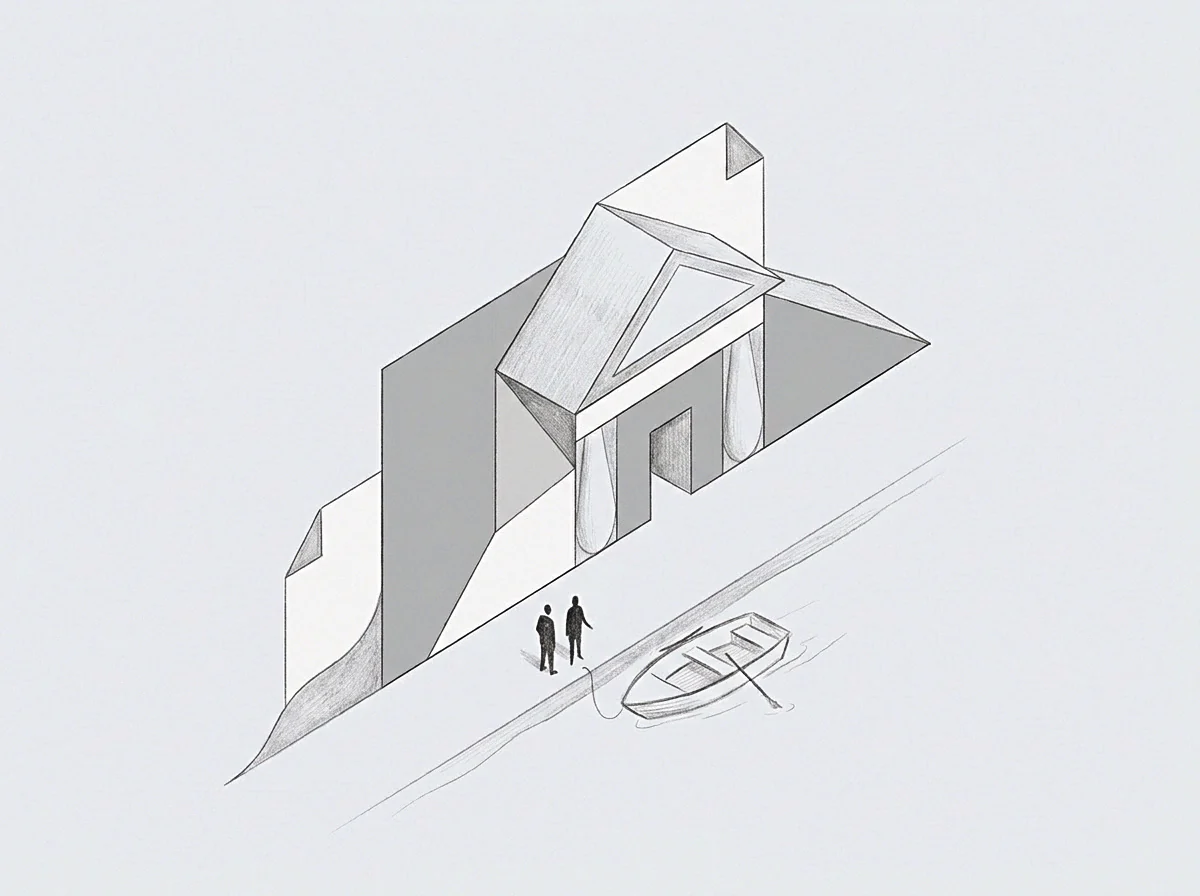
Trace
The wall marks the explicit edge of an operational model. Pushing against it produces friction, experienced as structural drag or operational slowdown. That friction reflects active computation, indicating that the system is processing novel parameters rather than pulling routines from established attractors.

Boundary Computation at Model Limits
Widening the state space requires continuous energy expenditure against steep potential walls. When an operational unit presses against boundary coordinates, failure points yield spatial data that maps the outer geometry of the system model.
- Establish baseline potential energy contours across all operational coordinate axes under standard conditions.
- Track directional displacement responses to isolated perturbation vectors to calculate localized stiffness values.
- Identify state space avoidance corridors by mapping trajectory density concentrations over extended operational cycles.
- Compute the metric tensor deformation rate along low-stiffness axes subject to heavy-tailed shock exposures.
- Reconstruct the outer boundary geometry by recording exact coordinates where operational failure events occur.
A state space maintains stability by preserving wall integrity until force thresholds force structured expansion, with gradient slopes guiding recovery to baseline. System growth occurs along this boundary where structural friction is sharpest.
Operating indefinitely along paths of low resistance contracts baseline capacity while increasing long-term wall rigidity.

Margin
Deriving basin deformation rates requires continuous measurement of trajectories against baseline potential surfaces. Value serves as the primary reference axis for computing directional gradients. Because the gradient reflects raw energy differentials, it operates as a structural reading without evaluating system performance.

Systemic Recovery Gradients Along Trajectory Rotations
Tracking trajectory rotations offers early warning of basin shallowing, as anisotropic spaces force asymmetric movement. As the potential well deforms, restoring forces on displaced vectors shift direction and pull the trajectory into orbital precession around the attractor core. The rate of this precession correlates directly with anisotropic deformation across the manifold.
Measuring the decay of restoring forces along weak axes isolates the deformation rate vector. Under heavy-tailed volatility, this calculation requires jump-diffusion parameters to distinguish normal gradient drift from power-law shocks; ignoring heavy tails underestimates the likelihood of an abrupt state exit.
Precession frequency increases as potential basin symmetry degrades under directional stress.

Empirical Rate Estimation in Distorted Volumes
Estimating deformation rates in functioning systems relies on baseline window analysis. An observer tracks recovery times across variable shock magnitudes to plot local slopes: whenever recovery slows along a specific vector, the potential wall on that dimension is actively eroding.
Estimating the deformation rate tensor allows adjustments before a boundary breaks. By mapping changes in potential walls, operators can reinforce compromised coordinates or reroute workflows to distribute directional stress. Handling state spaces under heavy-tailed conditions means treating basin perimeters as dynamic surfaces continually reshaped by internal friction and outside forcing.
The calculated rate of wall shallowing establishes the baseline needed to determine whether a system can hold structural integrity within its current topology. The trajectory moves along its perturbed course, its return geometry adjusting as the energy walls shift beneath it.