
Measuring Non Linear Tensor Friction At Structural Boundaries During Enterprise Capacity Realignment
Non-linear tensor friction measures multidimensional operational drag generated when enterprise capacity shifts across structural unit boundaries.
Gradient
Enterprise capacity realignment redirects headcount, financial capital, and engineering throughput across internal organizational boundaries. When an executive team shifts resources from legacy infrastructure to growth units, the operational path rarely follows a straight line. The rate of change in organizational performance relative to displaced capacity defines the enterprise gradient.
Capacity operates as a vector quantity possessing magnitude and direction across multiple business domains. A scalar reduction in one business unit produces non-uniform structural responses across adjacent departments.
Friction manifests when capacity vectors cross structural boundaries. These boundaries consist of explicit handoff protocols, implicit cultural norms, domain-specific tooling, and distinct financial accountability models. Standard linear models assume that moving ten units of engineering labor out of platform maintenance yields exactly ten units of output in product development.
Actual enterprise performance deviates sharply from this assumption. Structural friction dissipates energy at the boundary, reducing net output while generating systemic strain.
The rate of capacity reallocation across a structural boundary alters the friction coefficient of the interface itself.
Measuring this boundary friction requires mapping the underlying value axis against operational drag. Linear accounting metrics track financial spend and headcount transfers, yet fail to capture the multidimensional resistance generated during structural shifts. When a technical team transfers ownership of an internal service, the immediate administrative velocity masks the deep operational drag accumulating at the API boundary.
The system experiences immediate capacity loss through context switching, unwritten operational knowledge erosion, and conflicting incentive structures.
A system converging on its path of least resistance routes around structural boundaries that exhibit high friction. This avoidance behavior creates shadow operations within departments attempting to preserve throughput. Left unmeasured, boundary friction compounding across multiple realignments forces the organization into localized operational minima.
The cumulative cost of ignoring non-linear drag is the permanent degradation of cross-boundary execution capacity during strategic reallocations.

Gate
Structural boundaries operate as functional gates that filter, transform, or retard capacity flows across an enterprise. The physics of these gates depends heavily on their governance architecture. Hard technical interfaces enforce deterministic contracts, whereas operational boundaries rely on variable human coordination patterns.
Evaluating non-linear tensor friction demands an exact categorization of boundary gate types and their corresponding drag profiles.
Interface Architectures and Boundary Resistance Signals
Different enterprise interfaces respond to capacity reallocation with distinct drag curves. The interface structure dictates whether friction scales linearly with volume or explodes non-linearly past critical throughput thresholds.
| Boundary Gate Type | Governance Mechanism | Friction Characteristic | Latent Drag Multiplier |
|---|---|---|---|
| Hard Contract Handoff | Strict Service Level Agreements and Versioned APIs | Low initial friction, exponential spike upon contract breach | 1.2x base operational cost |
| Shared Pool Governance | Steering Committees and Prioritization Queues | High static friction, moderate linear growth under load | 2.4x base operational cost |
| Transfer Pricing Gate | Internal Financial Chargebacks and Allocation Models | Discontinuous step-function drag at fiscal period limits | 1.8x base operational cost |
| Informal Relational Network | Unmapped Interpersonal Trust and Historical Habits | Negligible initial friction, severe non-linear catastrophic breakdown | 3.5x base operational cost |
Informal relational networks present the highest latent drag multiplier during major capacity realignments. When capacity moves out of an informal network, tacit trust bonds sever instantly. The receiving unit cannot replicate the implicit knowledge exchanges that previously bypassed formal administrative delays.
The hidden operational load shifts directly onto formal gates, overwhelming governance channels unequipped for high-volume coordination.
A structural boundary absorbs energy whenever transferred capacity forces a re-negotiation of operational norms. The boundary wall expands or contracts based on organizational tolerance for friction. If an enterprise pushes capacity through a shared pool governance gate without adjusting queue depths, work items stall indefinitely in approval cycles.
The administrative backlog serves as a physical measurement of uncompensated boundary friction.
The unit losing capacity experiences operational failure before the unit receiving capacity achieves functional stability.
Tensor
Scalar measurements of enterprise capacity record magnitude without orientation. A balance sheet records fifty headcount reallocated from central operations to regional product teams. This metric fails because enterprise friction is multidimensional and directional.
Tensor analysis provides the mathematical structure to map operational strain along multiple axes simultaneously.

Multidimensional Strain Vectors across Enterprise Boundaries
When capacity shifts, friction generates stress components across technical, financial, political, and temporal axes. A realignment tensor captures how force applied along one axis produces displacement or failure along orthogonal axes. Mapping these components reveals why localized efficiency drives global enterprise drag.
- Technical Debt Shear occurs when engineering capacity relocates leaving architectural legacy components without core domain expertise.
- Governance Distortion arises when decision authority stays within the donor unit while execution responsibility moves to the recipient domain.
- Temporal Asynchrony manifests as execution cadence mismatches between fast-iterating product groups and slow-release platform teams.
- Incentive Misalignment produces active resistance when performance metrics rewarding local optimization conflict with enterprise capacity realignment goals.
Consider an enterprise attempting to accelerate cloud migration by reallocating twenty infrastructure engineers into product engineering units. The scalar metric shows zero net change in engineering headcount. The tensor representation maps a severe shear stress along the technical maintenance axis and a high compressive stress along the security compliance axis.
The infrastructure group, stripped of core capacity, defaults to emergency patching. Product teams, lacking compliance expertise, generate security violations that delay deployment cycles.
Non-linear tensor friction peaks when directional operational strain breaches the elasticity limit of informal coordination mechanisms.
Non-linear friction behavior appears when stress along one tensor component triggers structural failure across adjacent components. A small increase in capacity transfer velocity can cause a disproportionate spike in cross-departmental escalations. The relationship between realignment speed and systemic friction is governed by non-linear power laws rather than simple proportional additions.
Enterprise capacity realignment schedules that ignore cross-tensor coupling provisions inevitably induce structural hysteresis across technical operations.

Displacement
Examining a worked enterprise scenario highlights the actual dynamics of tensor friction during large-scale reallocations. Assume an enterprise software company operating with three thousand staff decides to shift thirty percent of its core infrastructure capacity to a new machine learning product line over twelve months. The initiative mandates moving one hundred and fifty senior engineers and twenty million dollars in cloud infrastructure spend across established departmental boundaries.
During the first quarter, scalar reports depict steady progress. Headcount transfer metrics show seventy engineers reassigned. Infrastructure budgets reflect the planned allocation shift.
Below the administrative surface, tensor friction begins compounding. The infrastructure unit, facing a thirty percent reduction in staff while supporting existing client workloads, stops non-critical system updates. System stability metrics hold steady initially, creating a false signal of baseline resilience.
By the third quarter, the unspent technical debt volume behind the infrastructure boundary breaks containment. System outages increase in frequency, requiring emergency interventions from the very engineers transferred to the machine learning unit. Context-switching drag consumes forty percent of the reassigned engineers’ weekly capacity.
The recipient unit experiences severe velocity loss, while the donor unit operates in permanent crisis response mode.
The total financial cost of emergency triage, missed product milestones, and attrition outpaces the original resource allocation plan by a factor of three. The enterprise executed the scalar reallocation plan flawlessly according to administrative metrics. The failure occurred entirely within the unmeasured non-linear friction generated at the boundary between core operations and new product development.
At what threshold of capacity velocity does boundary friction permanently degrade donor unit operational stability?

Hysteresis
Enterprise capacity realignment exhibits structural hysteresis. Hysteresis describes systems whose current state depends on their historical trajectory rather than merely their instantaneous inputs. Reverting a capacity reallocation does not restore the enterprise to its initial operational state.
Energy lost to non-linear friction during the original transfer leaves permanent structural deformation across departmental boundaries.
Which Capacity Reallocations Suffer Structural Hysteresis?
Reallocations involving specialized human capital, proprietary domain knowledge, or complex system integrations display severe path dependence. Once a team disintegrates or a system architecture splits across boundary gates, reversing administrative org charts fails to reconstitute the original baseline velocity.
- Establish baseline operational throughput metrics for both donor and recipient units prior to initiating capacity displacement.
- Measure cross-boundary communication frequency and escalation counts at weekly intervals during active resource transfer.
- Calculate tensor shear components by tracking context-switching hours logged by transferred personnel returning to support legacy domains.
- Map latency changes in core administrative approval gates under varying capacity transfer velocity rates.
- Mirror the cumulative friction curve against project delivery target deviations to identify non-linear inflection points.
When capacity returns to its origin following a failed strategic initiative, the structural boundary retains high resistance patterns. Trust networks built over years of informal collaboration remain shattered. System architecture fragments remain orphaned across unit lines.
The operational drag following a reversed realignment frequently exceeds the friction recorded during the initial capacity shift.
Reversing an administrative capacity transfer never restores the pre-existing baseline of informal operational coordination.
Quantifying structural hysteresis requires continuous monitoring of baseline recovery dynamics. If operational units require increasing energy inputs to maintain baseline output after a realignment cycle, the enterprise has absorbed permanent structural hysteresis. Understanding these dynamics prevents executive leadership from executing repeated, oscillatory capacity shifts under the illusion that administrative changes carry zero permanent systemic cost.
Capacity reallocated under high boundary tension remains structurally degraded long after administrative consolidation completes.
Mirror
Friction mapping provides the objective baseline required to govern enterprise capacity realignment. By calculating the inverse of the boundary friction gradient, leadership uncovers the latent operational potential trapped within structural interfaces. This unspent volume represents capacity currently dissipated as operational drag, administrative overhead, and political coordination cycles.
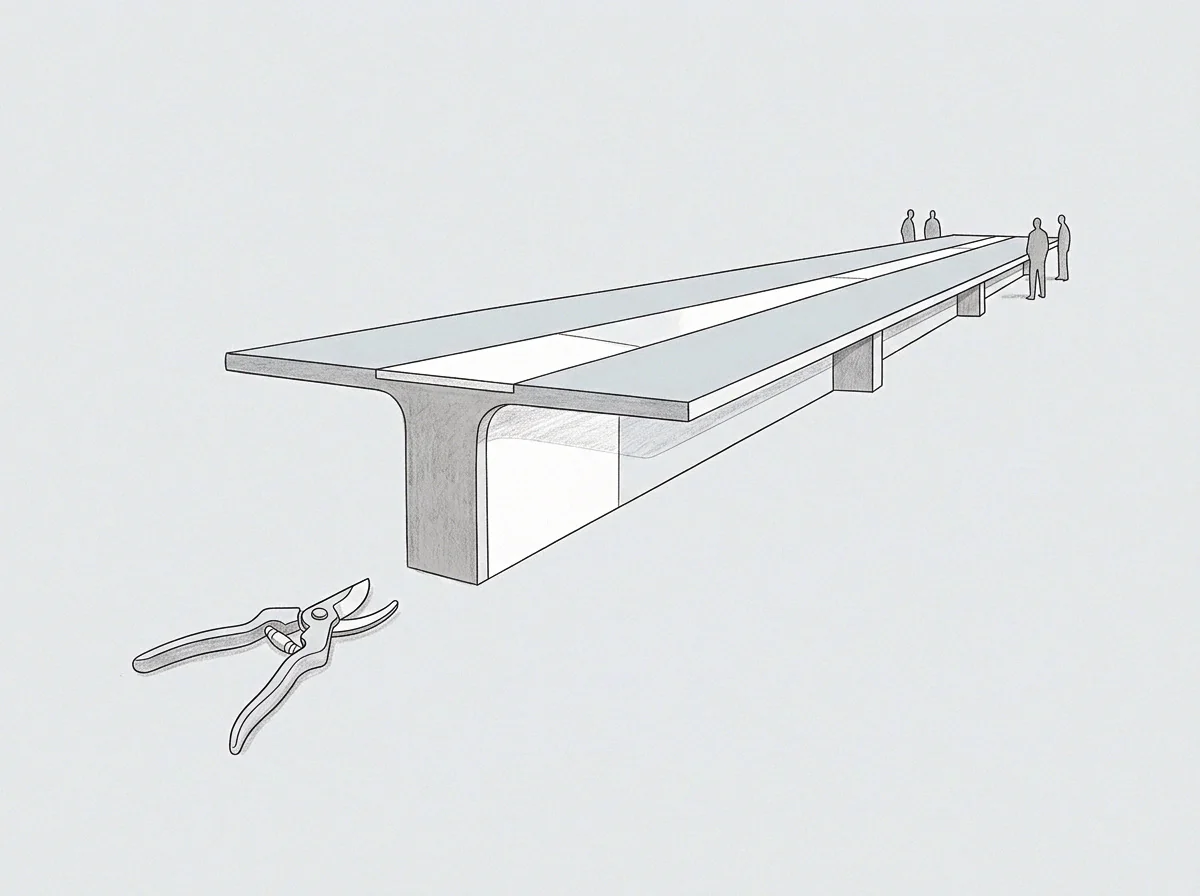
The boundary wall marks the current limit of enterprise organizational design. Every structural boundary reflects the cost choices made during past realignments. Discomfort experienced by leadership during capacity reallocation serves as a precise sensor signal.
It measures active computation along organizational boundaries rather than simple administrative execution of routine tasks.
Strategic realignment fails when executed as a pure scalar command passed down an administrative hierarchy. High-performing enterprise execution treats capacity shifts as vector operations constrained by multidimensional tensor fields. Measuring non-linear friction allows operators to tune transfer velocity, reinforce structural boundaries before shear failure occurs, and minimize long-term systemic hysteresis.
The boundary wall does not yield to administrative decree. It moves only when structural friction is precisely quantified, mapped against real operational costs, and methodically reduced through boundary gate re-engineering. Enterprise capacity aligns with strategic intent only when the energy expended fighting structural friction falls below the work produced by the reallocated assets.