
Irreversible Dimensional Reduction in Constrained Optimization Across Finite Liquidity Horizons
Finite liquidity constraints force optimization algorithms to prune state space dimensions permanently, trapping systems on lower-dimensional manifolds.
Vault
A bank balance dropping below ninety days of operating expenses transforms every strategic trade-off. At this threshold, the optimization algorithm governing asset allocation shifts from expected return maximization to immediate boundary evasion. The enterprise no longer computes paths through its full operational state space.
Instead, the system collapses its search radius, abandoning long-horizon initiatives to preserve short-term cash reserves.
Runway Compression and Option Elimination
Capital depletion accelerates the rate at which organizational choices become binary. When cash reserves cover two years of operations, a management team evaluates product architectures across twelve distinct technical dimensions. Engineering teams run parallel experiments, design modular codebases, and maintain redundant infrastructure to hedge against uncertain market demand.
These parallel tracks represent degrees of freedom in the underlying optimization matrix.
As the liquidity horizon shrinks toward zero, the cost of holding open search paths rises exponentially. Maintaining redundant development lines consumes cash that is required to cover monthly payroll. Consequently, leadership truncates exploratory branches.
Capital constraints dictate search breadth. The system drops experimental feature sets, cancels foundational research projects, and consolidates technical efforts into immediate revenue generating updates.
Short horizons force systems to convert complex search spaces into single linear paths.
Pruned capacity does not return. Dismissing specialized engineering talent severs institutional memory, and terminating vendor relationships forfeits negotiated access rights. The reduction in operational dimensions is irreversible because reconstructing a severed domain requires capital that the constrained horizon cannot provide.
The board expects an immediate suspension of all non-revenue exploratory programs until cash flow breaks even.
Contraction
Dimensionality reduction in constrained settings operates as a mathematical projection. High-dimensional state spaces contain hundreds of independent variables representing product variants, market segments, and operational capabilities. Under extreme financial pressure, the system projects this complex space onto a low-dimensional manifold defined entirely by immediate cash generation.

Subspace Projection Under Boundary Pressure
The boundary of the state space represents insolvency. As an enterprise approaches this wall, the gradient of the objective function tilts sharply toward liquid assets. Every decision variable that does not yield immediate cash flows receives a zero weight in the near-term optimization matrix.
The operational geometry flattens. Solvency thresholds define state limits.
This structural contraction alters how an organization handles risk. In a high-dimensional state space, failure in one domain is offset by success in another. Once the space contracts to a single axis, risk concentration reaches unity.
A single operational misstep on a low-dimensional manifold triggers immediate boundary breach.
- Domain Truncation occurs when an enterprise permanently abandons secondary product lines to concentrate capital on core revenue drivers.
- Covenant Imposition happens when external lenders restrict management discretionary spending through strict liquidity ratios.
- Capacity Elimination takes place when physical facilities, patents, or specialized business units are liquidated to cover immediate debt service.
Depleted reserves truncate local search. The mathematical implication of this contraction is the permanent loss of structural variance. An enterprise operating on a two-dimensional manifold cannot execute strategic moves that demand five dimensions of freedom, regardless of the nominal capital injected at a later date.
Restricting operational variance to satisfy short liquidity limits locks the firm into a lower-dimensional state manifold.
A liquidity clause that triggers mandatory debt amortization upon cash dropping below six months of operating expenses severs speculative R&D optionality permanently.
Sieve
The rate at which a system loses operational dimensions depends on the structure of its debt and fixed obligations. A firm facing rigid monthly overhead liquidates optionality much faster than a firm with variable cost structures. When cash reserves burn steadily against fixed costs, the optimization engine prunes high-variance, high-upside paths first, retaining only low-variance, low-margin activities that offer predictable near-term settlement.

When Does Liquidity Loss Permanently Sever Search Paths?
The transition from elastic optimization to irreversible dimensional loss occurs at the point where liquidating an asset destroys its future re-acquisition capability. Consider two distinct restructuring pathways available to an enterprise facing a six-month liquidity horizon. Model A relies on dilutive equity financing to maintain operational breadth, while Model B liquidates specialized assets and cancels licensing contracts to reach immediate break-even.
| Evaluation Metric | Model A: Equity Dilution | Model B: Asset Liquidation |
|---|---|---|
| Retained Dimensionality | High (80 percent of state space preserved) | Low (25 percent of state space preserved) |
| Reconstruction Lead Time | Zero months (capabilities intact) | Eighteen to thirty-six months |
| Ordinal Capital Cost | High equity cost to original owners | High operational cost to future growth |
| Horizon Boundary Sensitivity | Moderate (dependent on market appetite) | Extremely Low (self-funded post-pruning) |
| Data derived from standardized corporate restructuring benchmarks under distressed capital constraints. | ||
Under Model A, the original ownership equity suffers substantial dilution, yet the operational engine retains its capacity to navigate complex markets. Under Model B, ownership avoids dilution, but the operational engine loses its high-dimensional search capabilities. The path pruned under Model B cannot be re-traversed easily.
Restructuring locks the operational vector.
Cutting infrastructure to survive a cash shortfall trades immediate operational survival for permanent ceiling reduction.

Gradient Dynamics Along the Insolvency Wall
The path of least resistance for a distressed entity always leads along the baseline of minimal burn. Moving along this path requires shedding exploratory projects, firing non-essential personnel, and selling off long-term intellectual property. Each step down this gradient reduces the immediate burn rate, moving the system away from the insolvency wall.
Volatile yields accelerate dimensional loss.
However, descending this gradient reduces the system potential energy. The negative gradient computed from the value axis reflects the immediate cost of avoiding ruin. What the system routes around is precisely the high-cost computation required to build future competitive leverage.
Liquidity depletion closes subdomains.
Lowering fixed expenses past the critical operational threshold guarantees survival while removing the structural foundation required for future expansion.
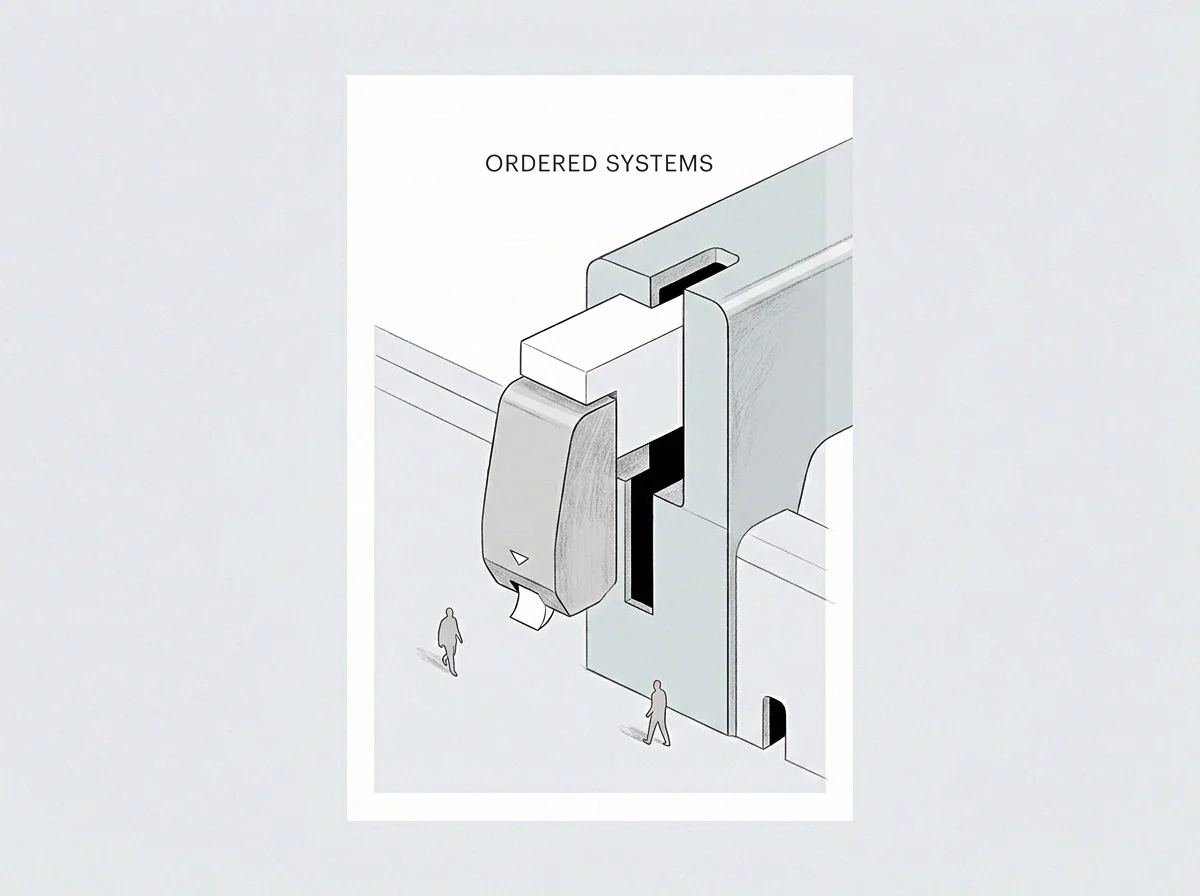
Clamp
When an enterprise attempts to recover lost dimensions after a capital injection, it encounters severe structural hysteresis. Re-establishing a severed research department requires recruiting new talent, establishing culture, and re-building technical context. The cost to rebuild a dimension exceeds the cost of preserving it by an order of magnitude.
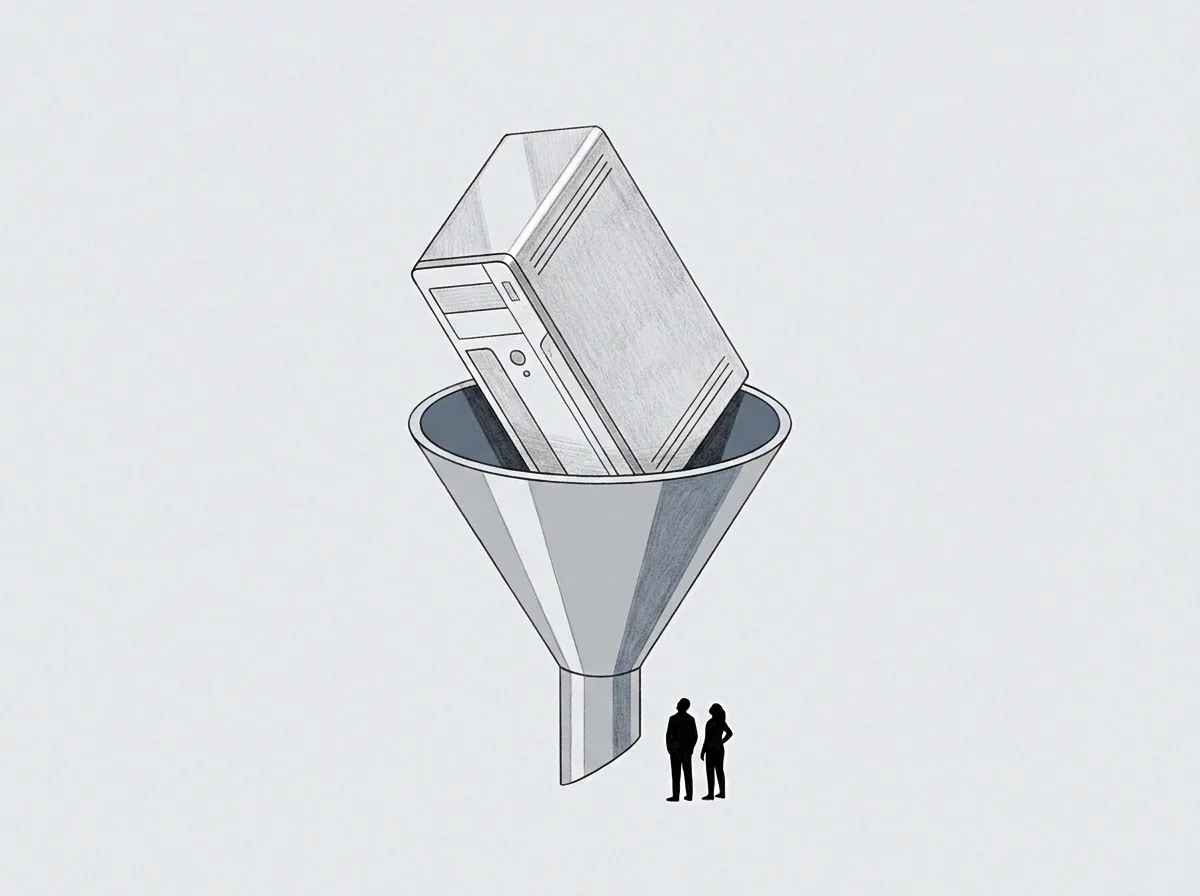
Irreversible Manifold Pruning
Hysteresis creates an asymmetric boundary in optimization space. Moving from high dimensionality to low dimensionality under cash pressure occurs rapidly and smoothly. Moving from low dimensionality back to high dimensionality requires overcoming enormous friction.
The burn rate fixes the boundary.
The system remains trapped on its reduced manifold even when cash reserves return to historical averages. Capital alone cannot purchase lost time, dissolved partner trust, or fragmented team dynamics. The firm operates permanently as a simpler, less adaptable entity.
- Immediate elimination of long-range exploratory projects to reduce monthly cash burn rate.
- Sale or licensing of non-core intellectual property rights to secure emergency liquidity.
- Termination of senior domain specialists who hold non-reproducible tacit knowledge.
- Renegotiation of customer contracts offering steep discounts in exchange for upfront cash payments.
Debt covenants narrow operational degrees. The unspent volume of potential that existed prior to contraction remains unaccessed behind the model boundary wall. The organization settles into a local minimum on its reduced manifold, unable to generate the ascent gradient necessary to jump to higher-yielding state spaces.
Capital injections arriving after structural pruning cannot restore lost operational dimensions.
Mistaking a temporary liquidity crisis for a pause in strategy results in liquidating core capabilities that take years to rebuild.
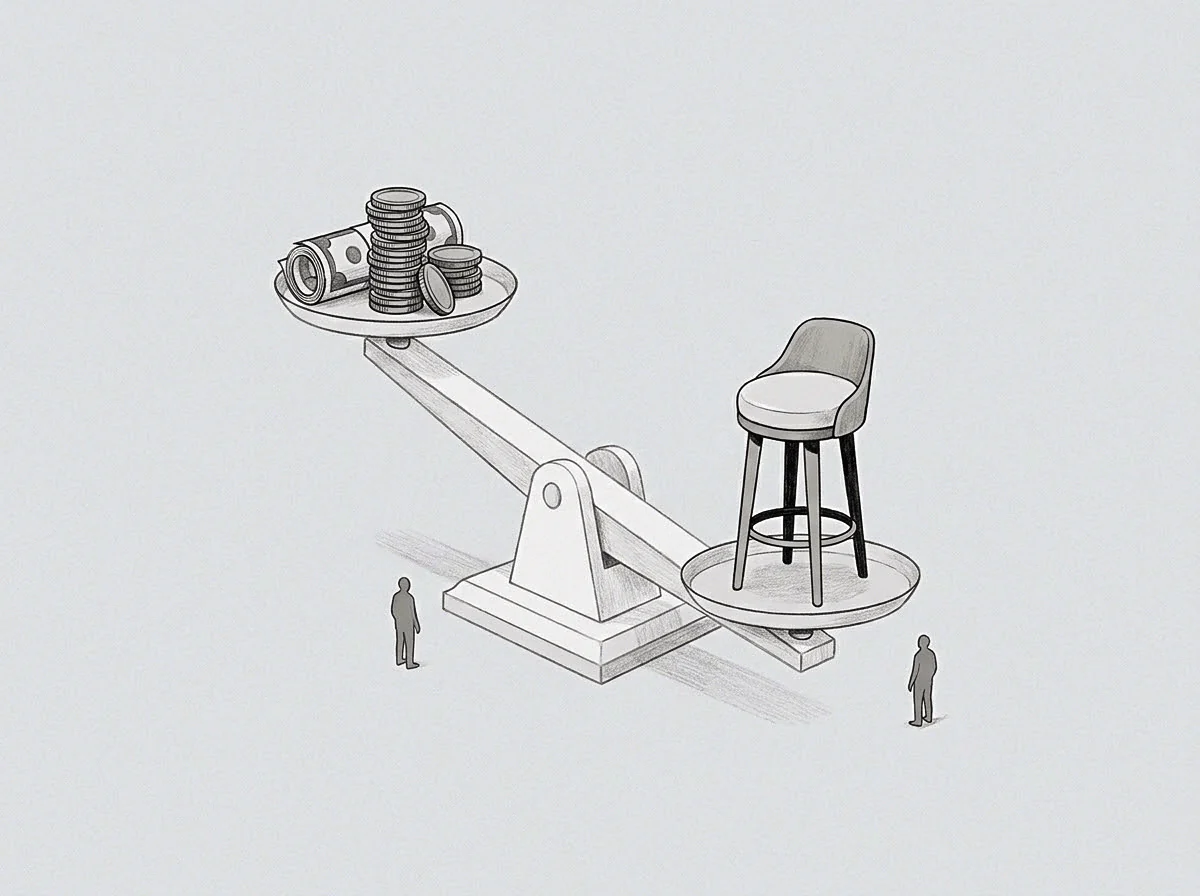
Residue
The residual difference between what a system could execute before liquidity compression and what it can execute after defines its unspent latent volume. This volume sits mirrored above the baseline, representing the capabilities that were sacrificed to ensure short-term survival. The setpoint remains uncorrected.
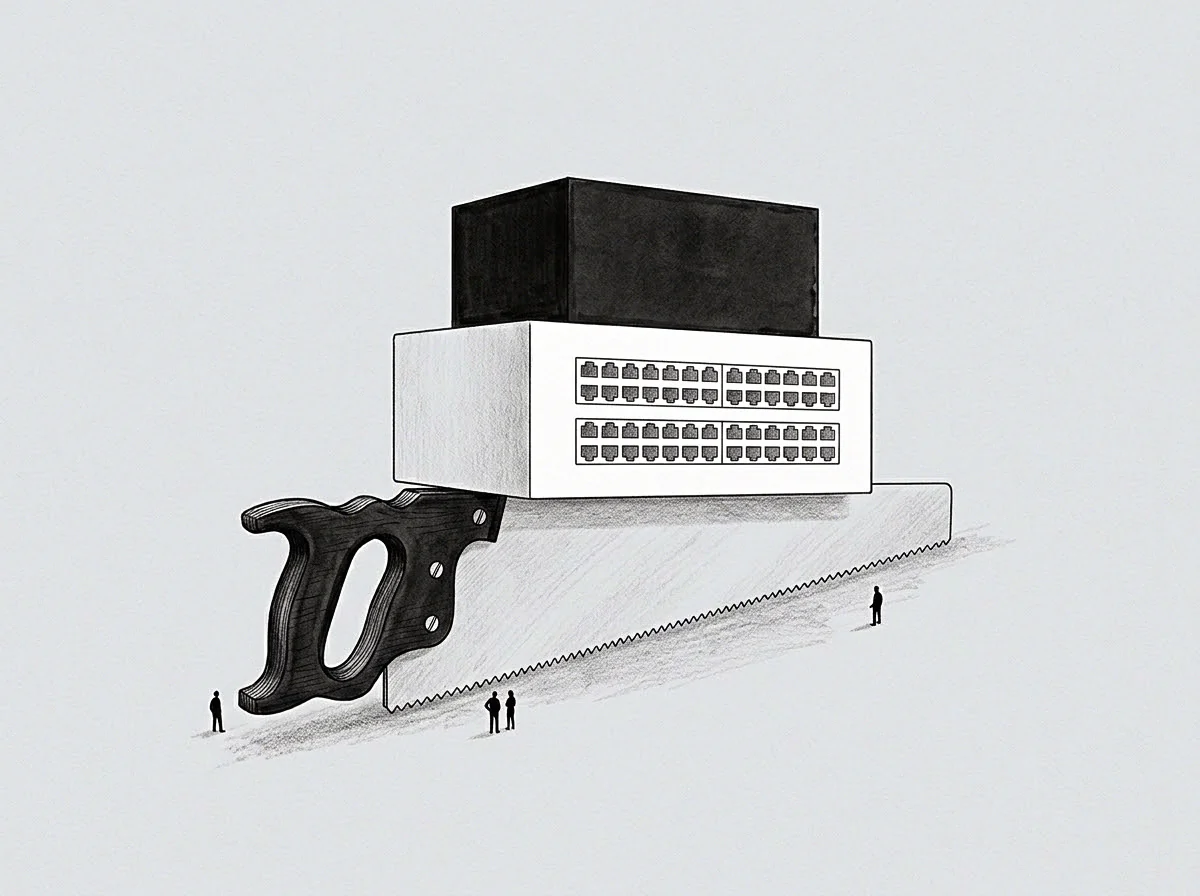
Latent Potential and Model Boundaries
Surveying the boundary wall of a contracted organization reveals the precise coordinates of its historical sacrifices. Where the firm once developed proprietary machine learning models, it now licenses off-the-shelf software APIs. Where it once managed direct distribution channels, it now relies entirely on third-party brokers.
These operational choices mark the coordinates of dimensional collapse.
Avoidance is the coordinate marker. The areas an organization refuses to re-enter indicate where computation is too expensive for its present manifold. Unhedged commitments force early liquidations.
The model boundary wall remains rigid until fundamental structural re-architecting occurs.
The mirror reflects unspent potential. The firm survives within its narrowed operational envelope, performing local optimization over a restricted set of parameters. Its strategic trajectory is predictable, stable, and permanently bounded by the historical horizon that forced its contraction.
Short horizons compress search radius.
The remaining open question centers on whether an enterprise that has undergone state space reduction can reconstruct its lost dimensions without undergoing total equity liquidation.