
Converting Ordinal Team Strain Vectors Into Contractual Performance Boundaries
Translating team strain into performance boundaries requires mapping multi-attribute ordinal friction onto cardinal contractual caps before capacity collapses.

Vector
Strain inside an operating engineering team exists as an ordered sequence of multi-attribute friction rather than a single numerical balance. An operator observing a deployment group feels the accumulation of pressure across distinct operational components long before financial accounting metrics reflect any operational loss. Hours spent on execution provide a crude cardinal measurement, yet total hours fail to capture the severe depletion of focused attention, the accumulation of cognitive context shifts, or the changing rate of skill acquisition.
One hour spent resolving repetitive infrastructure instability drains operational reserves far more aggressively than three hours spent designing novel baseline architecture. Because these internal friction states belong to an ordinal scale, an operator can rank state A as strictly more exhausting than state B, but mathematically cannot multiply, add, or average those states into a single cardinal index.
Cost precedes price in every operational environment. Hours measure duration. When leadership attempts to condense multi-attribute strain into a single dollar figure or a flat hourly commitment, the internal translation mechanism breaks down.
The true internal cost of executing a difficult client contract consists of multiple simultaneous vectors: hours consumed, technical proficiency acquired, overall capacity burned, and immediate attention diverted from internal tooling. Price absorbs friction. Converting this complex multi-attribute cost vector into a simplified cardinal price tag requires explicit decomposition before any external agreement is signed.
Internal operational pressure always accumulates on an ordinal scale before any financial invoice captures the loss.

Decomposing Operational Pressure Across Multiple Attributes
Internal friction consists of several distinct operational elements measured simultaneously. A engineering team executing a complex software integration manages four primary internal resource components. The first component is direct time, recorded as raw hours logged against project tickets.
The second component is attention, measured by the frequency and severity of context shifts required during a work shift. Attention decays rapidly. The third component is operational capacity, representing the remaining energy reserve available for unexpected system outages or emergency client requests.
Capacity drops fast. The fourth component is skill acquisition, tracking whether the operational effort builds long-term institutional knowledge or merely consumes human capital. In a typical delivery cycle, high context switching depletes attention while generating zero long-term skill acquisition, creating an unsustainable ordinal cost profile.

Limits of Cardinal Aggregation in Capacity Scaling
Assigning a single numerical total to mixed operational burdens obscures which specific resource exhausts first. Traditional project management attempts to average team strain into flat metrics like developer velocity or daily utilization percentages. This mathematical error assumes that ten hours of high-attention troubleshooting can be offset by ten hours of low-strain administrative documentation.
On an ordinal scale, these states cannot balance each other out. Operational fatigue accumulates non-linearly across the team. When attention depletion hits a critical limit, error rates compound exponentially regardless of total theoretical hours remaining in the work week.
The margin collapses. Treating ordinal team fatigue as a flat numerical capacity leads directly to systemic delivery failure and uncompensated operational collapse.

Room
Physical spaces and sustained delivery schedules reveal where operational friction converts into irreversible turnover. In the quiet hours after a major product deployment, an operator reads team strain not through executive dashboards, but through unanswered internal messages, delayed code reviews, and sudden resignations. The partner waits.
Operating a technical organization at an intentional monetary loss can represent an exact operational choice when the technical proficiency vector rises faster than cash reserves fall. Continued execution under high ordinal strain makes operational sense only while the team gains structural mastery that survives the project lifecycle. When skill acquisition flattens and pure attention depletion takes over, continuing execution at a financial loss becomes purely destructive.
The distinction between productive strain and destructive friction determines whether a client contract builds institutional equity or bankrupts the team. To make this operational choice conscious, the operator compares internal strain attributes directly against proposed contractual commitments before establishing fixed price agreements.
| Strain Vector Component | Ordinal Scale Characteristic | Cardinal Contractual Boundary | Conversion Mechanism |
|---|---|---|---|
| Attention Load | Ordered context shifts across disjointed accounts | Concurrency cap on active client threads | Limit simultaneous active tickets to five per engineer |
| Capacity Depletion | Non-additive fatigue accumulated over sustained Sprints | Weekly effort cap and overtime rates | Convert hours beyond baseline into explicit rate multipliers |
| Cognitive Friction | Uncertainty ranking across complex technical scope | Fixed revision quotas per scope deliverable | Cap iterative redesign rounds at two per contract phase |
| Skill Acquisition | Relative rank of technical mastery gained during execution | Base service level agreement response window | Index SLA response times to current team technical maturity |

Sustained Execution Under Asymmetrical Pressure
Running client commitments at a direct monetary loss can accumulate technical proficiency while consuming team stamina. A technical group undertaking a fixed-fee contract for an advanced enterprise architecture project may lose money on direct payroll costs during the initial twelve months. If the team acquires proprietary systems expertise that increases future market rate by three hundred percent, the ordinal vector moves upward despite negative fiscal returns.
Friction accumulates early. The cost stays rational as long as skill acquisition remains the dominant vector component. The moment technical learning plateaus, the ongoing monetary loss and attention fragmentation become uncompensated operational drain.
Cost precedes price. If leadership fails to convert these internal strain observations into protective performance limits, the client continues to extract operational capacity without paying for the underlying exhaustion.
When technical proficiency growth flattens while attention depletion accelerates, sustained execution produces structural failure rather than institutional learning.
Worked Situation Comparing Scope Commitments
Take two technical service groups operating over a thirty-six month delivery lifecycle. Both groups build customized data pipelines for external enterprise clients. Assume both groups begin with identical baseline payroll costs and identical engineering headcount.
Arrangement A operates under a standard open-ended service contract. The contract specifies a fixed monthly retainer price with an unconstrained scope clause promising continuous operational improvements. Over eighteen months, client ticket requests shift from scheduled core pipeline enhancements to real-time ad-hoc data requests.
The engineering group experiences extreme attention fragmentation, shifting between tasks seven times per day. Raw logged hours remain constant at forty hours per week per engineer, but capacity reserve drops to zero. Technical proficiency acquisition stops completely as engineers spend all available time applying temporary code patches.
The ordinal strain vector moves strictly upward into severe fatigue. Because the contract contains no cardinal performance boundary capping concurrency, the operator cannot legally reject incoming tasks or demand higher retainer pricing. The margin collapses.
Over thirty-six months, three senior engineers resign, replacement hiring costs consume all remaining retainer revenue, and the operating group dissolves.
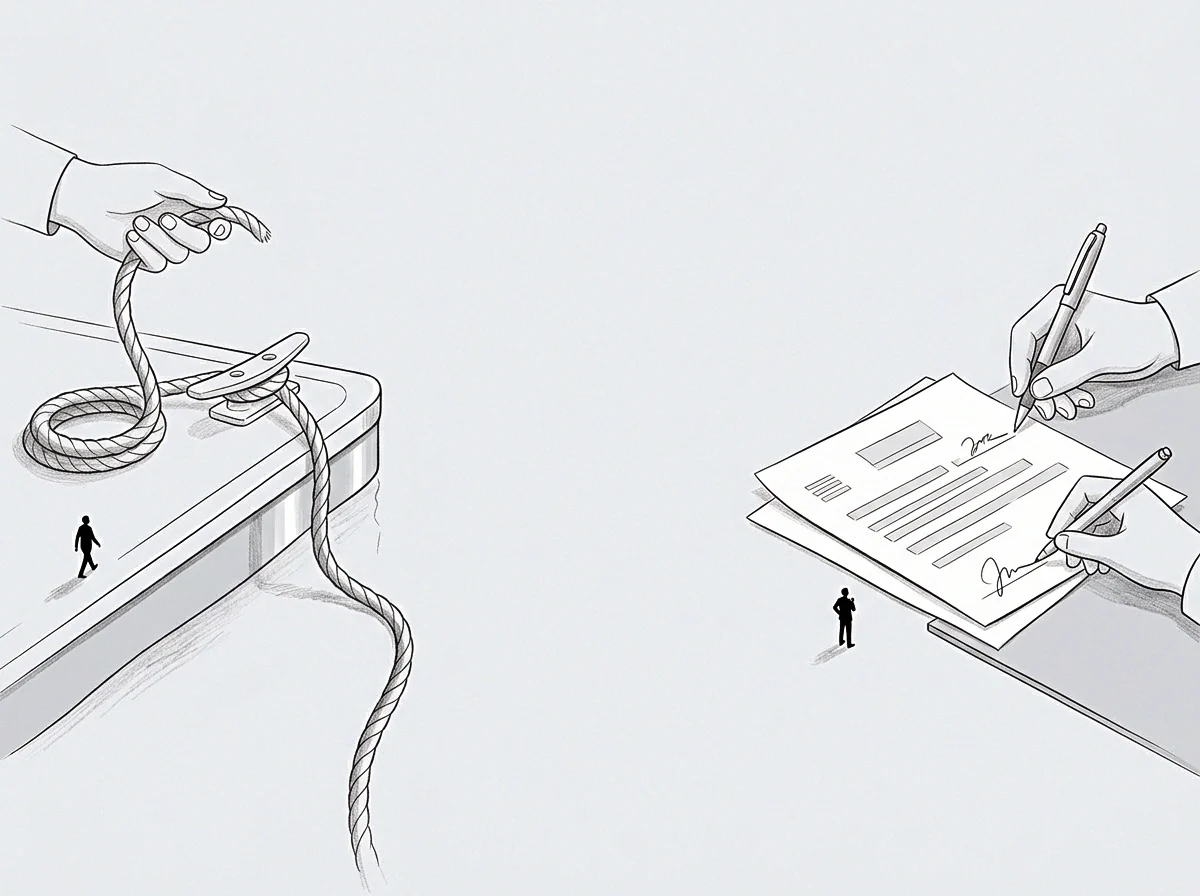
Arrangement B operates under a capacity-bounded contract. The operator decomposes team strain early and embeds explicit ordinal conversion limits into the legal agreement. The contract establishes a cardinal concurrency ceiling capping open high-priority requests at four simultaneous threads, alongside an explicit revision quota capping scope redesigns at two iterations per deliverable.
When client task requests expand during month fourteen, the concurrency ceiling triggers automatically. Scope expands silently. Additional incoming tasks enter a delayed queue, extending the agreed service level agreement response window from four hours to twenty-four hours.
The client receives an automated option to purchase secondary queue priority at a fifty percent rate surcharge. Attention fragmentation remains low, allowing engineers to focus on core pipeline stability while maintaining ten hours per week of internal infrastructure development. Technical proficiency continues rising, operating capacity reserves remain intact, and the client pays extra revenue whenever total operational strain spikes.
The contract holds. The client expects every requested modification delivered on time because the existing contract contains no explicit limit on operational iteration.
Strain Patterns in Execution Environments
Unmonitored operational strain manifests across distinct failure patterns within software delivery teams.
- Attention fragmentation occurs when team members context-shift across multiple disconnected client accounts within one afternoon.
- Capacity depletion arises when sustained weekly effort exhausts reserve energy needed for internal infrastructure maintenance.
- Cognitive strain scales non-linearly when unexpected technical edge cases disrupt planned development Sprints.
- Competence stagnation develops when routine service delivery consumes hours without building new technical proficiency.

Gradient
The direction and rate of change in team friction determine whether operational throughput remains stable or degrades. Monitoring operational strain requires reading the gradient of friction over sequential operational cycles. A steady level of high strain during an intentional product launch represents an expected operational phase.
Conversely, a positive strain gradient during routine maintenance indicates systemic structural failure. Operational psychology findings on cognitive fatigue rest on laboratory experiments measuring dual-task error rates under continuous strain. These findings hold when tasks require deliberate conscious processing, but shift significantly in environments where routines become automated through habituation.
In naval engineering, steam pipe joints accommodate thermal expansion through engineered flex loops rather than rigid welds. Operating systems experience identical structural demands, requiring mechanical play to absorb operational heat without fracturing structural joints. When contracts demand absolute rigid availability without operational flex loops, the team absorbs thermal expansion directly until mechanical failure occurs.
Operational boundaries established during calm execution protect operational capacity far better than emergency caps introduced during crisis.

Feedback Signals Against Pure Structural Friction
Operational systems maintain equilibrium by processing explicit error metrics rather than suppressing operational friction. When internal team strain reaches elevated ordinal thresholds, leadership often attempts to apply cultural motivation or administrative validation. Validation offers emotional reassurance without altering physical workload parameters.
Feedback alters system parameters directly. When attention depletion rises, an effective control loop reduces incoming work volume or extends delivery timelines. Without structural feedback loops, internal strain accumulates silently until the system hits hard operational limits.

Why Do Teams Misread Early Strain Signals?
Early indicators of cognitive overload mirror standard operational effort during intense deployment phases. Engineers report high engagement during initial problem-solving, masking the simultaneous depletion of long-term attention reserves. Because raw output volume remains steady during initial exhaustion stages, executive leadership assumes current operational strain remains fully sustainable.
Strain precedes break. The team runs on reserve operational capacity, disguising the true ordinal cost of execution. When reserve capacity hits absolute zero, team performance degrades catastrophically within a single Sprint cycle.
Whether team leaders can accurately isolate pure skill acquisition from irreversible attention exhaustion before contract renegotiation remains an open empirical question.
Terms
Translating team strain into legal agreements requires converting internal ordinal friction into measurable cardinal limits. Stating terms early keeps choices conscious and protects team capacity before commitments become binding. When converting internal cost vectors into external contractual language, the operator translates multi-attribute strain indicators into explicit numerical thresholds.
An internal strain vector defined by high attention fragmentation converts into a contractual concurrency cap. An internal strain vector defined by rapid capacity depletion converts into explicit overtime pricing multipliers or fixed weekly effort thresholds.
Contractual analysis research on service level performance relies on observational data from enterprise IT procurement arrangements. These models apply cleanly in transactional software delivery, but break down when contract terms face unexpected operational dependencies across third-party supply chains. The precise quantitative boundary where ordinal team strain transitions into irreversible retention loss cannot be calculated with absolute precision across diverse software engineering groups.
A prudent operator manages this uncertainty by establishing scope limits at eighty percent of theoretical team throughput capacity.
A contract clause that caps simultaneous open support threads prevents ordinal attention fragmentation from degrading overall response throughput.

Converting Multi-Attribute Friction Into Cardinal Caps
Cardinally defined contracts enforce precise operational boundaries using explicit quantitative figures. Converting ordinal internal strain into external contractual performance boundaries follows a structured sequence.
- Decompose internal strain vectors into distinct resource components over ninety days.
- Identify the specific friction point reaching exhaustion earliest under delivery pressure.
- Translate the ordinal threshold into a cardinal boundary clause within standard contracts.
- Attach explicit pricing multipliers or scope limits to contractual threshold breaches.

Constructing Protective Operational Thresholds
Contractual provisions establish explicit limits on task concurrency and response delays. Terms filter demand. By defining hard performance boundaries within the written client agreement, the operator prevents internal attention fragmentation from eroding operational margin.
A well-constructed contract contains explicit operational conversion mechanisms:
First, specify an explicit concurrency ceiling that limits active simultaneous project streams. When a client submits requests beyond the ceiling, secondary tasks pause automatically until primary deliverables achieve completion. Second, establish tiered service level agreement response windows tied directly to team capacity.
High-capacity periods guarantee rapid turnaround; low-capacity periods automatically expand response windows. Third, embed dynamic price escalation clauses that apply rate multipliers when total effort hours exceed baseline thresholds within a single billing cycle. The introduction of a dynamic concurrency ceiling clause automatically reallocates non-critical engineering requests to secondary queues whenever active task volume exceeds baseline limits.

Limit
Definite performance boundaries protect operational margin while ensuring long term contractual viability. Establishing explicit boundaries shifts the baseline of client negotiation from continuous availability to defined delivery capacity. The ceiling holds.
When an organization defines clear operational boundaries, price reflects true internal cost rather than uncalculated human friction. Cost precedes price. Operating without clear boundaries forces the internal team to absorb uncompensated context switching, driving turnover and operational instability.
Dynamic rate adjustments and explicit concurrency caps align client demand with actual team capacity. Rates adjust as scope expands. By stating terms early and converting ordinal strain vectors into cardinal contractual boundaries, leadership maintains healthy operational reserves across extended client relationships.
The contractual boundary holds the space where technical proficiency continues to accumulate without destroying the team that builds it.