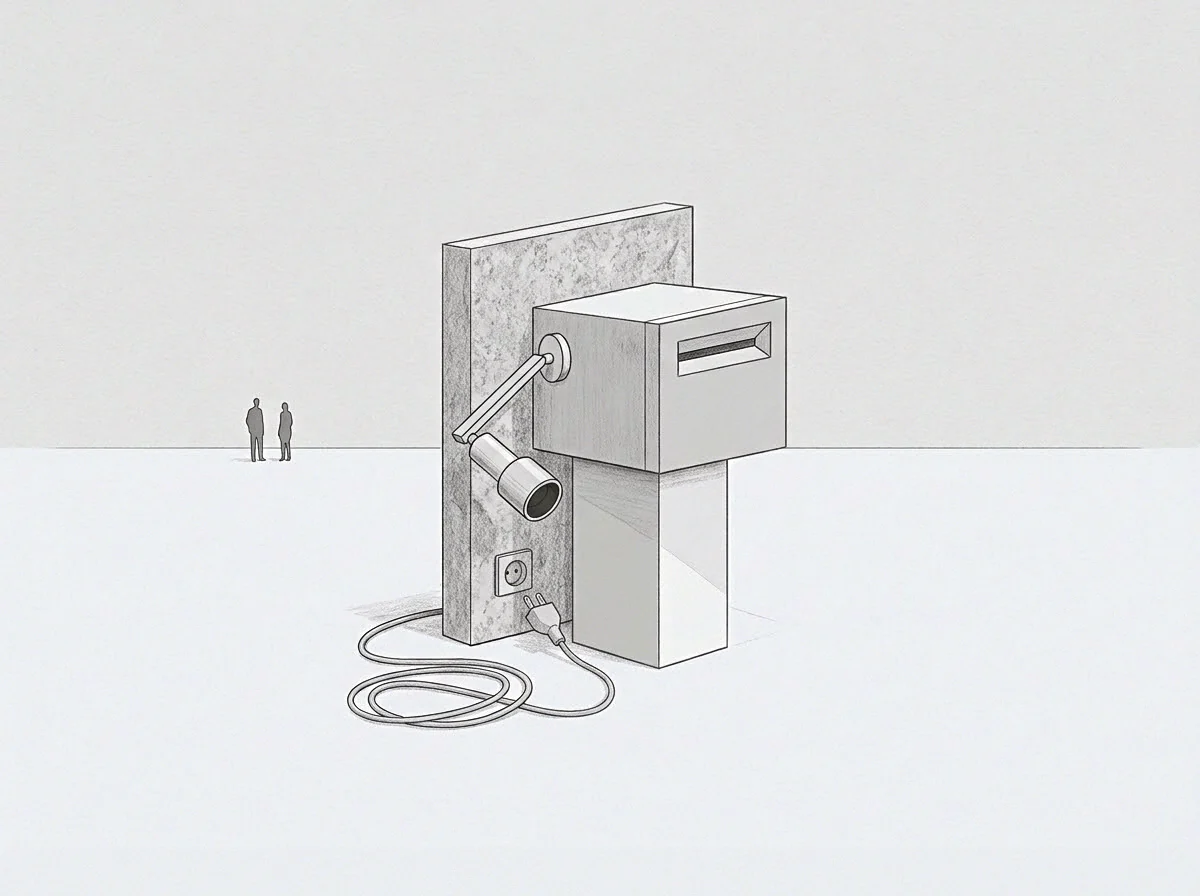
Did it move. Feedback lives in data that needs no third party; validation is the moment a thing leaves the head. The shortcut is invariant, the same answer whatever enters it, and invariance is the tell.
Dynamic signal variance thresholding replaces static Gaussian bounds with rolling quantile estimators to isolate true execution signals under non-Gaussian noise.
Synthetic reference baselines isolate real operational regressions by modeling expected system telemetry as a direct mathematical function of ambient workload variations.
Dynamic thresholding separates baseline operational drift from transient variance by evaluating signal moving medians against calibrated rolling percentile bounds.
Synthetic reference envelopes collapse when real user interaction patterns exceed offline generative distributions, requiring live telemetry recalibration.
Operators reconcile missing reference classes by replacing cached baseline assumptions with live telemetry gathered over expanding measurement windows.
Signal drift over long windows is detected by introducing active perturbations into the system to verify that reporting instruments compute rather than cache.
Operators build reference points by logging ordinal physical deltas across fixed windows rather than projecting cardinal figures from absent baselines.
Historical market telemetry decays rapidly during volatility shocks, turning cached features into liabilities that misprice liquidity and amplify losses.
Software telemetry decouples from commercial health when customer purchasing transitions to consumption tiers, requiring systems to tag events with contract data.
Calibrating variance bands without reference classes relies on measuring runtime delta gradients across dynamic compute windows to separate churn from failure.
Establishing new delivery baselines after a direction change requires purging legacy metrics and recording throughput over a fresh observational window.
Structural variance occurs when trailing financial metrics lag live operational execution vectors, requiring window alignment to read true directional momentum.
Gross contribution margin degrades across distribution transitions when unbudgeted compliance fines, trade allowances, and settlement delays erode unit cash yields.
Trailing customer payback windows measure historical cohort cash recovery, masking marginal acquisition cost increases and churn before distribution shifts.
Six fields, each writing its own terms
The terms are written where they belong. Each field holds three desks, and every entry a desk writes raises the terms it uses, each term given a meaning, a mechanism and the places it appears. The record on these pages stays first person and hand made; the fields grow the nomenclature.