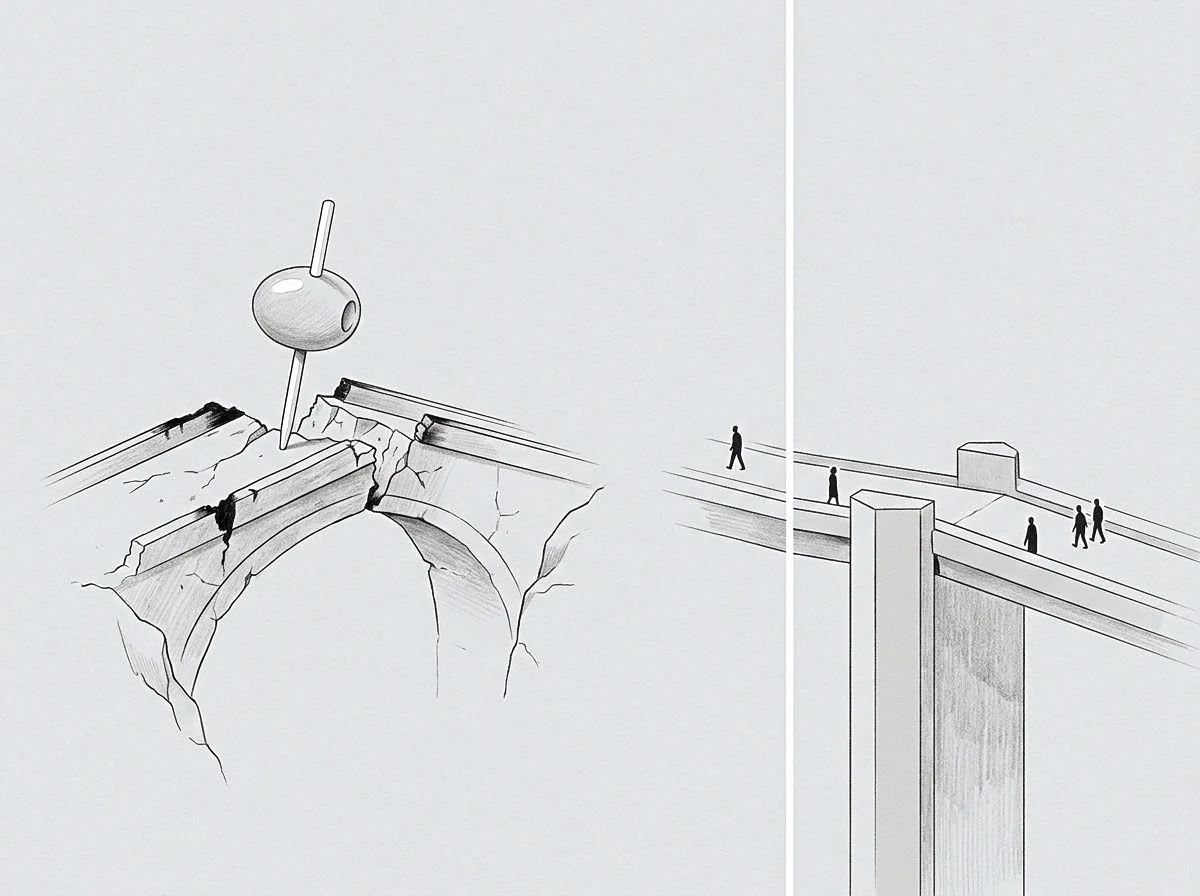
Value is the axis. The gradient is computed from it and carries no judgment: descent is the path of least resistance, and its mirror above the baseline is the latent potential. What a system routes around is where its unprocessed material sits.
Continuous high frequency phase modulation separates unmeasured interfacial contact resistance from bulk kinetic signals across high throughput screening channels.
Normalised vector velocity collapses when administrative friction multiplies queue latencies and diverts cognitive focus away from real value delivery.
Unseen operational drag is quantified by measuring the distance between reported telemetry speed and the path of avoidance taken around fragile pipeline stages.
Structural friction accumulates when probabilistic autonomous agents generate code that satisfies local syntax while violating global deterministic invariants.
Vector divergence in multidimensional software delivery quantifies directional drift between engineering velocity vectors and production deployment trajectories.
Structural governance inefficiencies trigger avoidance loops by decoupling decision rights from operational accountability, elevating friction across team boundaries.
Internal interface drag accumulates when handoffs across team boundaries generate hidden rework and queue latency that degrade projected delivery schedules.
Recovery thresholds vanish permanently when metric variance amplitude exceeds the topological distance between the operational baseline and the nearest saddle point.
True operational reserves are calculated by measuring post-disruption recovery latency rather than surface output speed, isolating structural buffer decay.
Unscaled variance leakage occurs when learned Mahalanobis metrics collapse minor eigenvalues during training, rendering the metric insensitive to tail shifts along unregularized feature axes.
Distance function calibration transforms raw output vectors through inverse-variance covariance weighting to isolate directional drift from high-dimensional noise.
Finite liquidity constraints force optimization algorithms to prune state space dimensions permanently, trapping systems on lower-dimensional manifolds.
Real-time liquidity depletion breaks gradient continuity in non-convex markets, forcing adaptive step algorithms into self-induced slippage and capital stall.
Marginal gradient ascent in non-convex asset allocation traps capital in local sub-optima, mistaking zero-gradient saddle coordinates for completed stability.
Extrapolation breakdown metrics quantify the divergence between linear risk models and realized asset losses as return vectors cross historical convex bounds during regime shifts.
Continuous value interpolation generates differentiable valuation surfaces across time and factor spaces to eliminate discrete rebalancing turnover spikes.
Nonlinear spectral shrinkage bounds residual covariance spikes during dimensional expansion by compressing detached eigenvalues back into the bulk distribution.
Six fields, each writing its own terms
The terms are written where they belong. Each field holds three desks, and every entry a desk writes raises the terms it uses, each term given a meaning, a mechanism and the places it appears. The record on these pages stays first person and hand made; the fields grow the nomenclature.