

Managing Operational Margin Erosion Under Rigid External Contractual Pricing Adjustments
Operational margin erosion under locked pricing adjustments forces service scope unbundling and capacity caps to balance ordinal costs against fixed revenue.
Operational margin erosion under locked pricing adjustments forces service scope unbundling and capacity caps to balance ordinal costs against fixed revenue.

Converting ordinal strain vectors to cardinal pricing maps non-additive operational losses onto monetary rates through explicit capacity conversion factors.

Converting internal multi-resource vectors into fixed commercial contracts transfers operational volatility directly into unmetered labor and capacity exhaustion.

Decoupling cardinal cash metrics from ordinal resource gradients prevents cash timeline compression from distorting operational capability trajectory.

Capital drain is measured in cardinal figures while capability gains move along an ordinal vector that dictates long-term commercial leverage.

Rising benchmark rates increase hurdle gradients, causing direct illiquid asset shifts to absorb immediate capital losses and operational drag.

Unresolved operational resource exhaustion occurs when venture allocation models treat bounded human capacity as an infinite linear variable convertible with cash.

Resource expenditures move as multi-attribute ordinal vectors that must be tracked across internal dimensions before conversion into cardinal market prices.

Financial cash outlays obscure internal effort by converting multidimensional operational drains into single cardinal price figures.

Capital shortfalls under Knightian uncertainty force organizations to rank capacity vectors on ordinal scales when cardinal pricing mechanisms break down.

Continuous force on an operational slope causes hidden structural degradation before baseline performance collapse occurs.

Immediate cash shortages consume mental bandwidth, forcing operators to liquidate high-leverage cognitive focus to satisfy urgent cardinal payment obligations.

Emergency capital resolves balance sheet liquidity immediately, but executive cognitive recovery lags by days, causing exhausted operators to concede vital governance rights.

Internal operational strain maps to commercial terms when multi attribute friction vectors convert into explicit contract triggers and fee adjustments.

Operational friction quantifies the non-monetary coordination drag and capacity drain that balance sheet expenditures impose on internal teams.

Reversing an operational avoidance vector yields a mechanical ascent gradient whose magnitude equals the computational cost of the unperformed work.

Non-monetary compensation transfers balance-sheet preservation onto operators as unpriced cognitive drag and rapid functional capital degradation.

Ordinal prioritization sequences rank enterprise functions by immediate cash generation speed and statutory compliance before funding secondary operations.

Non monetary resource substitution measures the conversion of unpriced human, social, and operational reserves to absorb acute cash shortfalls.

Fixed enterprise contracts conceal human depletion by exchanging cardinal revenue for unmeasured cognitive exhaustion unless strict operational limits protect capacity.

Subjective fatigue converts to objective terms by bounding response latency, capping weekly throughput, and pricing communication velocity directly.

Operational capacity limits protect firm throughput by converting multi-attribute internal attention costs into explicit, measurable client agreement terms.

Retainer escalation bands adjust contract fees dynamically based on counterparty approval latency to protect vendor capacity vectors.

Unpriced internal attention consumption converts into cardinal contract surcharges by mapping cognitive switching friction onto explicit threshold tariffs.

Indexing retainer fees to measured friction bands converts unpriced operational drag into explicit cardinal rate escalations across enterprise contracts.

Live operational signals change dynamically with changing parameter inputs, while cached retrieval returns static output despite altered system state.

Unbounded multi channel client communication inflates internal labor hours through context switching, compressing fixed retainer margins unless structured portal restrictions convert communication overhead into explicit cardinal pricing terms.

Unpriced channel communication consumes operational capacity; converting attention drain into cardinal surcharge terms aligns counterparty incentives.
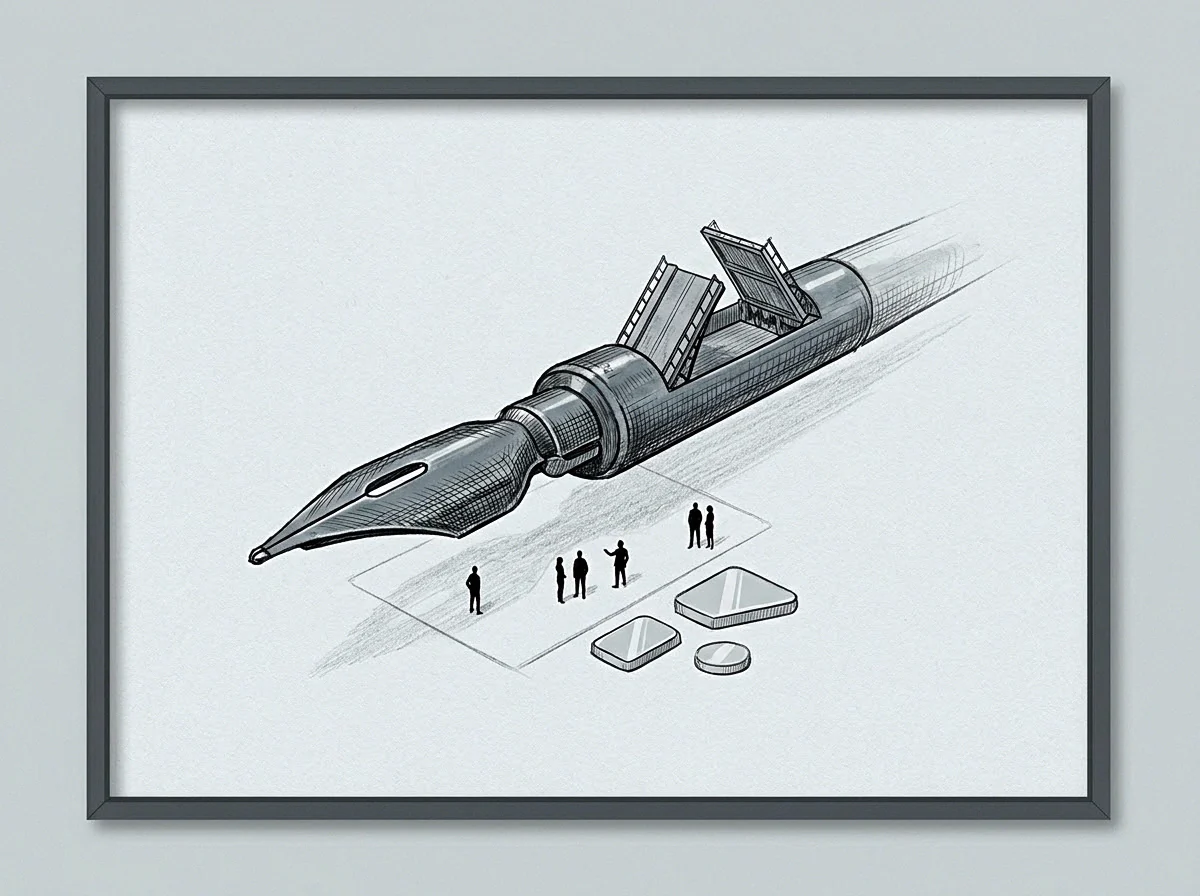
Client messaging friction expands vendor cost vectors by consuming cognitive attention and task-switching capacity outside cardinal retainer fees.

Signal resolution drops when operators read performance deltas over windows shorter than the systemic lag of the underlying process.
The terms are written where they belong. Each field holds three desks, and every entry a desk writes raises the terms it uses, each term given a meaning, a mechanism and the places it appears. The record on these pages stays first person and hand made; the fields grow the nomenclature.